
Surah Al Mulk Read in Arabic with English translation, transliteration, tafseer & lessons.
Surah Al Mulk
| Surah Number | 67 |
| Surah Name | Al-Mulk (The Dominion) |
| Revelation Place | Makkah |
| Total Ayat | 30 |
| Main Theme | Allah’s sovereignty, accountability, Hereafter |
Ayah by Ayah (Arabic, Transliteration, Translation)
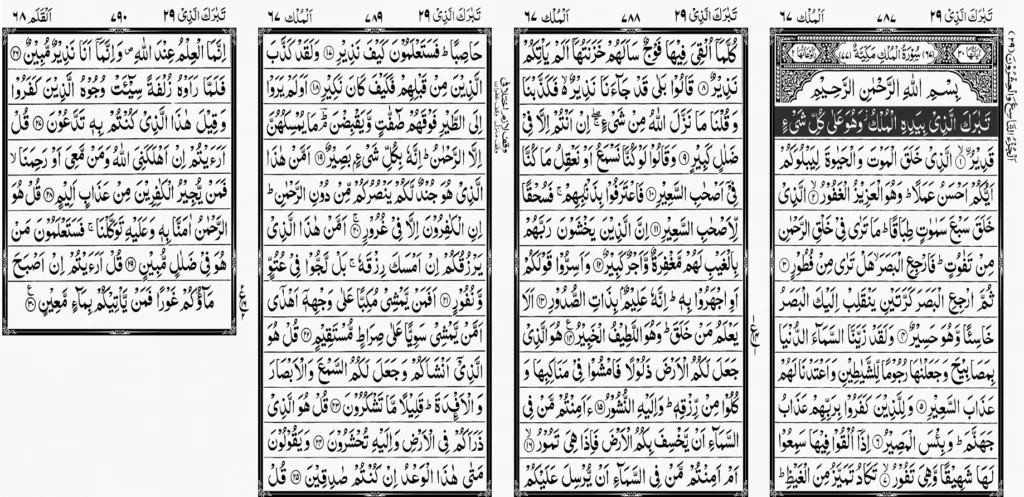
| تَبَارَكَ الَّذِي بِيَدِهِ الْمُلْكُ وَهُوَ عَلَىٰ كُلِّ شَيْءٍ قَدِيرٌ ﴿١﴾ |
| Tabaarakal-ladhee biyadihil-mulk, wa huwa ‘alaa kulli shay’in qadeer |
| Blessed is He in whose hand is dominion, and He is over all things competent. |
| الَّذِي خَلَقَ الْمَوْتَ وَالْحَيَاةَ لِيَبْلُوَكُمْ أَيُّكُمْ أَحْسَنُ عَمَلًا ۚ وَهُوَ الْعَزِيزُ الْغَفُورُ ﴿٢﴾ |
| Alladhee khalaqal-mawta wal-hayaata liyabluwakum ayyukum aḥsanu ‘amalaa, wa huwal-‘azeezul-ghafoor |
| [He] who created death and life to test you [as to] which of you is best in deed – and He is the Exalted in Might, the Forgiving. |
| الَّذِي خَلَقَ سَبْعَ سَمَاوَاتٍ طِبَاقًا ۖ مَّا تَرَىٰ فِي خَلْقِ الرَّحْمَٰنِ مِن تَفَاوُتٍ ۖ فَارْجِعِ الْبَصَرَ هَلْ تَرَىٰ مِن فُطُورٍ ﴿٣﴾ |
| Alladhee khalaqa sab‘a samaawaatin tibaaqaa, maa taraa fee khalqir-Raḥmaani min tafawut; farji‘il-baṣara hal taraa min fuṭoor |
| [He] who created seven heavens in layers. You do not see in the creation of the Most Merciful any inconsistency. So return your vision [to the sky]; do you see any breaks? |
| ثُمَّ ارْجِعِ الْبَصَرَ كَرَّتَيْنِ يَنقَلِبْ إِلَيْكَ الْبَصَرُ خَاسِئًا وَهُوَ حَسِيرٌ ﴿٤﴾ |
| Thummarji‘il-baṣara karratayni yanqalib ilaykal-baṣaru khaasi’an wa huwa ḥaseer |
| Then return [your] vision twice again. [Your] vision will return to you humbled while it is fatigued. |
| وَلَقَدْ زَيَّنَّا السَّمَاءَ الدُّنْيَا بِمَصَابِيحَ وَجَعَلْنَاهَا رُجُومًا لِّلشَّيَاطِينِ ۖ وَأَعْتَدْنَا لَهُمْ عَذَابَ السَّعِيرِ ﴿٥﴾ |
| Wa laqad zayyannas-samaa’ad-dunyaa bimaṣaabeeḥa wa ja‘alnaahaa rujooman lish-shayaaṭeen, wa a‘tadnaa lahum ‘adhaabas-sa‘eer |
| And We have certainly beautified the nearest heaven with stars and have made them missiles for the devils and have prepared for them the punishment of the Blaze. |
| وَلِلَّذِينَ كَفَرُوا بِرَبِّهِمْ عَذَابُ جَهَنَّمَ ۖ وَبِئْسَ الْمَصِيرُ ﴿٦﴾ |
| Wa lilladheena kafaroo birabbihim ‘adhaabu jahannam, wa bi’sal-maṣeer |
| And for those who disbelieved in their Lord is the punishment of Hell, and wretched is the destination. |
| إِذَا أُلْقُوا فِيهَا سَمِعُوا لَهَا شَهِيقًا وَهِيَ تَفُورُ ﴿٧﴾ |
| Idhaa ulqoo feehaa sami‘oo lahaa shaheeqan wa hiya tafoor |
| When they are thrown into it, they hear from it a [dreadful] inhaling while it boils up. |
| تَكَادُ تَمَيَّزُ مِنَ الْغَيْظِ ۖ كُلَّمَا أُلْقِيَ فِيهَا فَوْجٌ سَأَلَهُمْ خَزَنَتُهَا أَلَمْ يَأْتِكُمْ نَذِيرٌ ﴿٨﴾ |
| Takaadu tamayyazu minal-ghayẓ; kullamaa ulqiya feehaa fawjun sa’alahum khazanatuhaa alam ya’tikum nadheer |
| It almost bursts with rage. Every time a group is thrown into it, its keepers ask them, “Did there not come to you a warner?” |
| قَالُوا بَلَىٰ قَدْ جَاءَنَا نَذِيرٌ فَكَذَّبْنَا وَقُلْنَا مَا نَزَّلَ اللَّهُ مِن شَيْءٍ إِنْ أَنتُمْ إِلَّا فِي ضَلَالٍ كَبِيرٍ ﴿٩﴾ |
| Qaaloo balaa qad jaa’anaa nadheerun fakadh-dhabnaa wa qulnaa maa nazzalallaahu min shay’, in antum illaa fee ḍalaalin kabeer |
| They will say, “Yes, a warner had come to us, but we denied and said, ‘Allah has not sent down anything. You are not but in great error.’” |
| وَقَالُوا لَوْ كُنَّا نَسْمَعُ أَوْ نَعْقِلُ مَا كُنَّا فِي أَصْحَابِ السَّعِيرِ ﴿١٠﴾ |
| Wa qaaloo law kunnaa nasma‘u aw na‘qilu maa kunnaa fee aṣḥaabis-sa‘eer |
| And they will say, “If only we had been listening or reasoning, we would not be among the companions of the Blaze.” |
| فَاعْتَرَفُوا بِذَنبِهِمْ فَسُحْقًا لِّأَصْحَابِ السَّعِيرِ ﴿١١﴾ |
| Fa‘tarafū bidhambihim fasuhqan li-aṣḥābis-sa‘īr |
| And they will admit their sin, so [it is] alienation for the companions of the Blaze. |
| إِنَّ الَّذِينَ يَخْشَوْنَ رَبَّهُم بِالْغَيْبِ لَهُم مَّغْفِرَةٌ وَأَجْرٌ كَبِيرٌ ﴿١٢﴾ |
| Innal-ladhīna yakhshawna rabbahum bil-ghaybi lahum maghfiratun wa ajrun kabīr |
| Indeed, those who fear their Lord unseen will have forgiveness and great reward. |
| وَأَسِرُّوا قَوْلَكُمْ أَوِ اجْهَرُوا بِهِ ۖ إِنَّهُ عَلِيمٌ بِذَاتِ الصُّدُورِ ﴿١٣﴾ |
| Wa asirrū qawlakum awij-harū bih, innahū ‘alīmun bidhātis-ṣudūr |
| And conceal your speech or declare it; indeed, He is Knowing of that within the breasts. |
| أَلَا يَعْلَمُ مَنْ خَلَقَ وَهُوَ اللَّطِيفُ الْخَبِيرُ ﴿١٤﴾ |
| Alā ya‘lamu man khalaqa wa huwal-laṭīful-khabīr |
| Does He who created not know, while He is the Subtle, the Acquainted? |
| هُوَ الَّذِي جَعَلَ لَكُمُ الْأَرْضَ ذَلُولًا فَامْشُوا فِي مَنَاكِبِهَا وَكُلُوا مِن رِّزْقِهِ ۖ وَإِلَيْهِ النُّشُورُ ﴿١٥﴾ |
| Huwal-ladhī ja‘ala lakumul-arḍa dhalūlan famshū fī manākibihā wa kulū mir-rizqih, wa ilayhin-nushūr |
| It is He who made the earth tame for you so walk among its slopes and eat of His provision—and to Him is the resurrection. |
| أَأَمِنتُم مَّن فِي السَّمَاءِ أَن يَخْسِفَ بِكُمُ الْأَرْضَ فَإِذَا هِيَ تَمُورُ ﴿١٦﴾ |
| A-amintum man fis-samā’i an yakhsifa bikumul-arḍa fa-idhā hiya tamūr |
| Do you feel secure that He who is above would not cause the earth to swallow you and suddenly it would sway? |
| أَمْ أَمِنتُم مَّن فِي السَّمَاءِ أَن يُرْسِلَ عَلَيْكُمْ حَاصِبًا ۖ فَسَتَعْلَمُونَ كَيْفَ نَذِيرِ ﴿١٧﴾ |
| Am amintum man fis-samā’i an yursila ‘alaykum ḥāṣibā, fasata‘lamūna kayfa nadhīr |
| Or do you feel secure that He who is above would not send against you a storm of stones? Then you would know how [severe] was My warning. |
| وَلَقَدْ كَذَّبَ الَّذِينَ مِن قَبْلِهِمْ فَكَيْفَ كَانَ نَكِيرِ ﴿١٨﴾ |
| Wa laqad kadhdhabal-ladhīna min qablihim fakayfa kāna nakīr |
| And already had those before them denied, and how [terrible] was My reproach. |
| أَوَلَمْ يَرَوْا إِلَى الطَّيْرِ فَوْقَهُمْ صَافَّاتٍ وَيَقْبِضْنَ ۚ مَا يُمْسِكُهُنَّ إِلَّا الرَّحْمَٰنُ ۚ إِنَّهُ بِكُلِّ شَيْءٍ بَصِيرٌ ﴿١٩﴾ |
| Awa lam yaraw ilat-ṭayri fawqahum ṣāffātin wa yaqbiḍn, mā yumsikuhunna illar-Raḥmān, innahū bikulli shay’in baṣīr |
| Do they not see the birds above them with wings outspread and [sometimes] folded in? None holds them except the Most Merciful. Indeed He is, of all things, Seeing. |
| أَمَّنْ هَٰذَا الَّذِي هُوَ جُندٌ لَّكُمْ يَنصُرُكُم مِّن دُونِ الرَّحْمَٰنِ ۚ إِنِ الْكَافِرُونَ إِلَّا فِي غُرُورٍ ﴿٢٠﴾ |
| Amman hādhalladhī huwa jundullakum yanṣurukum min dūnir-Raḥmān; inil-kāfirūna illā fī ghurūr |
| Or who is it that could be an army for you to aid you other than the Most Merciful? The disbelievers are not but in delusion. |
| أَمَّنْ هَـٰذَا ٱلَّذِى هُوَ جُندٌۭ لَّكُمْ يَنصُرُكُم مِّن دُونِ ٱلرَّحْمَـٰنِ ۚ إِنِ ٱلْكَـٰفِرُونَ إِلَّا فِى غُرُورٍۢ ﴿٢١﴾ |
| Amman haazallazee huwa jundul lakum yansurukum min doonir-Rahmaan; inil-kaafiroona illaa fee ghuroor |
| Or who is it that could be an army for you to aid you other than the Most Merciful? The disbelievers are not but in delusion. |
| أَمَّنْ هَـٰذَا ٱلَّذِى يَرْزُقُكُمْ إِنْ أَمْسَكَ رِزْقَهُۥ ۚ بَل لَّجُّوا۟ فِى عُتُوٍّۢ وَنُفُورٍۢ ﴿٢٢﴾ |
| Amman haazallazee yarzuqukum in amsaka rizqah; bal lajjoo fee ‘utuwwin wa nufoor |
| Or who is it that could provide for you if He withheld His provision? But they persist in arrogance and aversion. |
| قُلْ هُوَ ٱلَّذِىٓ أَنشَأَكُمْ وَجَعَلَ لَكُمُ ٱلسَّمْعَ وَٱلْأَبْصَـٰرَ وَٱلْأَفْـِٔدَةَ ۖ قَلِيلًۭا مَّا تَشْكُرُونَ ﴿٢٣﴾ |
| Qul huwallazee ansha’akum wa ja‘ala lakumus-sam‘a wal-absaara wal-af’idah; qaleelam maa tashkuroon |
| Say, “It is He who produced you and made for you hearing, vision and hearts; little are you grateful.” |
| قُلْ هُوَ ٱلَّذِى ذَرَأَكُمْ فِى ٱلْأَرْضِ وَإِلَيْهِ تُحْشَرُونَ ﴿٢٤﴾ |
| Qul huwallazee zara’akum fil-ardi wa ilaihi tuhsharoon |
| Say, “It is He who has spread you throughout the earth, and to Him you will be gathered.” |
| وَيَقُولُونَ مَتَىٰ هَـٰذَا ٱلْوَعْدُ إِن كُنتُمْ صَـٰدِقِينَ ﴿٢٥﴾ |
| Wa yaqooloona mataa haazal-wa‘du in kuntum saadiqeen |
| And they say, “When is this promise, if you are truthful?” |
| قُلْ إِنَّمَا ٱلْعِلْمُ عِندَ ٱللَّهِ وَإِنَّمَآ أَنَا۠ نَذِيرٌۭ مُّبِينٌۭ ﴿٢٦﴾ |
| Qul innamal ‘ilmu ‘indallaahi wa innamaa ana nazeerum mubeen |
| Say, “Knowledge is only with Allah, and I am only a clear warner.” |
| فَلَمَّا رَأَوْهُ زُلْفَةًۭ سِيٓـَٔتْ وُجُوهُ ٱلَّذِينَ كَفَرُوا۟ وَقِيلَ هَـٰذَا ٱلَّذِى كُنتُم بِهِۦ تَدَّعُونَ ﴿٢٧﴾ |
| Falammaa ra’awhu zulfatan see’at wujoohullazeena kafaroo wa qeela haazallazee kuntum bihee tadda‘oon |
| When they see it approaching, the faces of the disbelievers will be distressed. |
| قُلْ أَرَءَيْتُمْ إِنْ أَهْلَكَنِىَ ٱللَّهُ وَمَن مَّعِىَ أَوْ رَحِمَنَا فَمَن يُجِيرُ ٱلْكَـٰفِرِينَ مِنْ عَذَابٍ أَلِيمٍۢ ﴿٢٨﴾ |
| Qul ara’aytum in ahlakaniyallaahu wa man ma‘iya aw rahimanaa faman yujeerul kaafireena min ‘azaabin aleem |
| Say, “Who can protect the disbelievers from a painful punishment?” |
| قُلْ هُوَ ٱلرَّحْمَـٰنُ ءَامَنَّا بِهِۦ وَعَلَيْهِ تَوَكَّلْنَا ۖ فَسَتَعْلَمُونَ مَنْ هُوَ فِى ضَلَـٰلٍۢ مُّبِينٍۢ ﴿٢٩﴾ |
| Qul huwar-Rahmaan aamannaa bihee wa ‘alaihi tawakkalnaa |
| Say, “He is the Most Merciful; we have believed in Him and relied upon Him.” |
| قُلْ أَرَءَيْتُمْ إِنْ أَصْبَحَ مَآؤُكُمْ غَوْرًۭا فَمَن يَأْتِيكُم بِمَآءٍۢ مَّعِينٍۭ ﴿٣٠﴾ |
| Qul ara’aytum in asbaha maa’ukum ghawran faman ya’teekum bimaa’in ma‘een |
| Say, “If your water were to sink, who could bring you flowing water?” |
Full Surah English Transliteration
(1) Tabaarakal-ladhee biyadihil-mulku wa Huwa ‘alaa kulli shay’in Qadeer
(2) Alladhee khalaqal-mawta wal-hayaata liyabluwakum ayyukum ahsanu ‘amalaa wa Huwal-‘Azeezul-Ghafoor
(3) Alladhee khalaqa sab‘a samaawaatin tibaaqan maa taraa fee khalqir-Rahmaani min tafaa-wut farji‘il-basara hal taraa min futoor
(4) Thummarji‘il-basara karratayn yanqalib ilaykal-basaru khaasi’an wa huwa haseer
(5) Wa laqad zayyannas-samaa’ad-dunyaa bimaasaabeeha wa ja‘alnaahaa rujoolal-lish-shayaateen wa a‘tadnaa lahum ‘adhaabas-sa‘eer
(6) Wa lilladheena kafaroo bi rabbihim ‘adhaabu jahannama wa bi’sal-maseer
(7) Idhaa ulqoo feehaa sami‘oo lahaa shaheeqan wa hiya tafoor
(8) Takaadu tamayyazu minal-ghaydh kullamaa ulqiya feehaa fawjun sa’alahum khazanatuhaa alam ya’tikum nadheer
(9) Qaaloo balaa qad jaa’anaa nadheerun fakadhdhabnaa wa qulnaa maa nazzalallaahu min shay’in in antum illaa fee dalaalin kabeer
(10) Wa qaaloo law kunnaa nasma‘u aw na‘qilu maa kunnaa fee ashaabis-sa‘eer
(11) Fa‘tarafoo bidhambihim fasuhqan li-ashaabis-sa‘eer
(12) Innal-ladheena yakhshawna rabbahum bil-ghaybi lahum maghfiratun wa ajrun kabeer
(13) Wa asirroo qawlakum awij-haroo bih innahoo ‘aleemun bidhatis-sudoor
(14) Alaa ya‘lamu man khalaqa wa Huwal-Lateeful-Khabeer
(15) Huwal-ladhee ja‘ala lakumul-arda dhaloolan famshoo fee manaakibihaa wa kuloo mir-rizqih wa ilayhin-nushoor
(16) A-amintum man fis-samaa’i an yakhsifa bikumul-arda fa idhaa hiya tamoor
(17) Am amintum man fis-samaa’i an yursila ‘alaykum haasibaa fasata‘lamoona kayfa nadheer
(18) Wa laqad kadhdhabal-ladheena min qablihim fakayfa kaana nakeer
(19) Awa lam yaraw ilat-tayri fawqahum saaffaatin wa yaqbidn maa yumsikuhunna illar-Rahmaan innahoo bikulli shay’in Baseer
(20) Amman haazalladhee huwa jundul lakum yansurukum min doonir-Rahmaan inil-kaafiroona illaa fee ghuroor
(21) Amman haazalladhee yarzuqukum in amsaka rizqah bal lajjoo fee ‘utuwwin wa nufoor
(22) Afaman yamshi mukibban ‘alaa wajhihil-ahdaa amman yamshi sawiyyan ‘alaa siraatin mustaqeem
(23) Qul huwalladhee ansha’akum wa ja‘ala lakumus-sam‘a wal-absaara wal-af’idah qaleelam maa tashkuroon
(24) Qul huwalladhee dhara’akum fil-ardi wa ilayhi tuhsharoon
(25) Wa yaqooloona mataa haazal-wa‘du in kuntum saadiqeen
(26) Qul innamal-‘ilmu ‘indallaahi wa innamaa ana nadheerum mubeen
(27) Falammaa ra’awhu zulfatan see’at wujoohulladheena kafaroo wa qeela haazalladhee kuntum bihee tadda‘oon
(28) Qul ara’aytum in ahlakaniyallaahu wa man ma‘iya aw rahimanaa faman yujeerul-kaafireena min ‘adhaabin aleem
(29) Qul huwar-Rahmaan aamannaa bihee wa ‘alayhi tawakkalnaa fasata‘lamoona man huwa fee dalaalim mubeen
(30) Qul ara’aytum in asbaha maa’ukum ghawran faman ya’teekum bimaa’in ma‘een
Full Surah English Translation
(1) Blessed is He in whose hand is dominion, and He is over all things competent.
(2) [He] who created death and life to test you [as to] which of you is best in deed – and He is the Exalted in Might, the Forgiving.
(3) [He] who created seven heavens in layers. You do not see in the creation of the Most Merciful any inconsistency. So return your vision [to the sky]; do you see any breaks?
(4) Then return your vision twice again. Your vision will return to you humbled while it is fatigued.
(5) And We have certainly beautified the nearest heaven with stars and have made [from] them what is thrown at the devils and have prepared for them the punishment of the Blaze.
(6) And for those who disbelieved in their Lord is the punishment of Hell, and wretched is the destination.
(7) When they are thrown into it, they hear from it a [dreadful] inhaling while it boils up.
(8) It almost bursts with rage. Every time a company is thrown into it, its keepers ask them, “Did there not come to you a warner?”
(9) They will say, “Yes, a warner had come to us, but we denied and said, ‘Allah has not sent down anything. You are not but in great error.’”
(10) And they will say, “If only we had been listening or reasoning, we would not be among the companions of the Blaze.”
(11) And they will admit their sin, so [it is] alienation for the companions of the Blaze.
(12) Indeed, those who fear their Lord unseen will have forgiveness and great reward.
(13) And conceal your speech or publicize it; indeed, He is Knowing of that within the breasts.
(14) Does He who created not know, while He is the Subtle, the Acquainted?
(15) It is He who made the earth tame for you – so walk among its slopes and eat of His provision – and to Him is the resurrection.
(16) Do you feel secure that He who is above would not cause the earth to swallow you and suddenly it would sway?
(17) Or do you feel secure that He who is above would not send against you a storm of stones? Then you would know how [severe] was My warning.
(18) And already those before them denied, and how [terrible] was My reproach.
(19) Do they not see the birds above them with wings outspread and [sometimes] folded in? None holds them [aloft] except the Most Merciful. Indeed He is, of all things, Seeing.
(20) Or who is it that could be an army for you to aid you other than the Most Merciful? The disbelievers are not but in delusion.
(21) Or who is it that could provide for you if He withheld His provision? But they have persisted in insolence and aversion.
(22) Then is one who walks fallen on his face better guided or one who walks erect on a straight path?
(23) Say, “It is He who has produced you and made for you hearing and vision and hearts; little are you grateful.”
(24) Say, “It is He who has multiplied you throughout the earth, and to Him you will be gathered.”
(25) And they say, “When is this promise, if you should be truthful?”
(26) Say, “The knowledge is only with Allah, and I am only a clear warner.”
(27) But when they see it approaching, the faces of those who disbelieve will be distressed, and it will be said, “This is that for which you used to call.”
(28) Say, “Have you considered: whether Allah should cause my death and those with me or have mercy upon us, who can protect the disbelievers from a painful punishment?”
(29) Say, “He is the Most Merciful; we have believed in Him, and upon Him we have relied. And you will [come to] know who it is that is in clear error.”
(30) Say, “Have you considered: if your water was to become sunken into the earth, then who could bring you flowing water?”
Tafseer of Surah Al-Mulk (Ibn Kathir – Long Form)
Ayah 1–2: Absolute Authority of Allah & Purpose of Life
Ibn Kathir explains that Surah Al-Mulk opens by declaring the complete sovereignty of Allah. The phrase “Blessed is He in whose Hand is the dominion” means that all power, authority, command, and ownership belong solely to Allah. No ruler, king, or force can act independently of His will.
Allah mentions death before life to remind humans of their origin and inevitable return. Life is not for enjoyment alone, but a test. According to Ibn Kathir, this test is about the quality of deeds, not their quantity. Deeds must be sincere and in accordance with divine guidance.
Ayah 3–5: Perfection of Creation & Guarded Heavens
Allah invites mankind to reflect on the flawless creation of the seven heavens. Ibn Kathir emphasizes that no contradiction or weakness exists in Allah’s creation. Repeated observation only results in human exhaustion and realization of divine perfection.
The stars are both an adornment and a protection. Ibn Kathir explains that devils attempting to steal information are struck by flaming meteors, showing Allah’s protection of revelation and His control over the unseen world.
Ayah 6–11: Hellfire & Regret of the Disbelievers
These verses describe the terror of Hellfire. Ibn Kathir explains that Hell roars and boils due to intense anger. When disbelievers are cast into it, they are questioned to establish proof against them.
The people of Hell admit that messengers came to them, but they rejected the truth arrogantly. Their confession highlights that denial was a choice, not ignorance. Ibn Kathir notes that regret after death is useless.
Ayah 12–14: Fear of Allah & His Complete Knowledge
Those who fear Allah unseen are promised forgiveness and great reward. Ibn Kathir explains that this fear comes from strong faith and awareness that Allah sees everything.
Allah’s knowledge includes secrets, intentions, and whispers of the heart. The Creator is fully aware of His creation, and denying this is irrational.
Ayah 15–18: Earth as a Blessing & Warning
Allah made the earth easy to live upon. Ibn Kathir explains this includes stability, provision, and pathways. However, humans are warned not to feel secure, as punishment can come suddenly.
Previous nations were destroyed for denial. These verses serve as a reminder that Allah’s warnings are serious and His punishment is real.
Ayah 19–21: Sustenance & Protection Only from Allah
The flight of birds is mentioned as a sign of Allah’s mercy. Ibn Kathir explains that air, balance, and instinct are all controlled by Allah.
No army, no provider, and no protector exists besides Allah. Arrogance blinds the disbelievers from accepting this truth.
Ayah 22–24: Guidance vs Misguidance
Ibn Kathir explains that a believer walks upright on guidance, while a disbeliever stumbles blindly. Allah reminds humans of the blessings of hearing, sight, and intellect, yet most fail to show gratitude.
Ayah 25–27: Mockery of the Hereafter & Sudden Punishment
Disbelievers mockingly demand the coming of punishment. Ibn Kathir explains that when it finally arrives, fear overtakes them and excuses are no longer accepted.
Ayah 28–29: Tawakkul & Clear Truth
The Prophet ﷺ is commanded to declare trust in Allah alone. Ibn Kathir highlights that true reliance includes obedience, not just verbal claims.
Ayah 30: Final Warning – Water as a Mercy
The Surah ends with a powerful question about water. Ibn Kathir explains that water is life itself, and if Allah withholds it, no one can replace Him. This leaves humanity without any argument.
Benefits & Lessons of Surah Al-Mulk
1. Reminder of Allah’s Absolute Authority
Surah Al-Mulk constantly reminds believers that all control, power, and dominion belong only to Allah. Everything in the universe functions under His command, helping strengthen faith and humility in the heart of a believer.
2. Life as a Test of Deeds
This Surah teaches that life and death are created to test humans regarding the quality of their deeds. Success is not based on quantity but on sincerity and obedience to Allah’s guidance.
3. Protection from the Punishment of the Grave
According to authentic Hadith, regular recitation of Surah Al-Mulk serves as protection and intercession against the punishment of the grave, making it highly recommended to recite it daily.
4. Encouragement to Reflect on Creation
Surah Al-Mulk urges believers to observe the perfection of the heavens and the earth. Reflection on Allah’s creation strengthens certainty in His wisdom and eliminates doubt from the heart.
5. Warning Against Arrogance and Denial
The Surah warns that arrogance and rejection of truth lead to regret in the Hereafter. It highlights the fate of those who deny Allah’s signs despite clear warnings.
6. Awareness of the Reality of Hellfire
Vivid descriptions of Hellfire serve as a strong reminder of accountability. These verses encourage believers to remain cautious, repent sincerely, and avoid sinful behavior.
7. Importance of Fear of Allah in Private
Surah Al-Mulk emphasizes that those who fear Allah without being seen by others are promised forgiveness and great reward. This lesson encourages sincerity and inner piety.
8. Complete Dependence on Allah for Sustenance
The Surah clearly teaches that provision comes only from Allah. No human, army, or system can provide sustenance independently of Him.
9. Gratitude for Human Faculties
Allah reminds mankind of the blessings of hearing, sight, and understanding. The Surah teaches that gratitude is shown by using these gifts in obedience to Allah.
10. Reliance on Allah Alone
Surah Al-Mulk concludes by emphasizing complete reliance on Allah. It teaches that true trust is not merely verbal but is demonstrated through obedience and faith.
FAQs
Surah Al-Mulk emphasizes Allah’s absolute authority over creation, the reality of life as a test, accountability in the Hereafter, and complete dependence of humans on Allah for protection and sustenance.
Surah Al-Mulk contains a total of 30 ayahs.
Surah Al-Mulk is a Makki Surah, revealed in Makkah.
According to Hadith, Surah Al-Mulk intercedes for the one who recites it regularly and protects from the punishment of the grave.
Surah Al-Mulk is commonly recited at night before sleeping.
Death is mentioned first to remind humans of their return to Allah and to emphasize humility, accountability, and the temporary nature of worldly life.
The final ayah teaches that water, which is essential for life, is completely under Allah’s control, and no one besides Him can provide it.