
Surah Ar Rahman read in Arabic with English translation, transliteration, tafseer Ibn Kathir, benefits, and lessons.
Surah Ar Rahman
| Surah Number | 55 |
| Surah Name | Ar-Rahman (The Most Merciful) |
| Revelation Place | Mostly Makki |
| Total Ayat | 78 |
| Main Theme | Allah’s mercy, blessings, power, and accountability of humans & jinn |
| Repeated Verse | Which of the favors of your Lord will you deny? |
Ayah by Ayah (Arabic, Transliteration & Translation)
| الرَّحْمَٰنُ ﴿١﴾ |
| Ar-Rahmaan |
| The Most Merciful, |
| عَلَّمَ الْقُرْآنَ ﴿٢﴾ |
| ‘Allamal-Qur’aan |
| Taught the Qur’an. |
| خَلَقَ الْإِنسَانَ ﴿٣﴾ |
| Khalaqal-insaan |
| Created man. |
| عَلَّمَهُ الْبَيَانَ ﴿٤﴾ |
| ‘Allamahul-bayaan |
| Taught him speech. |
| الشَّمْسُ وَالْقَمَرُ بِحُسْبَانٍ ﴿٥﴾ |
| Ash-shamsu wal-qamaru bihusbaan |
| The sun and the moon move by precise calculation. |
| وَالنَّجْمُ وَالشَّجَرُ يَسْجُدَانِ ﴿٦﴾ |
| Wan-najmu wash-shajaru yasjudaan |
| The stars and the trees prostrate. |
| وَالسَّمَاءَ رَفَعَهَا وَوَضَعَ الْمِيزَانَ ﴿٧﴾ |
| Was-samaa’a rafa‘ahaa wa wada‘al-meezaan |
| And the heaven He raised and established the balance. |
| أَلَّا تَطْغَوْا فِي الْمِيزَانِ ﴿٨﴾ |
| Allaa tatghaw fil-meezaan |
| So that you do not transgress in the balance. |
| وَأَقِيمُوا الْوَزْنَ بِالْقِسْطِ وَلَا تُخْسِرُوا الْمِيزَانَ ﴿٩﴾ |
| Wa aqeemul-wazna bil-qisti wa laa tukhsirul-meezaan |
| Establish weight in justice and do not fall short in the balance. |
| وَالْأَرْضَ وَضَعَهَا لِلْأَنَامِ ﴿١٠﴾ |
| Wal-arda wada‘ahaa lil-anaam |
| And the earth He laid out for all creatures. |
Surah Ar Rahman – Ayat 11 to 40
| فِيهَا فَاكِهَةٌ وَالنَّخْلُ ذَاتُ الْأَكْمَامِ ﴿١١﴾ |
| Feehaa faakihatun wan-nakhlu dhaatul-akmaam |
| In it are fruits and palm trees with sheaths. |
| وَالْحَبُّ ذُو الْعَصْفِ وَالرَّيْحَانُ ﴿١٢﴾ |
| Wal-habbu dhul-‘asfi war-rayhaan |
| And grain having husks and fragrant flowers. |
| فَبِأَيِّ آلَاءِ رَبِّكُمَا تُكَذِّبَانِ ﴿١٣﴾ |
| Fabiaiyi aalaa’i rabbikumaa tukadh-dhibaan |
| So which of the favors of your Lord will you deny? |
| خَلَقَ الْإِنسَانَ مِن صَلْصَالٍ كَالْفَخَّارِ ﴿١٤﴾ |
| Khalaqal-insaana min salsaalin kal-fakhkhaar |
| He created man from clay like pottery. |
| وَخَلَقَ الْجَانَّ مِن مَّارِجٍ مِّن نَّارٍ ﴿١٥﴾ |
| Wa khalaqal-jaanna min maarijim-min naar |
| And He created the jinn from a smokeless flame of fire. |
| فَبِأَيِّ آلَاءِ رَبِّكُمَا تُكَذِّبَانِ ﴿١٦﴾ |
| Fabiaiyi aalaa’i rabbikumaa tukadh-dhibaan |
| So which of the favors of your Lord will you deny? |
| رَبُّ الْمَشْرِقَيْنِ وَرَبُّ الْمَغْرِبَيْنِ ﴿١٧﴾ |
| Rabbul-mashriqayni wa rabbul-maghribayn |
| Lord of the two easts and Lord of the two wests. |
| فَبِأَيِّ آلَاءِ رَبِّكُمَا تُكَذِّبَانِ ﴿١٨﴾ |
| Fabiaiyi aalaa’i rabbikumaa tukadh-dhibaan |
| So which of the favors of your Lord will you deny? |
| مَرَجَ الْبَحْرَيْنِ يَلْتَقِيَانِ ﴿١٩﴾ |
| Marajal-bahrayni yaltaqiyaan |
| He released the two seas, meeting together. |
| بَيْنَهُمَا بَرْزَخٌ لَّا يَبْغِيَانِ ﴿٢٠﴾ |
| Baynahumaa barzakhul-laa yabghiyaan |
| Between them is a barrier they do not cross. |
| فَبِأَيِّ آلَاءِ رَبِّكُمَا تُكَذِّبَانِ ﴿٢١﴾ |
| Fabiaiyi aalaa’i rabbikumaa tukadh-dhibaan |
| So which of the favors of your Lord will you deny? |
| يَخْرُجُ مِنْهُمَا اللُّؤْلُؤُ وَالْمَرْجَانُ ﴿٢٢﴾ |
| Yakhruju minhumal-lu’lu’u wal-marjaan |
| From both of them emerge pearls and coral. |
| فَبِأَيِّ آلَاءِ رَبِّكُمَا تُكَذِّبَانِ ﴿٢٣﴾ |
| Fabiaiyi aalaa’i rabbikumaa tukadh-dhibaan |
| So which of the favors of your Lord will you deny? |
| وَلَهُ الْجَوَارِ الْمُنشَآتُ فِي الْبَحْرِ كَالْأَعْلَامِ ﴿٢٤﴾ |
| Wa lahul-jawaariil-munsha’aatu fil-bahri kal-a‘laam |
| And His are the ships sailing in the sea like mountains. |
| فَبِأَيِّ آلَاءِ رَبِّكُمَا تُكَذِّبَانِ ﴿٢٥﴾ |
| Fabiaiyi aalaa’i rabbikumaa tukadh-dhibaan |
| So which of the favors of your Lord will you deny? |
| كُلُّ مَنْ عَلَيْهَا فَانٍ ﴿٢٦﴾ |
| Kullu man ‘alayhaa faan |
| Everyone upon it will perish. |
| وَيَبْقَىٰ وَجْهُ رَبِّكَ ذُو الْجَلَالِ وَالْإِكْرَامِ ﴿٢٧﴾ |
| Wa yabqaa wajhu rabbika dhul-jalaali wal-ikraam |
| And there will remain the Face of your Lord, Owner of Majesty and Honor. |
| فَبِأَيِّ آلَاءِ رَبِّكُمَا تُكَذِّبَانِ ﴿٢٨﴾ |
| Fabiaiyi aalaa’i rabbikumaa tukadh-dhibaan |
| So which of the favors of your Lord will you deny? |
| يَسْأَلُهُ مَن فِي السَّمَاوَاتِ وَالْأَرْضِ ۚ كُلَّ يَوْمٍ هُوَ فِي شَأْنٍ ﴿٢٩﴾ |
| Yas’aluhu man fis-samaawaati wal-ard; kulla yawmin huwa fee shaan |
| All in the heavens and the earth ask Him; every day He is bringing about a matter. |
| فَبِأَيِّ آلَاءِ رَبِّكُمَا تُكَذِّبَانِ ﴿٣٠﴾ |
| Fabiaiyi aalaa’i rabbikumaa tukadh-dhibaan |
| So which of the favors of your Lord will you deny? |
| سَنَفْرُغُ لَكُمْ أَيُّهَا الثَّقَلَانِ ﴿٣١﴾ |
| Sanafrughu lakum ayyuhath-thaqalaan |
| We will attend to you, O two burdens (jinn and mankind). |
| فَبِأَيِّ آلَاءِ رَبِّكُمَا تُكَذِّبَانِ ﴿٣٢﴾ |
| Fabiaiyi aalaa’i rabbikumaa tukadh-dhibaan |
| So which of the favors of your Lord will you deny? |
| يَا مَعْشَرَ الْجِنِّ وَالْإِنسِ إِنِ اسْتَطَعْتُمْ أَن تَنفُذُوا مِنْ أَقْطَارِ السَّمَاوَاتِ وَالْأَرْضِ فَانفُذُوا ۚ لَا تَنفُذُونَ إِلَّا بِسُلْطَانٍ ﴿٣٣﴾ |
| Yaa ma‘sharal-jinni wal-insi… |
| O company of jinn and mankind, if you can pass beyond the regions of the heavens and the earth, then pass; you will not pass except by authority. |
| فَبِأَيِّ آلَاءِ رَبِّكُمَا تُكَذِّبَانِ ﴿٣٤﴾ |
| Fabiaiyi aalaa’i rabbikumaa tukadh-dhibaan |
| So which of the favors of your Lord will you deny? |
| يُرْسَلُ عَلَيْكُمَا شُوَاظٌ مِّن نَّارٍ وَنُحَاسٌ فَلَا تَنتَصِرَانِ ﴿٣٥﴾ |
| Yursalu ‘alaykumaa shuwaazum-min naarin wa nuhaas |
| There will be sent upon you a flame of fire and smoke, and you will not defend yourselves. |
| فَبِأَيِّ آلَاءِ رَبِّكُمَا تُكَذِّبَانِ ﴿٣٦﴾ |
| Fabiaiyi aalaa’i rabbikumaa tukadh-dhibaan |
| So which of the favors of your Lord will you deny? |
| فَإِذَا انشَقَّتِ السَّمَاءُ فَكَانَتْ وَرْدَةً كَالدِّهَانِ ﴿٣٧﴾ |
| Fa idhash-shaqqatis-samaa’u fakaanat wardatan kadd-dihaan |
| When the sky is split open and becomes rose-colored like oil. |
| فَبِأَيِّ آلَاءِ رَبِّكُمَا تُكَذِّبَانِ ﴿٣٨﴾ |
| Fabiaiyi aalaa’i rabbikumaa tukadh-dhibaan |
| So which of the favors of your Lord will you deny? |
| فَيَوْمَئِذٍ لَّا يُسْأَلُ عَن ذَنبِهِ إِنسٌ وَلَا جَانٌّ ﴿٣٩﴾ |
| Fa yawma’idhil-laa yus’alu ‘an dhanbihi insun wa laa jaan |
| That Day, no human or jinn will be asked about his sin. |
| فَبِأَيِّ آلَاءِ رَبِّكُمَا تُكَذِّبَانِ ﴿٤٠﴾ |
| Fabiaiyi aalaa’i rabbikumaa tukadh-dhibaan |
| So which of the favors of your Lord will you deny? |
Surah Ar Rahman – Ayat 41 to 60
| يُعْرَفُ الْمُجْرِمُونَ بِسِيمَاهُمْ فَيُؤْخَذُ بِالنَّوَاصِي وَالْأَقْدَامِ ﴿٤١﴾ |
| Yu‘raful-mujrimoona biseemaahum fayu’khadhu bin-nawaasi wal-aqdaam |
| The criminals will be known by their marks, and they will be seized by the forelocks and the feet. |
| فَبِأَيِّ آلَاءِ رَبِّكُمَا تُكَذِّبَانِ ﴿٤٢﴾ |
| Fabiaiyi aalaa’i rabbikumaa tukadh-dhibaan |
| So which of the favors of your Lord will you deny? |
| هَٰذِهِ جَهَنَّمُ الَّتِي يُكَذِّبُ بِهَا الْمُجْرِمُونَ ﴿٤٣﴾ |
| Haadhihi jahannamul-latee yukadh-dhibu bihal-mujrimoon |
| This is Hell which the criminals deny. |
| يَطُوفُونَ بَيْنَهَا وَبَيْنَ حَمِيمٍ آنٍ ﴿٤٤﴾ |
| Yatoofoona baynahaa wa bayna hameemin aan |
| They will go around between it and scalding water. |
| فَبِأَيِّ آلَاءِ رَبِّكُمَا تُكَذِّبَانِ ﴿٤٥﴾ |
| Fabiaiyi aalaa’i rabbikumaa tukadh-dhibaan |
| So which of the favors of your Lord will you deny? |
| وَلِمَنْ خَافَ مَقَامَ رَبِّهِ جَنَّتَانِ ﴿٤٦﴾ |
| Wa liman khaafa maqaama rabbihi jannataan |
| But for the one who fears the standing before his Lord are two gardens. |
| فَبِأَيِّ آلَاءِ رَبِّكُمَا تُكَذِّبَانِ ﴿٤٧﴾ |
| Fabiaiyi aalaa’i rabbikumaa tukadh-dhibaan |
| So which of the favors of your Lord will you deny? |
| ذَوَاتَا أَفْنَانٍ ﴿٤٨﴾ |
| Dhawataa afnaan |
| Having spreading branches. |
| فَبِأَيِّ آلَاءِ رَبِّكُمَا تُكَذِّبَانِ ﴿٤٩﴾ |
| Fabiaiyi aalaa’i rabbikumaa tukadh-dhibaan |
| So which of the favors of your Lord will you deny? |
| فِيهِمَا عَيْنَانِ تَجْرِيَانِ ﴿٥٠﴾ |
| Feehimaa ‘aynani tajriyaan |
| In both of them are two flowing springs. |
| فَبِأَيِّ آلَاءِ رَبِّكُمَا تُكَذِّبَانِ ﴿٥١﴾ |
| Fabiaiyi aalaa’i rabbikumaa tukadh-dhibaan |
| So which of the favors of your Lord will you deny? |
| فِيهِمَا مِن كُلِّ فَاكِهَةٍ زَوْجَانِ ﴿٥٢﴾ |
| Feehimaa min kulli faakihatin zawjaan |
| In both of them are of every fruit, two kinds. |
| فَبِأَيِّ آلَاءِ رَبِّكُمَا تُكَذِّبَانِ ﴿٥٣﴾ |
| Fabiaiyi aalaa’i rabbikumaa tukadh-dhibaan |
| So which of the favors of your Lord will you deny? |
| مُتَّكِئِينَ عَلَىٰ فُرُشٍۢ بَطَآئِنُهَا مِنْ إِسْتَبْرَقٍۢ ۚ وَجَنَى الْجَنَّتَيْنِ دَانٍ ﴿٥٤﴾ |
| Muttaki’eena ‘alaa furushin bataa’inuhaa min istabraq… |
| Reclining on couches lined with brocade, and the fruit of the two gardens is hanging low. |
| فَبِأَيِّ آلَاءِ رَبِّكُمَا تُكَذِّبَانِ ﴿٥٥﴾ |
| Fabiaiyi aalaa’i rabbikumaa tukadh-dhibaan |
| So which of the favors of your Lord will you deny? |
| فِيهِنَّ قَاصِرَاتُ الطَّرْفِ لَمْ يَطْمِثْهُنَّ إِنسٌ قَبْلَهُمْ وَلَا جَانٌّ ﴿٥٦﴾ |
| Feehinna qaasiraatut-tarf… |
| In them are women limiting their glances, untouched by man or jinn. |
| فَبِأَيِّ آلَاءِ رَبِّكُمَا تُكَذِّبَانِ ﴿٥٧﴾ |
| Fabiaiyi aalaa’i rabbikumaa tukadh-dhibaan |
| So which of the favors of your Lord will you deny? |
| كَأَنَّهُنَّ الْيَاقُوتُ وَالْمَرْجَانُ ﴿٥٨﴾ |
| Ka’annahunnal-yaaqootu wal-marjaan |
| As if they were rubies and coral. |
| فَبِأَيِّ آلَاءِ رَبِّكُمَا تُكَذِّبَانِ ﴿٥٩﴾ |
| Fabiaiyi aalaa’i rabbikumaa tukadh-dhibaan |
| So which of the favors of your Lord will you deny? |
| هَلْ جَزَاءُ الْإِحْسَانِ إِلَّا الْإِحْسَانُ ﴿٦٠﴾ |
| Hal jazaa’ul-ihsaani illal-ihsaan |
| Is the reward for good anything but good? |
Surah Ar Rahman – Ayat 61 to 78
| فَبِأَيِّ آلَاءِ رَبِّكُمَا تُكَذِّبَانِ ﴿٦١﴾ |
| Fabiaiyi aalaa’i rabbikumaa tukadh-dhibaan |
| So which of the favors of your Lord will you deny? |
| وَمِن دُونِهِمَا جَنَّتَانِ ﴿٦٢﴾ |
| Wa min doonihimaa jannataan |
| And besides these two, there are two other gardens. |
| فَبِأَيِّ آلَاءِ رَبِّكُمَا تُكَذِّبَانِ ﴿٦٣﴾ |
| Fabiaiyi aalaa’i rabbikumaa tukadh-dhibaan |
| So which of the favors of your Lord will you deny? |
| مُدْهَامَّتَانِ ﴿٦٤﴾ |
| Mudh-hammataan |
| Dark green in color. |
| فَبِأَيِّ آلَاءِ رَبِّكُمَا تُكَذِّبَانِ ﴿٦٥﴾ |
| Fabiaiyi aalaa’i rabbikumaa tukadh-dhibaan |
| So which of the favors of your Lord will you deny? |
| فِيهِمَا عَيْنَانِ نَضَّاخَتَانِ ﴿٦٦﴾ |
| Feehimaa ‘aynani naddhaakhataan |
| In both of them are two gushing springs. |
| فَبِأَيِّ آلَاءِ رَبِّكُمَا تُكَذِّبَانِ ﴿٦٧﴾ |
| Fabiaiyi aalaa’i rabbikumaa tukadh-dhibaan |
| So which of the favors of your Lord will you deny? |
| فِيهِمَا فَاكِهَةٌ وَنَخْلٌ وَرُمَّانٌ ﴿٦٨﴾ |
| Feehimaa faakihatun wa nakhlun wa rumman |
| In them are fruits, date palms, and pomegranates. |
| فَبِأَيِّ آلَاءِ رَبِّكُمَا تُكَذِّبَانِ ﴿٦٩﴾ |
| Fabiaiyi aalaa’i rabbikumaa tukadh-dhibaan |
| So which of the favors of your Lord will you deny? |
| فِيهِنَّ خَيْرَاتٌ حِسَانٌ ﴿٧٠﴾ |
| Feehinna khayraatun hisaan |
| In them are good and beautiful companions. |
| فَبِأَيِّ آلَاءِ رَبِّكُمَا تُكَذِّبَانِ ﴿٧١﴾ |
| Fabiaiyi aalaa’i rabbikumaa tukadh-dhibaan |
| So which of the favors of your Lord will you deny? |
| حُورٌ مَّقْصُورَاتٌ فِي الْخِيَامِ ﴿٧٢﴾ |
| Hoorum maqsooraatun fil-khiyaam |
| Fair ones reserved in pavilions. |
| فَبِأَيِّ آلَاءِ رَبِّكُمَا تُكَذِّبَانِ ﴿٧٣﴾ |
| Fabiaiyi aalaa’i rabbikumaa tukadh-dhibaan |
| So which of the favors of your Lord will you deny? |
| لَمْ يَطْمِثْهُنَّ إِنسٌ قَبْلَهُمْ وَلَا جَانٌّ ﴿٧٤﴾ |
| Lam yatmith-hunna insun qablahum wa laa jaan |
| Untouched by man or jinn before them. |
| فَبِأَيِّ آلَاءِ رَبِّكُمَا تُكَذِّبَانِ ﴿٧٥﴾ |
| Fabiaiyi aalaa’i rabbikumaa tukadh-dhibaan |
| So which of the favors of your Lord will you deny? |
| مُتَّكِئِينَ عَلَىٰ رَفْرَفٍ خُضْرٍ وَعَبْقَرِيٍّ حِسَانٍ ﴿٧٦﴾ |
| Muttaki’eena ‘alaa rafrafin khudrin wa ‘abqariyyin hisaan |
| Reclining on green cushions and beautiful carpets. |
| فَبِأَيِّ آلَاءِ رَبِّكُمَا تُكَذِّبَانِ ﴿٧٧﴾ |
| Fabiaiyi aalaa’i rabbikumaa tukadh-dhibaan |
| So which of the favors of your Lord will you deny? |
| تَبَارَكَ اسْمُ رَبِّكَ ذِي الْجَلَالِ وَالْإِكْرَامِ ﴿٧٨﴾ |
| Tabaarakasmu rabbika dhil-jalaali wal-ikraam |
| Blessed is the Name of your Lord, Owner of Majesty and Honor. |
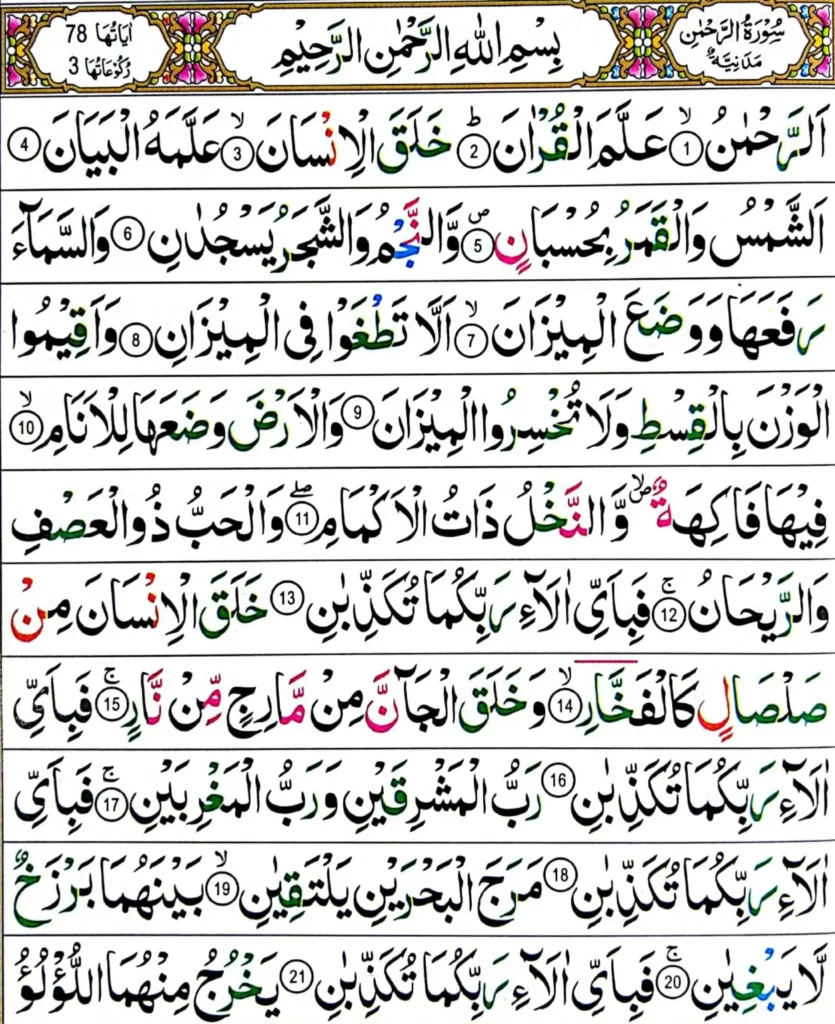
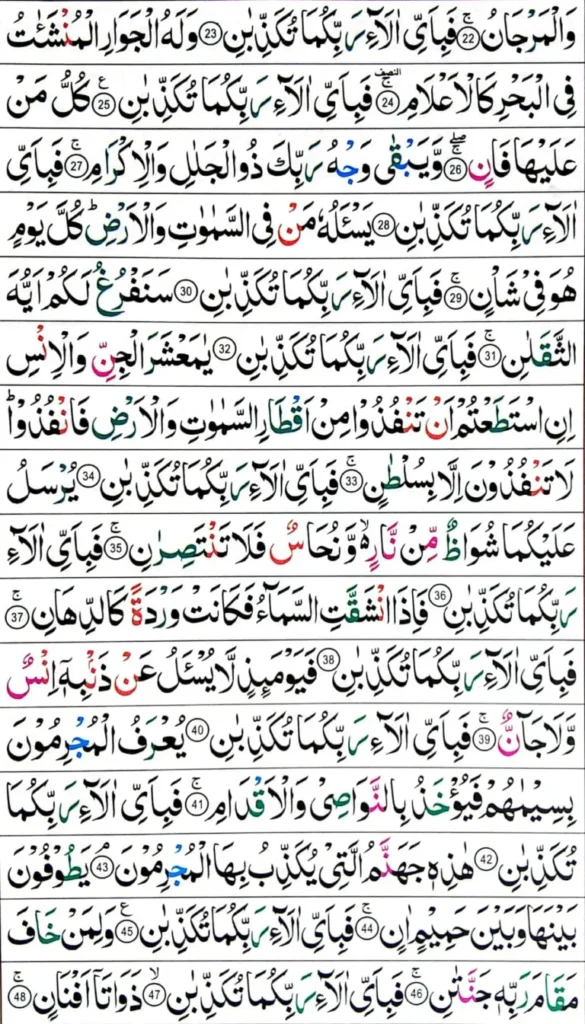
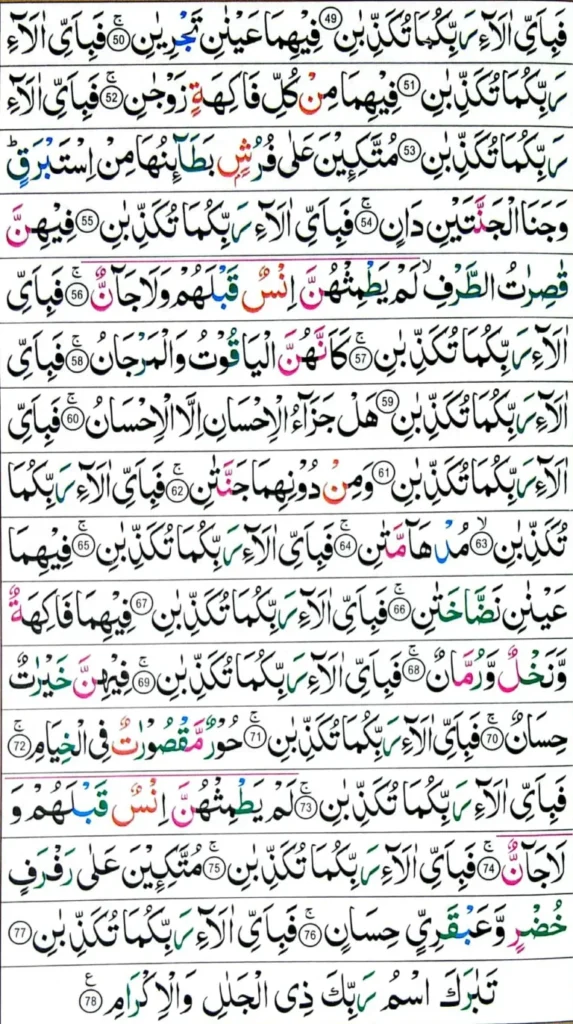
Full Surah Ar Rahman – English Transliteration
(1) Ar-Rahmaan
(2) ‘Allamal-Qur’aan
(3) Khalaqal-insaan
(4) ‘Allamahul-bayaan
(5) Ash-shamsu wal-qamaru bihusbaan
(6) Wan-najmu wash-shajaru yasjudaan
(7) Was-samaa’a rafa‘ahaa wa wada‘al-meezaan
(8) Allaa tatghaw fil-meezaan
(9) Wa aqeemul-wazna bil-qisti wa laa tukhsirul-meezaan
(10) Wal-arda wada‘ahaa lil-anaam
(11) Feehaa faakihatun wan-nakhlu dhaatul-akmaam
(12) Wal-habbu dhul-‘asfi war-rayhaan
(13) Fabiaiyi aalaa’i rabbikumaa tukadh-dhibaan
(14) Khalaqal-insaana min salsaalin kal-fakhkhaar
(15) Wa khalaqal-jaanna min maarijim-min naar
(16) Fabiaiyi aalaa’i rabbikumaa tukadh-dhibaan
(17) Rabbul-mashriqayni wa rabbul-maghribayn
(18) Fabiaiyi aalaa’i rabbikumaa tukadh-dhibaan
(19) Marajal-bahrayni yaltaqiyaan
(20) Baynahumaa barzakhul-laa yabghiyaan
(21) Fabiaiyi aalaa’i rabbikumaa tukadh-dhibaan
(22) Yakhruju minhumal-lu’lu’u wal-marjaan
(23) Fabiaiyi aalaa’i rabbikumaa tukadh-dhibaan
(24) Wa lahul-jawaaril-munsha’aatu fil-bahri kal-a‘laam
(25) Fabiaiyi aalaa’i rabbikumaa tukadh-dhibaan
(26) Kullu man ‘alayhaa faan
(27) Wa yabqaa wajhu rabbika dhul-jalaali wal-ikraam
(28) Fabiaiyi aalaa’i rabbikumaa tukadh-dhibaan
(29) Yas’aluhu man fis-samaawaati wal-ard, kulla yawmin huwa fee sha’n
(30) Fabiaiyi aalaa’i rabbikumaa tukadh-dhibaan
(31) Sanaf-rughu lakum ayyuhath-thaqalaan
(32) Fabiaiyi aalaa’i rabbikumaa tukadh-dhibaan
(33) Yaa ma‘sharal-jinni wal-insi inistata‘tum an tanfudhoo min aqtaaris-samaawaati wal-ardi fanfudhoo, laa tanfudhoona illa bisultaan
(34) Fabiaiyi aalaa’i rabbikumaa tukadh-dhibaan
(35) Yursalu ‘alaykum shuwaazum-min naarin wa nuhaasun falaa tantasiraan
(36) Fabiaiyi aalaa’i rabbikumaa tukadh-dhibaan
(37) Fa-idhan shaqqatis-samaa’u fakaanat wardatan kaddihhaan
(38) Fabiaiyi aalaa’i rabbikumaa tukadh-dhibaan
(39) Fa-yawma’idhil-laa yus’alu ‘an dhanbihi insun wa laa jaan
(40) Fabiaiyi aalaa’i rabbikumaa tukadh-dhibaan
(41) Yu‘rafu-l-mujrimoona bisimaa-hum fa-yu’khadhu bin-nawaasi wal-aqdaam
(42) Fabiaiyi aalaa’i rabbikumaa tukadh-dhibaan
(43) Haadhihee jahannamul-latee yukadh-dhibu bihal-mujrimoon
(44) Yatoofoona baynahaa wa bayna hameemin aan
(45) Fabiaiyi aalaa’i rabbikumaa tukadh-dhibaan
(46) Wa liman khaafa maqaama rabbihi jannataan
(47) Fabiaiyi aalaa’i rabbikumaa tukadh-dhibaan
(48) Dhawaatay afnaan
(49) Fabiaiyi aalaa’i rabbikumaa tukadh-dhibaan
(50) Feehimaa ‘aynaan tajriyaan
(51) Fabiaiyi aalaa’i rabbikumaa tukadh-dhibaan
(52) Feehimaa min kulli faakihatin zawjaan
(53) Fabiaiyi aalaa’i rabbikumaa tukadh-dhibaan
(54) Muttaki’eena ‘alaa furooshim-bataa’inuhaa min istabraq, wa janal-jannatayni daan
(55) Fabiaiyi aalaa’i rabbikumaa tukadh-dhibaan
(56) Feehinna qaasiraatut-tarfi lam yatmith-hunna insun qablahum wa laa jaan
(57) Fabiaiyi aalaa’i rabbikumaa tukadh-dhibaan
(58) Ka-annahunna al-yaaqootu wal-marjaan
(59) Fabiaiyi aalaa’i rabbikumaa tukadh-dhibaan
(60) Hal jazaa’ul-ihsaani illal-ihsaan
(61) Fabiaiyi aalaa’i rabbikumaa tukadh-dhibaan
(62) Wa min doonihimaa jannataan
(63) Fabiaiyi aalaa’i rabbikumaa tukadh-dhibaan
(64) Mudhaammataan
(65) Fabiaiyi aalaa’i rabbikumaa tukadh-dhibaan
(66) Feehimaa ‘aynaan naddaakhaataan
(67) Fabiaiyi aalaa’i rabbikumaa tukadh-dhibaan
(68) Feehimaa faakihatun wa nakhlun wa rumman
(69) Fabiaiyi aalaa’i rabbikumaa tukadh-dhibaan
(70) Feehinna khayraatun hisaan
(71) Fabiaiyi aalaa’i rabbikumaa tukadh-dhibaan
(72) Hoorum-maqsooraatun fil-khiyaam
(73) Fabiaiyi aalaa’i rabbikumaa tukadh-dhibaan
(74) Lam yatmith-hunna insun qablahum wa laa jaan
(75) Fabiaiyi aalaa’i rabbikumaa tukadh-dhibaan
(76) Muttaki’eena ‘alaa rafrafin khudrin wa ‘abqariyyin hisaan
(77) Fabiaiyi aalaa’i rabbikumaa tukadh-dhibaan
(78) Tabaarakasm-u rabbika dhil-jalaali wal-ikraam
Full Surah Ar Rahman – English Translation
(1) The Most Merciful.
(2) Taught the Qur’an.
(3) Created man.
(4) Taught him eloquence.
(5) The sun and the moon move by precise calculation.
(6) And the stars and the trees prostrate.
(7) And the heaven He raised and set the balance.
(8) That you may not transgress in the balance.
(9) And establish weight in justice and do not make deficient the balance.
(10) And the earth He laid out for the creatures.
(11) Therein are fruit and palm trees with sheaths.
(12) And grain having husks and fragrant plants.
(13) So which of the favors of your Lord will you deny?
(14) He created man from clay like pottery.
(15) And He created the jinn from a smokeless flame of fire.
(16) So which of the favors of your Lord will you deny?
(17) Lord of the two Easts and Lord of the two Wests.
(18) So which of the favors of your Lord will you deny?
(19) He released the two seas, meeting side by side.
(20) Between them is a barrier they do not transgress.
(21) So which of the favors of your Lord will you deny?
(22) From both of them emerge pearl and coral.
(23) So which of the favors of your Lord will you deny?
(24) And to Him belong the ships with sails raised high like mountains.
(25) So which of the favors of your Lord will you deny?
(26) Everyone upon it will perish.
(27) And there will remain the Face of your Lord, Owner of Majesty and Honor.
(28) So which of the favors of your Lord will you deny?
(29) Whoever is in the heavens and earth asks Him; every day He is bringing about a matter.
(30) So which of the favors of your Lord will you deny?
(31) We will attend to you, O two heavy beings.
(32) So which of the favors of your Lord will you deny?
(33) O assembly of jinn and mankind, if you are able to pass beyond the regions of the heavens and the earth, then pass. You will not pass except by authority.
(34) So which of the favors of your Lord will you deny?
(35) A flame of fire and smoke will be sent upon you, and you will not defend yourselves.
(36) So which of the favors of your Lord will you deny?
(37) And when the heaven is split open and becomes rose-colored like oil.
(38) So which of the favors of your Lord will you deny?
(39) That Day no man or jinn will be asked about his sin.
(40) So which of the favors of your Lord will you deny?
(41) The criminals will be known by their marks and seized by the forelocks and the feet.
(42) So which of the favors of your Lord will you deny?
(43) This is Hell which the criminals deny.
(44) They will go around between it and scalding water.
(45) So which of the favors of your Lord will you deny?
(46) But for the one who fears standing before his Lord are two gardens.
(47) So which of the favors of your Lord will you deny?
(48) Having spreading branches.
(49) So which of the favors of your Lord will you deny?
(50) In both of them are two flowing springs.
(51) So which of the favors of your Lord will you deny?
(52) In both of them are of every fruit, two kinds.
(53) So which of the favors of your Lord will you deny?
(54) Reclining on couches lined with brocade, and the fruit of the two gardens is hanging low.
(55) So which of the favors of your Lord will you deny?
(56) In them are women limiting their glances, untouched by man or jinn.
(57) So which of the favors of your Lord will you deny?
(58) As if they were rubies and coral.
(59) So which of the favors of your Lord will you deny?
(60) Is the reward for good anything but good?
(61) So which of the favors of your Lord will you deny?
(62) And besides these two, there are two other gardens.
(63) So which of the favors of your Lord will you deny?
(64) Dark green in color.
(65) So which of the favors of your Lord will you deny?
(66) In both of them are two gushing springs.
(67) So which of the favors of your Lord will you deny?
(68) In them are fruits, date palms, and pomegranates.
(69) So which of the favors of your Lord will you deny?
(70) In them are good and beautiful companions.
(71) So which of the favors of your Lord will you deny?
(72) Fair ones reserved in pavilions.
(73) So which of the favors of your Lord will you deny?
(74) Untouched by man or jinn before them.
(75) So which of the favors of your Lord will you deny?
(76) Reclining on green cushions and beautiful carpets.
(77) So which of the favors of your Lord will you deny?
(78) Blessed is the Name of your Lord, Owner of Majesty and Honor.
Tafseer Surah Ar-Rahman (Ibn Kathir) – Ayah 1 to 16
Ayah 1: Ar-Rahmaan
Ibn Kathir explains that Allah begins this Surah with His majestic name Ar-Rahman, the Most Merciful, to establish that everything mentioned afterward is a manifestation of His mercy. This name reflects Allah’s boundless compassion which encompasses all creation—believers and disbelievers alike through sustenance, life, guidance, and countless blessings.
The scholars mention that starting with “Ar-Rahman” sets the emotional and spiritual tone of the Surah: gratitude, humility, and recognition of divine favor before accountability is mentioned.
Ayah 2: ‘Allamal-Qur’aan
Ibn Kathir states that among the greatest manifestations of Allah’s mercy is that He taught the Qur’an. Teaching the Qur’an precedes even the creation of mankind in mention, highlighting that guidance is more valuable than physical existence. Without revelation, humanity would remain lost despite having intellect.
This ayah also refutes the claim that the Qur’an is authored by humans, as teaching is directly attributed to Allah alone.
Ayah 3: Khalaqal-Insaan
Here Allah reminds mankind of their origin. Ibn Kathir explains that human creation itself is a divine favor, granted with purpose and responsibility. Unlike animals, humans were created with moral accountability and the ability to receive divine instruction.
Ayah 4: ‘Allamahul-Bayaan
According to Ibn Kathir, bayan refers to the ability to speak, express, explain, and distinguish truth from falsehood. This faculty enables humans to understand revelation, convey knowledge, and establish justice. Speech is a blessing that separates humans from other creation.
Ayah 5: Ash-Shamsu wal-Qamaru bi-Husbaan
Ibn Kathir explains that the sun and moon operate according to precise calculation set by Allah. Their fixed orbits regulate time, seasons, and human affairs. This precision reflects divine order and refutes randomness in creation.
Ayah 6: Wan-Najmu wash-Shajaru Yasjudaan
Ibn Kathir clarifies that both plants and trees submit to Allah’s command. Their “prostration” is their obedience to the laws Allah placed within nature. This shows that all creation worships Allah in its own way.
Ayah 7: Was-Samaa’a Rafa‘ahaa wa Wada‘al-Meezaan
Allah raised the sky and established balance (justice). Ibn Kathir explains that this balance applies both physically in the universe and morally, through divine law. Justice is a core principle embedded in creation.
Ayah 8–9: Allaa Tatghaw fil-Meezaan…
These verses command humanity not to transgress in balance. Ibn Kathir states this includes fairness in trade, judgment, worship, and personal conduct. Corruption occurs when this balance is violated.
Ayah 10: Wal-Arda Wada‘ahaa lil-Anaam
The earth was spread out for all creatures. Ibn Kathir highlights Allah’s mercy in making the earth habitable, fertile, and accessible for human and animal life alike.
Ayah 11–12: Feehaa Faakihatun…
Fruits, grains, dates, and fragrance are signs of Allah’s generosity. Ibn Kathir notes that these blessings serve both physical nourishment and emotional pleasure, reminding humans of gratitude.
Ayah 13: Fabiaiyi Aalaa’i Rabbikumaa Tukadh-dhibaan
This repeated verse addresses both humans and jinn. Ibn Kathir explains that repetition is for emphasis, warning, and reflection. Every time it appears, it follows a blessing or a warning, asking how one can deny Allah’s favors.
Ayah 14–15: Creation of Man and Jinn
Ibn Kathir explains that man was created from clay while jinn were created from fire, showing their different natures yet equal accountability before Allah.
Ayah 16: Fabiaiyi Aalaa’i Rabbikumaa Tukadh-dhibaan
The repetition again seals the argument: creation itself is an undeniable proof of Allah’s mercy and power.
Tafseer Surah Ar-Rahman (Ibn Kathir) – Ayah 17 to 40
Ayah 17: Rabbul-Mashriqayni wa Rabbul-Maghribayn
Ibn Kathir explains that Allah is the Lord of both the two easts and the two wests. This refers to the changing positions of sunrise and sunset throughout the year. It highlights Allah’s complete control over time, direction, and the universe. Nothing moves without His command.
Ayah 18: Fabiaiyi Aalaa’i Rabbikumaa Tukadh-dhibaan
Ibn Kathir states that this repeated question is a powerful rebuke to both humans and jinn. After mentioning cosmic control, Allah asks how His favors can possibly be denied. The repetition is meant to awaken hearts that have become heedless.
Ayah 19–20: Marajal-Bahrayni Yaltaqiyaan…
Allah describes two seas that meet yet do not transgress. Ibn Kathir explains that this refers to fresh and salt water bodies separated by Allah’s decree. This natural barrier is a sign of divine wisdom and balance within creation.
Ayah 21: Fabiaiyi Aalaa’i Rabbikumaa Tukadh-dhibaan
After mentioning a scientific and observable sign, Allah again challenges denial. Ibn Kathir notes that repeated questioning strengthens the proof against those who reject obvious signs.
Ayah 22: Yakhruju Minhumal-Lu’lu’u wal-Marjaan
Pearls and coral emerge from the seas. Ibn Kathir explains that valuable sustenance coming from water is a mercy for humanity, proving that Allah brings benefit even from what seems ordinary.
Ayah 23–25: Ships Like Mountains
Ibn Kathir describes ships sailing the seas like mountains, carried only by Allah’s permission. This highlights Allah’s favor in facilitating trade, travel, and livelihood across vast waters.
Ayah 26–27: Kullu Man ‘Alayhaa Faan…
Everything on earth will perish, but Allah alone remains eternal. Ibn Kathir emphasizes that this verse humbles mankind and reminds them that reliance should only be on the Ever-Living.
Ayah 28: Fabiaiyi Aalaa’i Rabbikumaa Tukadh-dhibaan
Even the reminder of death is a mercy, as it directs humans toward repentance and preparation for the Hereafter.
Ayah 29: Yas’aluhu Man fis-Samaawaati wal-Ard
All creation depends upon Allah at every moment. Ibn Kathir explains that Allah is constantly managing affairs forgiving sins, granting sustenance, raising some and lowering others.
Ayah 30: Fabiaiyi Aalaa’i Rabbikumaa Tukadh-dhibaan
This verse reinforces human dependence. Denial here becomes a form of arrogance against reality.
Ayah 31: Sanaf-rughu Lakum Ayyuhath-Thaqalaan
Allah addresses humans and jinn together, warning that they will be called to account. Ibn Kathir states this is a threat indicating the Day of Judgment when excuses will end.
Ayah 33: Escape Is Impossible Without Allah’s Permission
Ibn Kathir explains that neither humans nor jinn can escape Allah’s dominion. Power and authority belong solely to Him, and no one can flee divine accountability.
Ayah 35–36: Flames and Smoke
These verses describe punishment for those who attempt escape. Ibn Kathir notes this imagery instills fear and reinforces Allah’s absolute authority.
Ayah 37: The Sky Split Open
On the Day of Judgment, the sky will turn red like molten oil. Ibn Kathir explains this as a terrifying transformation signaling the collapse of the universe.
Ayah 39–40: No Questioning of Sins
Ibn Kathir clarifies that criminals will be recognized by their signs. There will be no need for questioning, as Allah’s knowledge is complete and perfect.
Tafseer Surah Ar-Rahman (Ibn Kathir) – Ayah 41 to 78
Ayah 41: Yu‘rafu-l-Mujrimoona bisimaa-hum
Ibn Kathir explains that on the Day of Judgment, criminals will be recognized by visible signs on their faces. Their humiliation will be apparent, and they will be seized forcefully. This verse shows that guilt will not be hidden, and justice will be swift.
Ayah 42: Fabiaiyi Aalaa’i Rabbikumaa Tukadh-dhibaan
Even punishment is followed by this question, indicating that warnings themselves are a mercy. Ibn Kathir states that Allah sends reminders before punishment so people may repent.
Ayah 43–44: Description of Jahannam
Ibn Kathir describes Hell as a place the criminals once denied but will now face. They will move between blazing fire and boiling water, symbolizing extreme physical and psychological torment.
Ayah 45: Fabiaiyi Aalaa’i Rabbikumaa Tukadh-dhibaan
This repetition after punishment emphasizes accountability. Ibn Kathir explains that denial leads directly to suffering.
Ayah 46: Wa liman khaafa maqaama rabbihi jannataan
Those who feared standing before Allah are promised two gardens. Ibn Kathir explains that this fear is not despair, but awareness that leads to obedience. Such fear elevates a believer’s rank.
Ayah 47: Fabiaiyi Aalaa’i Rabbikumaa Tukadh-dhibaan
The reward of Paradise is again followed by this question, proving that Allah’s generosity far outweighs His punishment.
Ayah 48–49: Gardens with Branches
Ibn Kathir explains that these gardens are lush, vast, and filled with shade. Their beauty reflects eternal comfort for those who obeyed Allah.
Ayah 50–54: Rivers, Fruits, and Comfort
Flowing springs, abundant fruits, and luxurious resting places are mentioned. Ibn Kathir highlights that Paradise contains both physical pleasure and spiritual peace.
Ayah 55–58: Pure Companions
The companions of Paradise are described as pure and modest. Ibn Kathir explains this symbolizes complete emotional and moral perfection, free from jealousy or harm.
Ayah 59–60: Hal Jazaa’ul-Ihsaani illal-Ihsaan
This verse establishes a divine principle: goodness is rewarded with goodness. Ibn Kathir notes that Allah multiplies rewards far beyond human effort.
Ayah 61–64: Two More Gardens
Another pair of gardens is mentioned for those of a different rank. Ibn Kathir explains that Paradise has levels, each according to deeds.
Ayah 65–68: Springs and Fruits
Dark green gardens with gushing springs and fruits like dates and pomegranates show Allah’s generosity and variety in reward.
Ayah 69–72: Noble Companions
Ibn Kathir explains that these companions are honored, protected, and content, emphasizing dignity and peace in Paradise.
Ayah 73–77: Rest and Honor
The believers recline on green cushions and fine carpets. Ibn Kathir says this reflects eternal rest after worldly struggle.
Ayah 78: Tabaarakasm-u Rabbika Dhil-Jalaali wal-Ikraam
The Surah ends by glorifying Allah’s name, the Possessor of Majesty and Honor. Ibn Kathir explains that this ending ties all blessings, warnings, and rewards back to Allah alone, reminding humanity to worship Him sincerely.
Benefits & Lessons of Surah Ar-Rahman
1. Allah ki Rehmat ka gehra ehsaas paida hota hai
Surah Ar-Rahman ki shuruaat Allah ke naam “Ar-Rahman” se hoti hai jo yeh sikhata hai ke har cheez ki bunyaad rehmat par hai. Is Surah ko padhne se dil mein Allah ki muhabbat aur shukr ka jazba mazid gehra ho jata hai.
2. Insaan aur Jinn dono ki jawab-dehi yaad dilata hai
Is Surah mein Allah baar-baar insaan aur jinn dono ko mukhatib karta hai, jo yeh wazeh karta hai ke dono Allah ke hukum ke paband hain. Is se ghaflat door hoti hai aur aakhirat ki tayyari ka ehsaas barhta hai.
3. Shukar guzari ki ahmiyat samjhata hai
“Fabiaiyi aalaa’i rabbikumaa tukadh-dhibaan” ki baar-baar takraar yeh batati hai ke Allah ki ne’maton ko nazar-andaz karna sab se badi na-shukri hai. Is Surah se shukar ada karne ki aadat paida hoti hai.
4. Kainaat mein balance aur insaaf ka dars deta hai
Allah ne har cheez ko meezaan ke sath paida kiya hai—chahe wo asmaan ho ya insaani muashra. Yeh Surah sikhati hai ke zindagi mein insaaf aur aitdaal ikhtiyar karna Allah ka pasandeeda tareeqa hai.
5. Duniya ki faniyat ka ehsaas dilata hai
“Kullu man ‘alayhaa faan” insaan ko yaad dilata hai ke yeh duniya hamesha rehne wali nahi. Is se dil duniya ki muhabbat se nikal kar Allah ki taraf jhukta hai.
6. Qayamat aur hisaab ki tayyari ka paighaam deta hai
Surah Ar-Rahman mein qayamat ke manazir bayan karke yeh sikhaya gaya hai ke har shakhs ko apne aamaal ka jawab dena hoga. Yeh yaqeen insaan ko gunah se roakta hai aur taqwa barhata hai.
7. Jahannam se bachne aur Jannah ki taraf raghbat paida hoti hai
Is Surah mein Jahannam ke azaab aur Jannah ki ne’maton ka muqabla karke bayan kiya gaya hai. Yeh andaz insaan ko ghalat raaste se hata kar nek amal ki taraf le aata hai.
8. Allah ka khauf aur umeed dono paida karta hai
Jo log Allah ke samne kharay hone se darte hain unke liye jannatein hain. Is se banda na sirf Allah se darta hai balkay uski rehmat se umeed bhi rakhta hai.
9. Imaan ko mazboot aur yaqeen ko taaza karta hai
Kainaat, insaan, jinn, rizq, aur aakhirat ka zikr Imaan ko taaza karta hai. Surah Ar-Rahman dil ko Allah ki qudrat par yaqeen dilati hai.
10. Zikr aur tilawat ka shauq paida karti hai
Is Surah ki rhythmic ayat aur takraar dil ko khinchti hai. Is ki tilawat se sukoon milta hai aur Allah ke zikr se qurbat mehsoos hoti hai.
FAQs About Surah Ar-Rahman
Surah Ar-Rahman talks about Allah’s mercy, His countless blessings, and the balance in creation. It reminds humans and jinn to be grateful and prepares them for accountability in the Hereafter.
It begins with Allah’s name Ar-Rahman (The Most Merciful) and repeatedly highlights His favors. The Surah focuses more on mercy, blessings, and rewards than punishment.
This verse is repeated to make humans and jinn reflect deeply on Allah’s blessings. The repetition strengthens the message and removes excuses for denial or ingratitude.
Surah Ar-Rahman is addressed to both humans and jinn. This shows that both creations are responsible for believing in Allah and obeying His commands.
It teaches gratitude, justice, balance, accountability, and reliance on Allah. It also encourages people to choose the path that leads to Paradise.
Most scholars consider Surah Ar-Rahman to be a Makki Surah, although some mention that a few verses may have been revealed in Madinah.
Reciting Surah Ar-Rahman increases gratitude, strengthens faith, and brings peace to the heart. It reminds the believer of Allah’s mercy and the rewards of the Hereafter.
The Surah gives a beautiful description of Paradise, its gardens, rivers, fruits, and comfort. It shows that Allah’s rewards are far greater than human imagination.
Allah mentions punishment to warn and reward to give hope. This balance helps people stay on the right path without despair or arrogance.
It should increase thankfulness, obedience, humility, and preparation for the Hereafter. A believer should recognize Allah’s blessings and live according to His guidance.
Relates Posts: