For every man, that Day, will be a matter adequate for him
وُجُوهٌ يَوْمَئِذٍ مُّسْفِرَةٌ ﴿٣٨﴾
Wujoohun yawma’idhin musfirah
Some faces, that Day, will be bright
ضَاحِكَةٌ مُّسْتَبْشِرَةٌ ﴿٣٩﴾
Daahikatun mustabshirrah
Laughing, rejoicing at good news
وَوُجُوهٌ يَوْمَئِذٍ عَلَيْهَا غَبَرَةٌ ﴿٤٠﴾
Wa wujoohun yawma’idhin ‘alayhaa ghabarah
And other faces, that Day, will have upon them dust
تَرْهَقُهَا قَتَرَةٌ ﴿٤١﴾
Tarhaquhaa qatarah
Darkness will cover them
أُولَٰئِكَ هُمُ الْكَفَرَةُ الْفَجَرَةُ ﴿٤٢﴾
Ulaaa’ika humul-kafaratal-fajarah
Those are the disbelievers, the wicked ones
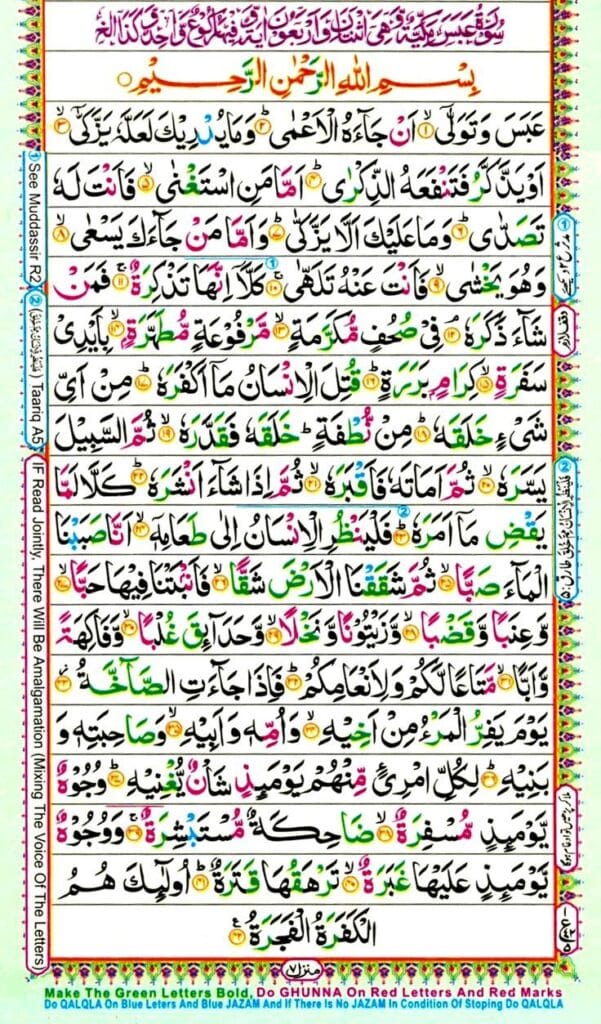
Surah Abasa – English Transliteration (1–42)
Abasa wa tawallaa
An jaa’ahul a‘maa
Wa maa yudreeka la‘allahu yazzakkaa
Aw yazzakkaru fatanfa‘ahuz zikraa
Amma manistaghnaa
Fa anta lahu tasaddaa
Wa maa ‘alayka allaa yazzakkaa
Wa amma man jaa’aka yas‘aa
Wa huwa yakhshaa
Fa anta ‘anhu talahhaa
Kallaa innahaa tazkirah
Faman shaa’a zakarah
Fee suhufim mukarramah
Marfoo‘atim mutahharah
Bi aydin safarah
Kiraamim bararah
Qutilal insaanu maa akfarah
Min ayyi shai’in khalaqah
Min nutfatin khalaqahu faqaddarah
Thummas sabeela yassarah
Thumma amaatahu fa aqbarah
Thumma idhaa shaa’a ansharah
Kallaa lamma yaqdi maa amarah
Falyanzuril insaanu ilaa ta‘aamih
Annaa sababnal maa’a sabbaa
Thumma shaqaqnal arda shaqqaa
Fa ambatnaa feehaa habbaa
Wa ‘inaban wa qadbaa
Wa zaitoonan wa nakhlaa
Wa hadaa’iqa ghulbaa
Wa faakihatan wa abbaa
Mataa‘al lakum wa li an‘aamikum
Fa idhaa jaa’atis saakhkhah
Yawma yafirrul mar’u min akheeh
Wa ummihi wa abeeyh
Wa saahibatihi wa baneeh
Likullimri’im minhum yawma’idhin sha’nun yughneeh
Wujoohun yawma’idhin musfirah
Daahikatun mustabshirrah
Wa wujoohun yawma’idhin ‘alaihaa ghabarah
Tarhaquhaa qatarah
Ulaaa’ika humul kafaratul fajarah
Surah Abasa – English Translation (Saheeh International) (1–42)
He frowned and turned away
Because there came to him the blind man.
But what would make you perceive that perhaps he might be purified
Or be reminded and the remembrance would benefit him?
As for he who thinks himself without need,
To him you give attention.
And not upon you is any blame if he will not be purified.
But as for he who came to you striving for knowledge
While he fears Allah,
From him you are distracted.
No! Indeed, these verses are a reminder;
So whoever wills may remember it.
Recorded in honored sheets,
Exalted and purified,
Carried by the hands of messenger-angels,
Noble and dutiful.
Cursed is man; how disbelieving is he.
From what substance did He create him?
From a sperm-drop He created him and destined for him;
Then He eased the way for him;
Then He causes his death and provides a grave for him.
Then when He wills, He will resurrect him.
No! Man has not yet accomplished what He commanded him.
Then let mankind look at his food –
How We poured down water in torrents,
Then We broke open the earth, splitting it with sprouts,
And caused to grow within it grain
And grapes and herbage
And olive and palm trees
And gardens of dense shrubbery
And fruit and grass –
As provision for you and your grazing livestock.
But when there comes the Deafening Blast
On the Day a man will flee from his brother
And his mother and his father
And his wife and his children,
For every man, that Day, will be a matter adequate for him.
Some faces, that Day, will be bright –
Laughing, rejoicing at good news.
And other faces, that Day, will have upon them dust.
Blackness will cover them.
Those are the disbelievers, the wicked ones.
Surah Abasa Tafseer (Ibn Kathir Summary)
Surah Abasa was revealed in Makkah. The opening verses refer to the incident when the Prophet ﷺ was the leaders of Quraysh, hoping they would accept Islam. During this time, the blind companion Abdullah ibn Umm Maktum (RA) approached seeking guidance. The Prophet frowned slightly because he was focused on the chiefs. Allah immediately corrected this action, showing that sincere seekers of guidance are more honorable than arrogant leaders.
Allah emphasizes that the Qur’an is a reminder preserved in honored and purified sheets, carried by noble angels. No human status or wealth determines who deserves guidance. Taqwa and sincerity are what matter.
The Surah then reminds mankind of his humble origin created from a sperm-drop, provided sustenance, given life and death, and will be resurrected. Despite all these blessings, many humans remain ungrateful.
Allah directs humans to reflect upon their food how rain falls, earth splits, crops grow, fruits and vegetation flourish all as provision. This shows Allah’s power and mercy.
The Surah concludes with scenes of the Day of Judgment. When the Deafening Blast comes, people will flee even from their closest relatives. Some faces will shine with joy, while others will be covered with dust and darkness the faces of disbelievers and wicked ones.
Lessons & Benefits of Surah Abasa
Sincerity is more valuable than social status.
Islam honors those who seek knowledge sincerely.
The Qur’an is a divine reminder preserved by angels.
Human beings should reflect on their creation.
Allah alone provides sustenance.
The Day of Judgment will be overwhelming.
True success is brightness of face on the Day of Resurrection.
Arrogance leads to spiritual loss.
Frequently Asked Questions (FAQs)
What is the main theme of Surah Abasa?
The main theme of Surah Abasa is the importance of sincerity in seeking guidance. It teaches that those who truly fear Allah and seek knowledge are more honorable than wealthy or powerful people who show arrogance.
Why was Surah Abasa revealed?
Surah Abasa was revealed when the Prophet ﷺ was speaking to Quraysh leaders and the blind companion Abdullah ibn Umm Maktum (RA) approached him seeking guidance. Allah corrected the situation to emphasize the value of sincere believers.
Is Surah Abasa Makki or Madani?
Surah Abasa is a Makki Surah. It was revealed in Makkah before the migration (Hijrah) to Madinah.
How many verses are in Surah Abasa?
Surah Abasa consists of 42 verses.
What lesson does the ending of Surah Abasa teach?
The ending of the Surah describes the Day of Judgment when people will flee from their closest relatives. It teaches accountability, the seriousness of the Hereafter, and that true success is having a bright and joyful face on that Day.