
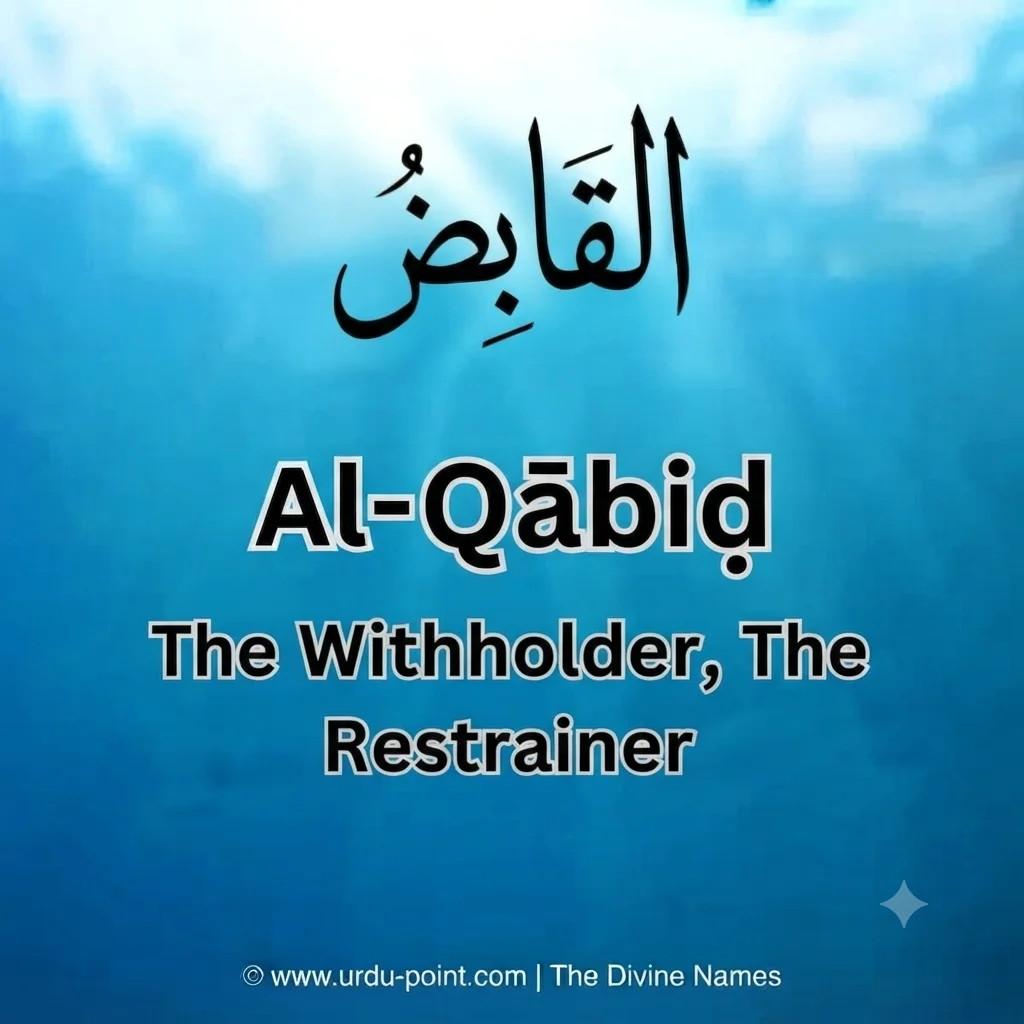
Al Qabid – The Withholder, The Restrainer | Meaning, Quran, Hadith & Benefits
Table of contents
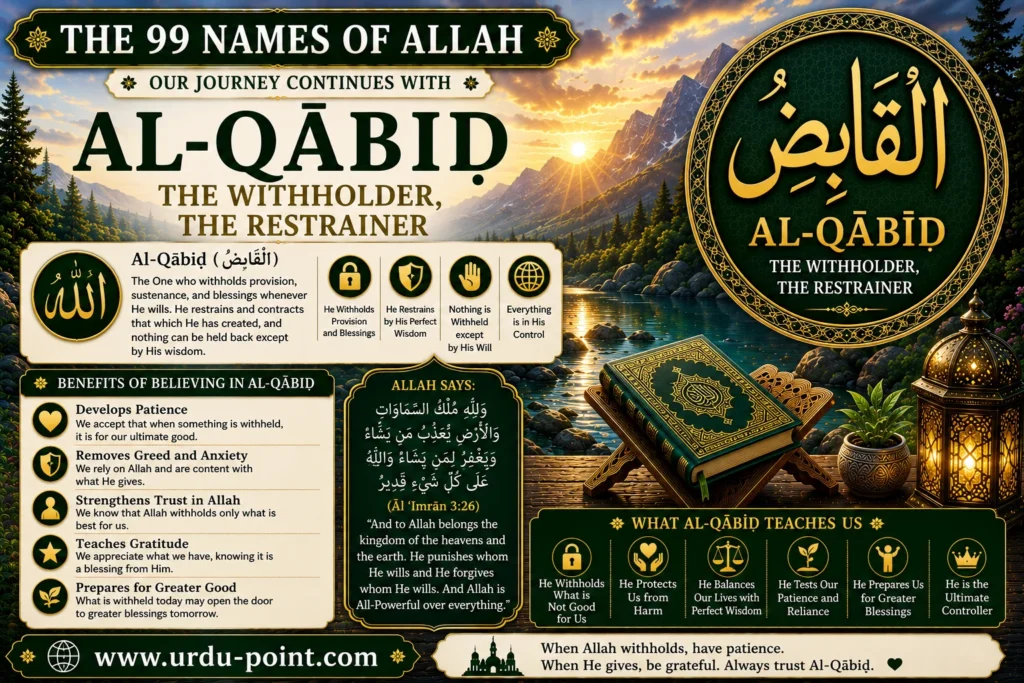
Al-Qabid (ٱلْقَابِضُ) is understood as “The Withholder” or “The Restrainer.” Allah has complete control over what He gives and withholds. He may restrict provision or circumstances according to His perfect wisdom, while no one can prevent what He decrees to reach His servants.
Al Qabid – The Withholder, The Restrainer | Meaning, Quran, Hadith & Benefits
Quick Answer: Al-Qabid means “The Withholder” or “The Restrainer.” The Arabic root ق-ب-ض (Q-B-D) carries meanings connected with taking, holding, grasping, and restricting. In relation to Allah, the Name reminds believers that He has complete authority over provision, circumstances, and all matters of creation. His withholding is never without wisdom, even when people do not immediately understand it.
Introduction
The Beautiful Name Al-Qabid reminds believers that Allah controls what is given and what is withheld. At times, a person may experience restricted provision, fewer opportunities, or a difficult period in life. Such circumstances should not automatically be viewed as rejection, because Allah’s wisdom is greater than our understanding.
Understanding Al-Qabid teaches Muslims to remain patient during difficulty, continue making lawful efforts, and trust Allah’s wisdom. What Allah withholds may contain protection, a lesson, or preparation for something better.
In this guide, you will learn the meaning of Al-Qabid, its Qur’anic connections, related Hadith, benefits, practical life lessons, and how this Name can strengthen patience and trust in Allah.
Quick Facts About Al-Qabid
| Name | Al-Qabid (ٱلْقَابِضُ) |
|---|---|
| English Meaning | The Withholder; The Restrainer |
| Arabic Root | ق-ب-ض (Q-B-D) |
| Root Meaning | To take, hold, grasp, seize, or restrict. |
| Category | One of the Beautiful Names traditionally included in Asma-ul-Husna. |
| Related Name | Al-Basit – The Expander, The One Who Extends. |
| Main Attribute | Allah has complete authority over what He withholds, restricts, gives, and expands. |
| Main Lesson | When Allah withholds something, remain patient and trust His perfect wisdom while continuing to make lawful effort. |
Arabic Script, Transliteration & Pronunciation
| Arabic | ٱلْقَابِضُ |
|---|---|
| English Transliteration | Al-Qabid |
| Pronunciation | Al-Qaa-bid |
| Literal Meaning | The Withholder; The Restrainer |
| Arabic Root | ق-ب-ض (Q-B-D) |
Detailed Meaning (English, Urdu & Hindi)
The meaning of Al-Qabid is connected to Allah’s absolute authority to withhold, restrict, take, or limit according to His perfect knowledge and wisdom. A person may experience a period when provision becomes limited, an opportunity disappears, or something they hoped for does not happen. Such situations are within Allah’s knowledge and control.
Allah’s withholding should not be understood as human withholding. Human beings may withhold something because of weakness, selfishness, ignorance, or inability. Allah, however, knows exactly what His servants need and what is best for them. His decisions are based upon perfect knowledge and wisdom.
The meaning of Al-Qabid becomes especially important when considered together with Al-Basit, the One who expands and extends. Allah may restrict something at one time and expand it at another. He may withhold something that a person desires because it would harm them, while later opening a better path that the person could not have imagined.
This understanding teaches believers not to judge their entire situation by a temporary difficulty. A period of restriction can become a means of patience, gratitude, repentance, dependence upon Allah, or spiritual growth. The believer therefore responds to difficulty with patience and continues to ask Allah for what is good.
| Language | Meaning |
|---|---|
| English | The Withholder or Restrainer; Allah has complete authority to restrict, withhold, take, or limit according to His perfect wisdom. |
| Urdu | وہ ذات جو اپنی حکمت کے مطابق روکنے، محدود کرنے اور قبض کرنے والی ہے۔ اللہ جس چیز کو چاہے روک دے اور جسے چاہے اپنی حکمت کے مطابق عطا فرمائے۔ |
| Hindi | वह जो अपनी पूर्ण हिकमत के अनुसार रोकने, सीमित करने और अपने अधिकार में रखने वाला है। अल्लाह जिसे चाहे अपनी हिकमत के अनुसार रोकता है और जिसे चाहे प्रदान करता है। |
Al-Qabid vs Al-Basit
The Al-Qabid and Al-Basit are traditionally understood together because they describe opposite but complementary aspects of Allah’s control. Al-Qabid refers to withholding or restricting, while Al-Basit refers to expanding, extending, and granting abundance. Both meanings remind believers that Allah alone controls the circumstances of His creation.
| Al-Qabid | Al-Basit |
|---|---|
| The Withholder; The Restrainer. | The Expander; The One Who Extends. |
| Highlights Allah’s ability to restrict or withhold. | Highlights Allah’s ability to expand and increase. |
| Teaches patience during periods of difficulty and restriction. | Teaches gratitude when Allah grants ease and abundance. |
| Reminds believers that withholding can occur through Allah’s wisdom. | Reminds believers that every blessing and expansion comes from Allah. |
| Encourages patience and trust. | Encourages gratitude and humility. |
Reflecting upon Al-Qabid and Al-Basit together gives a balanced understanding of life’s changing circumstances. When Allah grants ease, a believer should be grateful. When circumstances become restricted, the believer should remain patient and trust Allah. Both situations can bring a person closer to Allah when responded to correctly.
Qur’anic References Related to Al-Qabid
The Qur’an teaches that Allah controls provision, gives abundantly to whom He wills, and restricts it according to His perfect wisdom. Although the exact Divine Name Al-Qabid is not explicitly mentioned in the Qur’an as a standalone Name, the Qur’an clearly establishes the attribute of Allah withholding, restricting, and taking, while also describing Him as the One who expands provision.
These verses help believers understand that changes in wealth, provision, circumstances, and opportunities are ultimately under Allah’s control. A period of restriction should therefore lead a believer toward patience, repentance, du’a, and trust rather than despair.
Key Qur’anic Verses Related to Al-Qabid
| Verse | English Translation | Reference | Lesson |
|---|---|---|---|
| اللَّهُ يَقْبِضُ وَيَبْسُطُ وَإِلَيْهِ تُرْجَعُونَ | Allah withholds and grants abundance, and to Him you will be returned. | Surah Al-Baqarah (2:245) | Allah has complete authority over withholding and expanding His blessings and provision. |
| وَاللَّهُ يَقْبِضُ وَيَبْسُطُ وَإِلَيْهِ تُرْجَعُونَ | Allah withholds and grants abundance, and to Him you will be returned. | Surah Al-Baqarah (2:245) | A believer should trust Allah when circumstances change because everything ultimately returns to Him. |
| اللَّهُ يَبْسُطُ الرِّزْقَ لِمَن يَشَاءُ وَيَقَدِرُ | Allah extends provision for whom He wills and restricts it. | Surah Ar-Ra’d (13:26) | Increase and restriction in provision occur according to Allah’s wisdom. |
| وَاللَّهُ يَرْزُقُ مَن يَشَاءُ بِغَيْرِ حِسَابٍ | And Allah gives provision to whom He wills without limit. | Surah Al-Baqarah (2:212) | Allah’s giving is not limited by human expectations or calculations. |
| وَمَا أَنفَقْتُم مِّن شَيْءٍ فَهُوَ يُخْلِفُهُ وَهُوَ خَيْرُ الرَّازِقِينَ | Whatever you spend of good, He will replace it, and He is the best of providers. | Surah Saba (34:39) | Even when wealth is spent for good, believers can trust Allah’s promise and provision. |
Important reflection: Surah Al-Baqarah 2:245 directly uses the words yaqbid (withholds) and yabsut (expands). This provides an important Qur’anic foundation for understanding the meanings associated with Al-Qabid and Al-Basit. The verse teaches believers that both restriction and expansion are under Allah’s authority.
Authentic Hadith About Withholding, Giving and Provision
The Sunnah teaches that Allah is the ultimate giver and that worldly provision is under His control. The Prophet ﷺ also taught Muslims to remain patient and trust Allah rather than becoming excessively attached to what they possess. These teachings help explain how believers should respond when something is withheld or when provision becomes restricted.
| Authentic Hadith | Source | Lesson |
|---|---|---|
| The Prophet ﷺ said: “By Allah, I do not fear poverty for you, but I fear that the world will be expanded for you as it was expanded for those before you.” | Sahih al-Bukhari & Sahih Muslim | Abundance can also be a test. A believer should remain grateful and avoid becoming attached to worldly wealth. |
| The Prophet ﷺ taught that Allah says: “O My servants, if the first of you and the last of you, and the human of you and the jinn of you were all to stand in one place and ask Me, and I were to give everyone what he asked for, that would not decrease what I have any more than a needle decreases the sea when it is put into it.” | Sahih Muslim 2577 | Allah’s treasures are unlimited. His giving is not diminished by the countless needs of creation. |
| The Prophet ﷺ said: “If you were to rely upon Allah with the reliance He deserves, He would provide for you as He provides for the birds.” | Jami’ at-Tirmidhi 2344 | True reliance upon Allah includes trusting Him while taking appropriate means. |
These teachings show that both abundance and restriction can be tests. A person who experiences limited provision should remain patient and seek lawful means, while a person who receives abundant provision should remain grateful and use Allah’s blessings responsibly. In both situations, the believer remembers that Allah is the ultimate controller and provider.
How to Call Upon Allah Using the Name Al-Qabid
When making du’a, Muslims may call upon Allah by His Beautiful Names and ask Him for what is beneficial. When reflecting upon Al-Qabid, a believer can ask Allah for patience during restriction, protection from harmful things, lawful provision, and the wisdom to understand His decree.
The examples below are general supplications based on the meaning of the Name. They are not fixed Sunnah formulas and should not be treated as prescribed du’as with a specific number of repetitions unless authentic evidence establishes that.
| Situation | Example Du’a |
|---|---|
| During Financial Difficulty | Yā Qābid, grant me patience during difficulty and provide for me through what is lawful and good. |
| When Something Is Withheld | Yā Qābid, help me trust Your wisdom when something I desire is withheld from me. |
| Seeking Protection | Yā Qābid, withhold from me whatever would harm my faith, my life, or my Hereafter. |
| Seeking Halal Provision | Yā Qābid, protect me from unlawful provision and grant me what is pure, lawful, and beneficial. |
| Seeking Patience | Yā Qābid, strengthen my heart with patience and make me content with Your decree. |
Remembering Al-Qabid should not make a believer fearful of every difficulty. Instead, it should create a balanced understanding of Allah’s wisdom. Sometimes Allah withholds something because it is harmful, sometimes because its time has not arrived, and sometimes because the believer is being tested. We may not know the exact reason in every situation, but we can trust that Allah’s knowledge and wisdom are perfect.
Therefore, when facing restriction, continue making du’a, take lawful practical steps, avoid despair, and remain patient. A believer should also remember Al-Basit, knowing that Allah can expand a person’s circumstances whenever He wills.
Benefits of Knowing Allah’s Name Al-Qabid
Understanding Al-Qabid helps believers develop patience and trust when life becomes difficult. Allah may restrict something a person wants, but His wisdom is perfect even when the reason is not immediately clear. Reflecting upon this Name teaches Muslims to respond to hardship with faith rather than despair.
It also creates balance in how we view worldly circumstances. Ease and difficulty, abundance and restriction, are all part of life. A believer should remain grateful when Allah expands their circumstances and patient when He restricts them.
| Benefit | Explanation |
|---|---|
| Strengthens Patience | Remembering Allah’s wisdom helps believers remain patient when circumstances become difficult. |
| Increases Tawakkul | A believer learns to trust Allah while continuing to use lawful and responsible means. |
| Reduces Despair | Temporary restriction does not mean that Allah has abandoned His servant. |
| Develops Contentment | Believers learn to accept Allah’s decree while continuing to ask Him for what is good. |
| Strengthens Gratitude | Understanding restriction makes a person appreciate Allah’s blessings when He grants ease and abundance. |
| Protects from Excessive Attachment | A believer understands that wealth, opportunities, and possessions are temporary blessings controlled by Allah. |
Life Lessons from the Name Al-Qabid
The Beautiful Name Al-Qabid teaches Muslims how to respond when something they desire is delayed, restricted, or taken away. Instead of assuming that every closed door is a punishment, a believer should consider that Allah may have wisdom behind what has happened.
This does not mean that a person should stop making effort. Islam encourages believers to use lawful means, seek solutions, make du’a, and work toward beneficial goals. At the same time, the heart should remain dependent upon Allah rather than upon worldly circumstances.
| Life Lesson | Practical Application |
|---|---|
| Be Patient During Restriction | Do not allow temporary hardship to destroy your hope in Allah. |
| Continue Making Effort | Take lawful practical steps while trusting Allah with the outcome. |
| Do Not Despair | A closed door today does not mean that Allah will not open another door tomorrow. |
| Accept Allah’s Timing | Something may be withheld because its time has not arrived or because another outcome is better. |
| Be Grateful for Ease | When Allah expands your circumstances, recognize the blessing and use it responsibly. |
| Keep Your Heart Attached to Allah | Do not allow wealth, success, or opportunities to become more important than your relationship with Allah. |
Can You Name a Child “Qabid”?
Parents sometimes ask whether Qabid can be used as a Muslim name. The Arabic word Qabid carries the meaning of one who holds, grasps, takes, or restrains. As a Divine Name, Al-Qabid refers to Allah’s perfect authority to withhold and restrict according to His wisdom.
Because this Divine attribute has a specific theological meaning, it is better to avoid using Al-Qabid as though it were an ordinary human title. The servant-name form Abdul Qabid (عبد القابض), meaning “Servant of the Withholder”, follows the established pattern of expressing servitude to Allah through one of His Names.
However, the Name Al-Qabid is less commonly used in personal names than many other Names of Allah. Parents should therefore consider the meaning carefully and consult a qualified scholar if they specifically want to use Abdul Qabid as a child’s name.
| Name | Meaning | Guidance |
|---|---|---|
| Qabid | One who holds, grasps, takes, or restrains. | The meaning is not commonly used as a personal name and should be considered carefully. |
| Al-Qabid | The Withholder; The Restrainer. | A Divine Name describing Allah’s perfect authority. |
| Abdul Qabid | Servant of the Withholder. | Servant-name form; consult a qualified scholar regarding its suitability before choosing it. |
Scholar’s Summary: Since Al-Qabid describes a specific Divine attribute, parents should be careful when considering it as part of a child’s name. If choosing a name based on this Divine Name, the servant-name form Abdul Qabid is the form that clearly expresses servitude to Allah.
Frequently Asked Questions About Al-Qabid
Al-Qabid means “The Withholder” or “The Restrainer.” It describes Allah’s authority to withhold, restrict, or take according to His perfect wisdom.
The main meaning is that Allah has complete authority over restriction and withholding. Nothing happens outside His knowledge and wisdom.
The exact Name Al-Qabid is not mentioned as a standalone Divine Name in the Qur’an, but Surah Al-Baqarah 2:245 states that Allah withholds and expands.
The main lesson is to remain patient and trust Allah when something is restricted or withheld, while continuing to make lawful effort and du’a.
Qabid is not a common personal name and carries a specific meaning. Parents considering a name derived from this Divine Name should consult a qualified Islamic scholar before choosing it.
Conclusion
The Beautiful Name Al-Qabid reminds believers that Allah controls what He gives and what He withholds. A period of restriction does not necessarily mean rejection or abandonment. Allah’s knowledge and wisdom are perfect, while human understanding is limited.
When something is withheld, a believer should remain patient, continue making lawful efforts, make du’a, and trust Allah’s decree. When Allah grants abundance and ease, the believer should respond with gratitude and humility. Remembering Al-Qabid together with Al-Basit helps Muslims maintain balance through both difficulty and ease.
May Allah teach us to trust His wisdom, remain patient during hardship, appreciate His blessings, and keep our hearts attached to Him in every circumstance. May He open for us what is good and protect us from whatever would harm our faith and our Hereafter. Ameen.
Related Posts:
- Surah Al Lail to Read in Arabic, English Translation, Transliteration & Tafseer
- Ar Razzaq – The Ultimate Provider | Meaning, Quran, Hadith & Benefits
- Dua for Entering a City in Arabic with English Transliteration, Translation & Benefits
- Al Bari – The Originator, The Evolver | Meaning, Quran, Hadith & Benefits
- Al Musawwir – The Fashioner, The Perfect Shaper | Meaning, Quran, Hadith & Benefits