Transliteration: Ka’annahum yawma yarawnahaa lam yalbasoo illaa ‘ashiyyatan aw duḥaahaa
Translation: It will be, on the Day they see it, as though they had not remained [in the world] except for an afternoon or a morning thereof.
English Transliteration (Ayah 1–46)
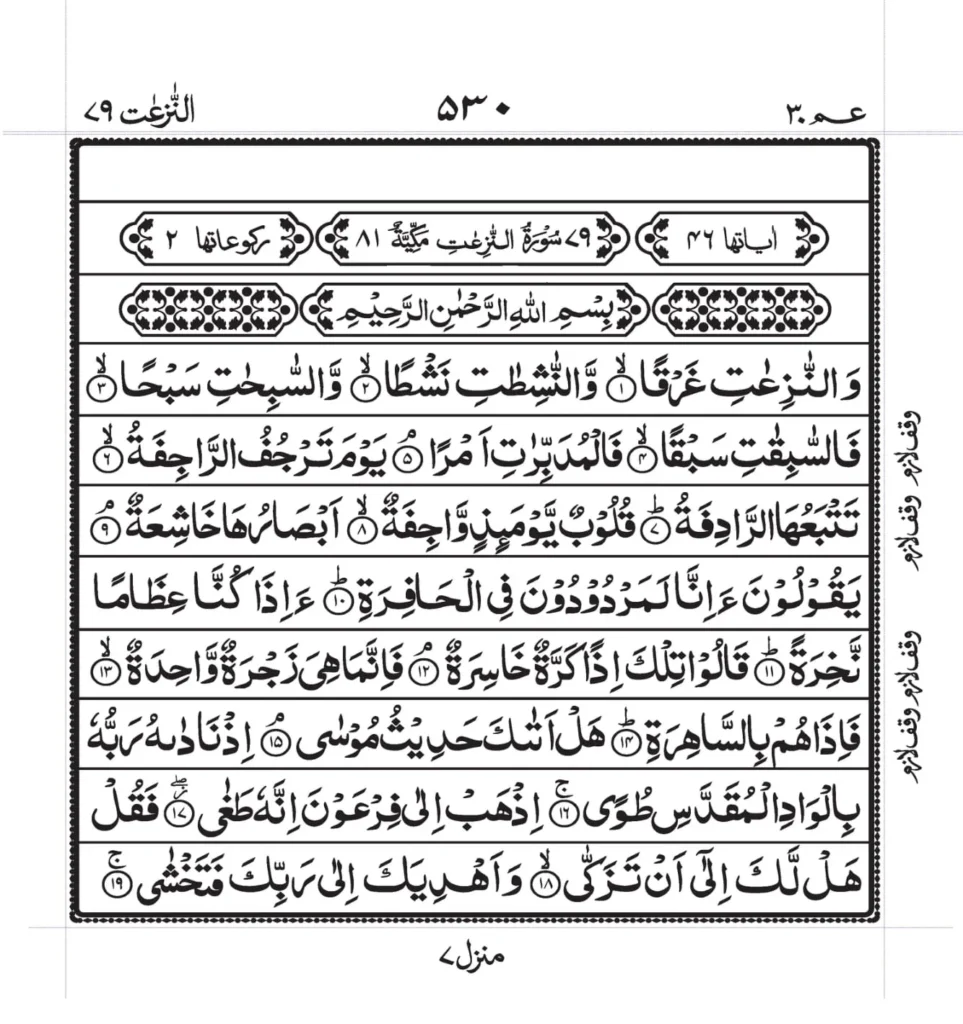
Wan naazi‘aati gharqaa
Wan naashitaati nashtaa
Was saabihaati sabhaa
Fas saabiqaati sabqaa
Fal mudabbiraati amraa
Yawma tarjufur raajifah
Tatba‘uhar raadifah
Quloobun yawma’izin waajifah
Absaaruhaa khaashi‘ah
Yaqooloona a’innaa lamardoodoona fil haafirah
A’iza kunnaa ‘izaaman nakhirah
Qaaloo tilka izan karratun khaasirah
Fa innamaa hiya zajratun waahidah
Fa izaa hum bis saahirah
Hal ataaka hadeethu Moosaa
Iz naadaahu Rabbuhu bil waadil muqaddasi Tuwaa
Izhab ilaa Fir‘awna innahu taghaa
Faqul hal laka ilaa an tazakkaa
Wa ahdiyaka ilaa Rabbika fatakhshaa
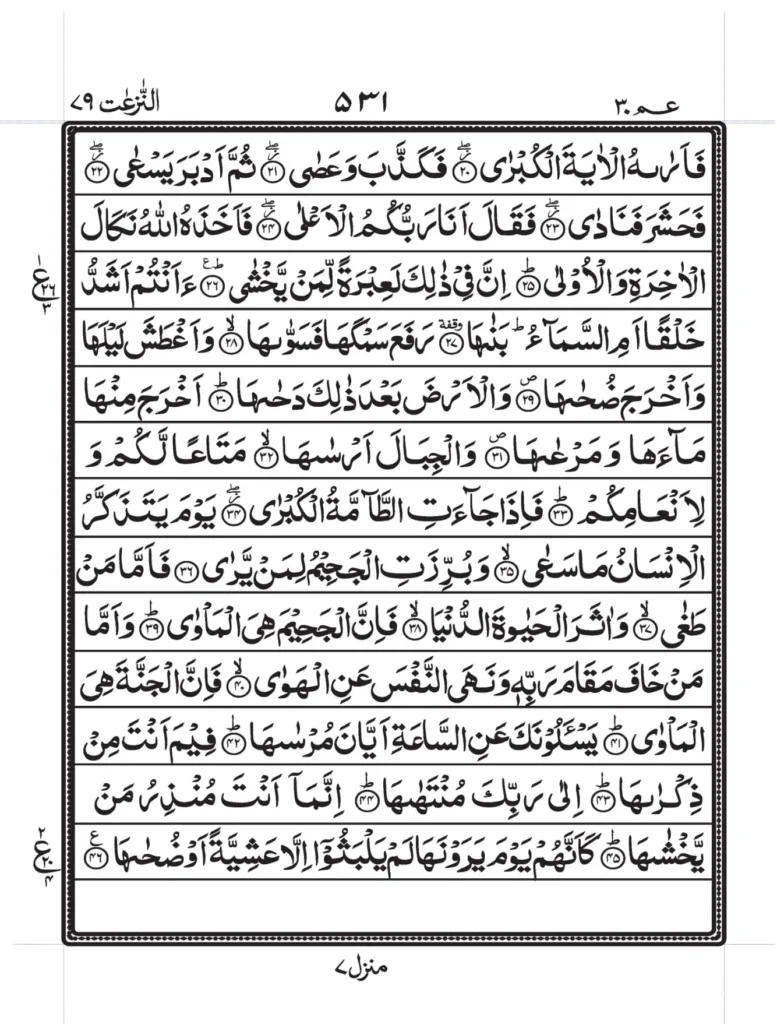
Fa araahul aayatal kubraa
Fakazzaba wa ‘asaa
Summa adbara yas‘aa
Fahashara fanaadaa
Faqaala ana Rabbukumul a‘laa
Fa akhazahullaahu nakaalal aakhirati wal oolaa
Inna fee zaalika la‘ibratal liman yakhshaa
A antum ashaddu khalqan amis samaa’u banaahaa
Rafa‘a samkahaa fasawwaahaa
Wa aghṭasha laylahaa wa akhraja duḥaahaa
Wal arda ba‘da zaalika dahaahaa
Akhraja minhaa maa’ahaa wa mar‘aahaa
Wal jibaala arsaahaa
Mataaa‘al lakum wa li an‘aamikum
Fa izaa jaa’atis taaaammatul kubraa
Yawma yatadhakkarul insaanu maa sa‘aa
Wa burrizatil jaḥeemu liman yaraa
Fa ammaa man taghaa
Wa aatharal hayaatad dunyaa
Fa innal jaḥeema hiyal ma’waa
Wa ammaa man khaafa maqaama Rabbihi wa nahan nafsa ‘anil hawaa
Fa innal jannata hiyal ma’waa
Yas’aloonaka ‘anis saa‘ati ayyaana mursaahaa
Feema anta min zikraahaa
Ilaa Rabbika muntahaahaa
Innamaa anta munziru man yakhshaahaa
Ka’annahum yawma yarawnahaa lam yalbasoo illaa ‘ashiyyatan aw duḥaahaa
English Translation (Ayah 1–46)
(Saheeh International)
By those [angels] who extract with violence
And those who remove with ease
And those who glide [as if] swimming
And those who race each other in a race
And those who arrange [each] matter
On the Day the blast will convulse creation
There will follow it the subsequent one
Hearts that Day will tremble
Their eyes humbled
They say, “Will we indeed be returned to our former state?”
Even if we should be decayed bones?
They say, “That then would be a losing return.”
But it will be only a single shout
And suddenly they will be upon the earth’s surface
Has there reached you the story of Moses?
When his Lord called to him in the sacred valley of Tuwa
Go to Pharaoh. Indeed, he has transgressed
And say, Would you be willing to purify yourself
And let me guide you to your Lord so you would fear Him
And he showed him the greatest sign
But Pharaoh denied and disobeyed
Then he turned his back striving
And he gathered his people and called out
And said, I am your most exalted lord
So Allah seized him in exemplary punishment for the last and the first
Indeed in that is a warning for whoever fears Allah
Are you a more difficult creation or is the heaven? He constructed it
He raised its ceiling and proportioned it
And He darkened its night and extracted its brightness
And after that He spread the earth
He extracted from it its water and its pasture
And the mountains He set firmly
As provision for you and your livestock
But when the greatest calamity comes
The Day when man will remember that for which he strove
And Hellfire will be exposed for all who see
So as for he who transgressed
And preferred the life of the world
Then indeed Hellfire will be his refuge
But as for he who feared standing before his Lord and restrained the soul from desire
Then indeed Paradise will be his refuge
They ask you about the Hour when is its arrival
In what position are you to mention it
To your Lord is its finality
You are only a warner for those who fear it
The Day they see it it will be as though they had not remained except an evening or a morning thereof
Tafseer of Surah An-Nazi’at (Ibn Kathir Summary)
According to the Tafseer of Ibn Kathir, Surah An-Nazi’at begins with a series of oaths by Allah referring to the angels who carry out His commands. These angels are responsible for taking the souls of people at the time of death. Some angels take the souls of disbelievers with force, while others take the souls of believers gently. The Surah then shifts attention to the Day of Judgment when the first and second blasts of the trumpet will shake the earth and resurrect mankind.
The Surah describes the fear and trembling of hearts on that Day. The disbelievers in this world used to doubt resurrection and questioned how they could be brought back to life after becoming bones and dust. Allah answers that resurrection will occur with just one command, and suddenly all people will stand again on the earth.
Allah then mentions the story of Prophet Musa (Moses) and Pharaoh. Musa was commanded to invite Pharaoh to purify himself and submit to Allah. However, Pharaoh arrogantly rejected the message and claimed to be the highest lord. Because of his arrogance and disbelief, Allah punished him as a lesson for those who fear Him.
After mentioning this example, the Surah draws attention to the signs of Allah’s power in creation. Allah created the heavens, raised them high, darkened the night, brought forth daylight, spread the earth, and placed mountains firmly within it. These signs prove that the One who created the universe can easily resurrect mankind.
The Surah then describes the fate of people on the Day of Judgment. Those who transgressed and preferred worldly life will have Hell as their destination. But those who feared standing before their Lord and restrained their desires will be rewarded with Paradise.
Finally, the Surah ends by reminding that knowledge of the exact time of the Day of Judgment belongs only to Allah. The Prophet ﷺ was sent only as a warner to those who fear it. When people finally witness that Day, it will feel as if their life in this world lasted only a short evening or morning.
Lessons & Benefits from Surah An-Nazi’at
1. Angels Carry Out Allah’s Commands The Surah highlights the role of angels who take souls and manage affairs according to Allah’s command, showing the organized system of the unseen world.
2. Certainty of Resurrection Even though disbelievers doubted life after death, Allah reminds that resurrection will happen instantly by His command.
3. Warning from the Story of Pharaoh Pharaoh’s arrogance and denial serve as a powerful lesson that pride and rejection of truth lead to destruction.
4. Signs of Allah in Creation The creation of the heavens, earth, mountains, night, and day proves Allah’s power and wisdom.
5. The Reality of the Day of Judgment The Surah vividly describes the fear, accountability, and consequences that will occur on the Day of Judgment.
6. Danger of Loving the World Too Much Those who prioritize worldly life over obedience to Allah risk punishment in the Hereafter.
7. Success Comes from Controlling Desires Those who fear Allah and restrain their desires will receive Paradise as their final home.
8. Only Allah Knows the Time of the Hour The exact time of the Day of Judgment is known only to Allah, reminding believers to always stay prepared.
Meaning of Surah An-Nazi’at (Simple Explanation)
Surah An-Nazi’at explains the reality of the Day of Judgment and life after death. The Surah begins by mentioning angels who take the souls of people and carry out Allah’s commands. It then describes the powerful events that will occur when the trumpet is blown and all humans are resurrected.
The Surah also presents the story of Prophet Musa (Moses) and Pharaoh, showing how arrogance and rejection of truth lead to punishment. Pharaoh denied Allah and claimed power for himself, which ultimately led to his destruction.
Another major theme of the Surah is the signs of Allah in creation, such as the sky, earth, mountains, night, and day. These signs remind people that the One who created the universe can easily bring people back to life after death.
In the final verses, the Surah contrasts the fate of two groups: those who choose worldly desires and those who fear Allah. The disbelievers will face Hell, while those who control their desires and obey Allah will be rewarded with Paradise.
Virtues of Surah An-Nazi’at
Although there is no specific authentic hadith mentioning a special reward only for this Surah, reciting Surah An-Nazi’at still carries the general virtues of reciting the Qur’an.
Some important virtues include:
1. Reward for Every Letter The Prophet ﷺ said that whoever recites a letter from the Qur’an receives a reward, and each reward is multiplied ten times.
2. Reminder of the Hereafter Surah An-Nazi’at strongly reminds believers about the Day of Judgment, helping strengthen faith and accountability.
3. Encouragement to Avoid Arrogance The example of Pharaoh teaches believers to avoid pride and always remain humble before Allah.
4. Strengthening Belief in Resurrection The Surah emphasizes that life after death is certain, encouraging believers to prepare for the Hereafter.
When to Recite Surah An-Nazi’at
Surah An-Nazi’at can be recited at any time, as all parts of the Qur’an are beneficial for believers. However, it is especially meaningful in the following situations:
1. During Daily Qur’an Recitation It can be part of regular Qur’an reading to reflect on the reality of the Hereafter.
2. In Salah (Prayer) Many shorter Makki surahs, including Surah An-Nazi’at, are often recited in voluntary or obligatory prayers.
3. For Reflection on the Day of Judgment The Surah contains powerful reminders about accountability and resurrection.
4. For Spiritual Reflection Reading and understanding the Surah helps believers think about the temporary nature of worldly life.
FAQs
What is Surah An-Nazi’at about?
Surah An-Nazi’at discusses the reality of the Day of Judgment, the resurrection after death, and lessons from the story of Prophet Musa and Pharaoh.
How many ayahs are in Surah An-Nazi’at?
Surah An-Nazi’at contains 46 verses (ayahs).
Where was Surah An-Nazi’at revealed?
It was revealed in Makkah, making it a Makki Surah.
What is the main message of Surah An-Nazi’at?
The Surah reminds people about accountability in the Hereafter and encourages fear of Allah and righteous living.