

Al Khafid – The Abaser, The One Who Lowers | Meaning, Quran, Hadith & Benefits
Table of contents
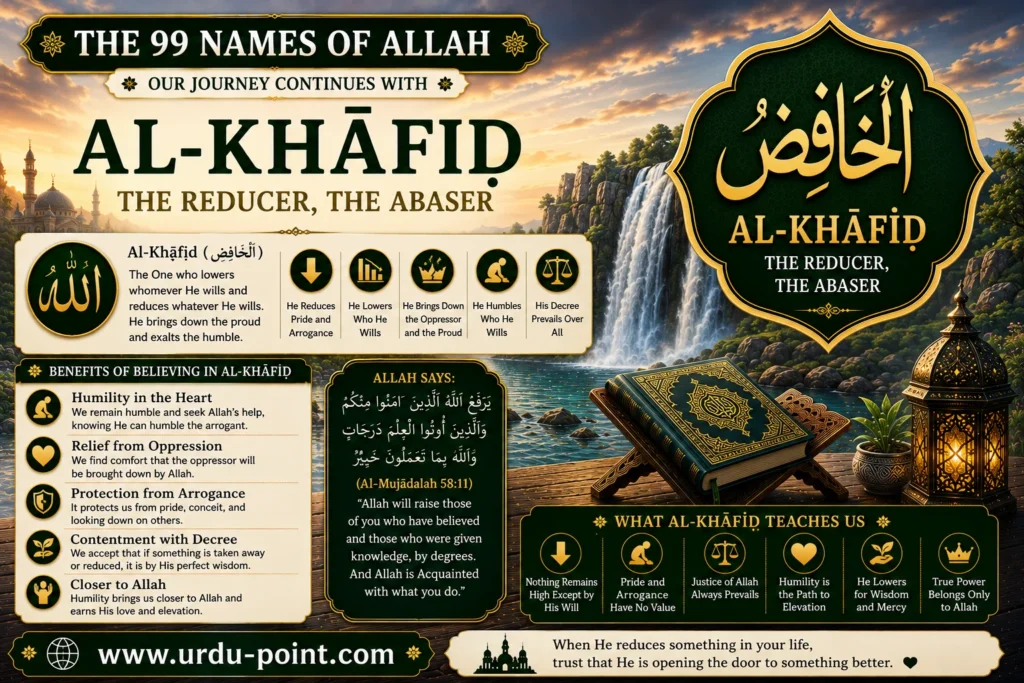
Al-Khafid (ٱلْخَافِضُ) is understood as “The Abaser” or “The One Who Lowers.” Allah has complete authority to lower whom He wills, humble the arrogant, and bring about changes in people’s status and circumstances according to His perfect knowledge and wisdom.
Al Khafid – The Abaser, The One Who Lowers | Meaning, Quran, Hadith & Benefits
Quick Answer: Al-Khafid means “The Abaser” or “The One Who Lowers.” It is traditionally included among the Beautiful Names of Allah. The meaning reminds believers that honor, status, strength, and worldly position are ultimately under Allah’s control. He lowers whom He wills according to His perfect wisdom, and no person can prevent what He decrees.
Introduction
The Beautiful Name Al-Khafid reminds believers that Allah has complete authority over people’s status, circumstances, and worldly position. He can lower arrogance, remove false pride, and change a person’s circumstances according to His perfect wisdom.
Understanding Al-Khafid teaches Muslims humility and warns against arrogance. A person should never become proud of wealth, power, knowledge, or social status because everything can change by Allah’s command.
In this guide, you will learn the meaning of Al-Khafid, its Qur’anic connections, authentic Hadith, benefits, practical life lessons, and how reflecting upon this Name can strengthen humility, patience, and trust in Allah.
Quick Facts About Al-Khafid
| Name | Al-Khafid (ٱلْخَافِضُ) |
|---|---|
| English Meaning | The Abaser; The One Who Lowers |
| Arabic Root | خ-ف-ض (Kh-F-D) |
| Root Meaning | To lower, bring down, reduce, or humble. |
| Category | One of the Beautiful Names traditionally included in Asma-ul-Husna. |
| Related Name | Ar-Rafi’ – The Exalter; The One Who Raises. |
| Main Attribute | Allah has complete authority to lower, humble, or reduce according to His perfect knowledge and wisdom. |
| Main Lesson | Remain humble and never become arrogant because honor and worldly status are ultimately controlled by Allah. |
Arabic Script, Transliteration & Pronunciation
| Arabic | ٱلْخَافِضُ |
|---|---|
| English Transliteration | Al-Khafid |
| Pronunciation | Al-Khaa-fid |
| Literal Meaning | The Abaser; The One Who Lowers |
| Arabic Root | خ-ف-ض (Kh-F-D) |
Detailed Meaning (English, Urdu & Hindi)
The Beautiful Name Al-Khafid is connected to the Arabic root خ-ف-ض, which carries meanings related to lowering, bringing down, reducing, and humbling. As a Divine Name, it reminds believers that Allah has complete authority over the rise and fall of people, circumstances, status, and worldly conditions according to His perfect wisdom.
Allah may lower a person’s worldly position, remove arrogance, reduce someone’s influence, or change circumstances that once seemed secure. Such changes are within His knowledge and control. A believer should therefore never consider worldly success permanent or assume that status makes a person superior in the sight of Allah.
The meaning of Al-Khafid also teaches humility. Wealth, authority, physical strength, knowledge, popularity, and social position can all change. A person who understands this becomes less attached to worldly pride and more concerned with faith, righteous actions, and sincere obedience to Allah.
Al-Khafid is especially meaningful when considered together with Ar-Rafi’, the One who raises and exalts. Allah can lower and raise according to His perfect wisdom. Therefore, believers should remain humble during success, patient during difficulty, and confident that true honor comes from Allah rather than from worldly status.
| English | Urdu | Hindi |
|---|---|---|
| The Abaser; The One Who Lowers. | پست کرنے والا، نیچا کرنے والا | नीचा करने वाला, पस्त करने वाला |
| Allah has complete authority to lower or humble whom He wills according to His perfect wisdom. | اللہ تعالیٰ اپنی کامل حکمت کے مطابق جسے چاہے پست یا عاجز کر سکتا ہے۔ | अल्लाह अपनी पूर्ण हिकमत के अनुसार जिसे चाहे नीचा या विनम्र कर सकता है। |
| Al-Khafid teaches believers to avoid arrogance and remember that worldly status can change at any time. | الخافض مومن کو تکبر سے بچنے اور یہ یاد رکھنے کی تعلیم دیتا ہے کہ دنیاوی مقام کسی بھی وقت بدل سکتا ہے۔ | अल-ख़ाफ़िद मोमिन को घमंड से बचने और यह याद रखने की शिक्षा देता है कि दुनियावी हैसियत कभी भी बदल सकती है। |
Al-Khafid vs Ar-Rafi’
The Al-Khafid and Ar-Rafi’ are traditionally understood together because they describe opposite but complementary aspects of Allah’s control. Al-Khafid refers to lowering or humbling, while Ar-Rafi’ refers to raising and exalting. Together, they remind believers that Allah controls honor, status, circumstances, and the changing conditions of His creation.
| Al-Khafid | Ar-Rafi’ |
|---|---|
| The Abaser; The One Who Lowers. | The Exalter; The One Who Raises. |
| Highlights Allah’s authority to lower and humble. | Highlights Allah’s authority to raise and honor. |
| Teaches humility during worldly success. | Teaches gratitude when Allah grants honor and elevation. |
| Reminds believers that worldly status can decrease. | Reminds believers that Allah can raise a person in rank and honor. |
| Encourages patience and humility. | Encourages gratitude and responsible use of honor. |
Reflecting upon Al-Khafid and Ar-Rafi’ together gives believers a balanced understanding of honor and status. A person should never become arrogant when elevated and should not lose hope when facing a temporary setback. Allah alone knows what is best and controls every rise and fall with perfect wisdom.
Qur’anic References Related to Al-Khafid
The Qur’an teaches that Allah controls honor, humiliation, elevation, and the changing circumstances of His creation. Although the exact Divine Name Al-Khafid is not mentioned as a standalone Name in the Qur’an, the Qur’an clearly establishes that Allah lowers and raises whom He wills.
These verses teach believers that worldly status is temporary and that true honor comes from Allah. A person should therefore avoid arrogance when elevated and remain patient when experiencing difficulty or a loss of worldly position.
Key Qur’anic Verses Related to Al-Khafid
| Verse | English Translation | Reference | Lesson |
|---|---|---|---|
| وَتُعِزُّ مَن تَشَاءُ وَتُذِلُّ مَن تَشَاءُ | You honor whom You will and humble whom You will. | Surah Aal-E-Imran (3:26) | Honor and humiliation are ultimately under Allah’s authority. |
| وَرَفَعَ بَعْضَكُمْ فَوْقَ بَعْضٍ دَرَجَاتٍ | And He has raised some of you above others in degrees. | Surah Al-An’am (6:165) | Differences in worldly circumstances are part of Allah’s test and wisdom. |
| يَرْفَعِ اللَّهُ الَّذِينَ آمَنُوا مِنكُمْ وَالَّذِينَ أُوتُوا الْعِلْمَ دَرَجَاتٍ | Allah will raise those who have believed among you and those who were given knowledge by degrees. | Surah Al-Mujadilah (58:11) | True elevation is connected with faith and beneficial knowledge, not merely worldly status. |
| وَلِلَّهِ الْعِزَّةُ وَلِرَسُولِهِ وَلِلْمُؤْمِنِينَ | And to Allah belongs all honor, and to His Messenger and to the believers. | Surah Al-Munafiqun (63:8) | True honor ultimately belongs to Allah and is not dependent upon worldly wealth or position. |
Important reflection: Surah Aal-E-Imran 3:26 is particularly relevant to the meaning associated with Al-Khafid. The verse teaches that Allah honors whom He wills and humbles whom He wills. This reminds believers that worldly position is never completely independent of Allah’s will and that arrogance is dangerous.
Authentic Hadith About Raising and Lowering
The Sunnah teaches that Allah raises and lowers people in ways connected with His wisdom and decree. The Prophet ﷺ also taught that true honor is not based simply on wealth, appearance, or worldly status. A believer should therefore seek elevation through faith, righteousness, humility, and obedience to Allah.
| Authentic Hadith | Source | Lesson |
|---|---|---|
| The Prophet ﷺ said: “Whoever humbles himself before Allah, Allah will raise him.” | Sahih Muslim 2588 | True humility before Allah is a means of spiritual elevation. |
| The Prophet ﷺ said: “Allah does not look at your bodies or your forms, but He looks at your hearts and your deeds.” | Sahih Muslim 2564 | A person’s true worth is not determined by appearance or worldly status, but by the heart and deeds. |
| The Prophet ﷺ said: “No one who has an atom’s weight of arrogance in his heart will enter Paradise.” | Sahih Muslim 91 | Arrogance is dangerous, and believers should protect themselves from pride and self-importance. |
These teachings provide an important balance. Allah may allow a person to experience worldly elevation, but this does not necessarily mean that the person is more beloved to Him. Likewise, a person who experiences poverty, weakness, or a reduction in worldly status is not automatically disgraced in the sight of Allah. What matters most is faith, sincerity, righteousness, and the condition of the heart.
How to Call Upon Allah Using the Name Al-Khafid
Muslims may call upon Allah by His Beautiful Names when making du’a. When reflecting upon Al-Khafid, a believer can ask Allah to humble the heart, protect against arrogance, lower harmful desires, and keep the person away from anything that damages faith.
The examples below are general supplications based on the meaning of the Name. They are not fixed Sunnah formulas and should not be treated as prescribed du’as with a specific number of repetitions unless authentic evidence establishes that.
| Situation | Example Du’a |
|---|---|
| Seeking Humility | Yā Khāfid, protect my heart from arrogance and make me humble before You. |
| Protection from Pride | Yā Khāfid, protect me from pride, self-importance, and looking down upon others. |
| During Loss of Status | Yā Khāfid, give me patience when my circumstances become difficult and keep my heart firm upon faith. |
| Seeking True Honor | Yā Khāfid, keep me away from false pride and grant me honor through faith and righteous deeds. |
| Seeking a Good Heart | Yā Khāfid, humble my heart and help me recognize that every strength and blessing comes from You. |
When making such du’a, believers should not ask Allah to humiliate innocent people or use the Name Al-Khafid as a means of wishing harm upon others. Instead, the meaning should lead to humility, self-correction, and protection from arrogance.
A believer should also remember Ar-Rafi’, the One who raises. Allah can lower a person from a worldly position and can also raise someone who is humble, sincere, and faithful. Therefore, the believer’s goal should not simply be worldly elevation but closeness to Allah and success in the Hereafter.
Benefits of Knowing Allah’s Name Al-Khafid
Understanding Al-Khafid helps believers recognize that worldly status, strength, wealth, and influence are temporary. Allah can lower or change circumstances according to His perfect wisdom. Reflecting upon this Name encourages humility, patience, and greater dependence upon Allah.
It also reminds believers that true honor is not measured only by social position or material success. A person may appear successful in the eyes of people while lacking faith and sincerity, while another may have little worldly status but be honored by Allah because of righteousness.
| Benefit | Explanation |
|---|---|
| Develops Humility | Remembering Al-Khafid protects the believer from becoming proud of wealth, knowledge, beauty, power, or social position. |
| Reduces Arrogance | A person realizes that every worldly advantage can change and that no blessing makes someone independent of Allah. |
| Strengthens Patience | When circumstances become difficult, the believer remembers that Allah knows the wisdom behind every change. |
| Increases Tawakkul | The believer depends upon Allah rather than placing complete confidence in worldly status or possessions. |
| Encourages Self-Reflection | The Name encourages Muslims to examine their hearts and remove pride, contempt, and excessive attachment to status. |
| Teaches True Honor | Believers learn that lasting honor comes through faith and righteousness rather than temporary worldly position. |
Life Lessons from the Name Al-Khafid
The Beautiful Name Al-Khafid teaches Muslims to remain humble regardless of their circumstances. A person may have wealth, influence, education, beauty, or authority today, but these things can change. Therefore, the believer should never allow worldly success to produce arrogance.
At the same time, experiencing a setback does not mean that a person has no value. Allah may allow difficulties as a test, a means of purification, or part of a wisdom that a person does not yet understand. The believer should respond with patience, du’a, and continued effort.
| Life Lesson | Practical Application |
|---|---|
| Do Not Be Arrogant | Never assume that wealth, education, power, or popularity makes you better than others. |
| Stay Humble During Success | When Allah gives you a high position, thank Him and treat others with kindness and respect. |
| Be Patient During Setbacks | A temporary loss of status or opportunity should not destroy your hope in Allah. |
| Do Not Look Down on Others | A person’s worldly circumstances do not determine their value before Allah. |
| Seek Honor Through Faith | Focus on obedience, sincerity, good character, and righteous deeds rather than seeking status for its own sake. |
| Remember That Circumstances Change | Use periods of ease wisely and remain patient when circumstances become difficult. |
The believer should also remember Ar-Rafi’, the One who raises and exalts. Allah may lower someone in worldly circumstances while raising another in faith, knowledge, character, or righteousness. Therefore, Muslims should seek the kind of elevation that remains valuable in the Hereafter.
Can You Name a Child “Khafid”?
Parents may wonder whether Khafid can be used as a Muslim name. The Arabic word Khafid carries the meaning of one who lowers, brings down, or humbles. As part of the Divine Name Al-Khafid, it refers to Allah’s perfect authority to lower and humble according to His wisdom.
The name Abdul Khafid (عبد الخافض) means “Servant of the One Who Lowers” or “Servant of the Abaser.” The prefix Abd expresses servitude to Allah and distinguishes the human name from the Divine Name.
Because Al-Khafid has a specific Divine meaning, parents should understand the name carefully before choosing it. If selecting a servant-name connected with this Divine Name, Abdul Khafid clearly expresses servitude to Allah.
| Name | Meaning | Guidance |
|---|---|---|
| Khafid | One who lowers, brings down, or humbles. | A word with a specific meaning that should be distinguished from the Divine Name. |
| Al-Khafid | The Abaser; The One Who Lowers. | A Divine Name describing Allah’s perfect authority to lower and humble. |
| Abdul Khafid | Servant of the One Who Lowers. | A servant-name form connected with the Divine Name. |
Scholar’s Summary: When choosing a name connected with a Divine Name, the meaning should be understood carefully. Abdul Khafid clearly expresses servitude to Allah. Parents who are uncertain about a particular name should consult a qualified Islamic scholar before making their final choice.
Frequently Asked Questions About Al-Khafid
Al-Khafid means “The Abaser” or “The One Who Lowers.” It refers to Allah’s authority to lower and humble according to His perfect knowledge and wisdom.
The main meaning is that Allah has complete authority over lowering, humbling, and changing the worldly circumstances and status of His creation.
The exact Name Al-Khafid is not mentioned as a standalone Divine Name in the Qur’an. However, the Qur’an states that Allah honors whom He wills and humbles whom He wills in Surah Aal-E-Imran 3:26.
The main lesson is to avoid arrogance, remain humble during success, and stay patient when facing a loss of worldly status or difficult circumstances.
Khafid has a meaning related to lowering or humbling. Parents considering a name derived from this Divine Name should understand the meaning carefully; Abdul Khafid clearly expresses servitude to Allah.
Conclusion
The Beautiful Name Al-Khafid reminds believers that Allah has complete authority over honor, status, strength, and worldly circumstances. He can lower and humble according to His perfect knowledge and wisdom. Therefore, no person should become arrogant because of wealth, power, knowledge, beauty, or social position.
Understanding Al-Khafid also teaches patience during difficult times. A setback or loss of worldly status does not mean that Allah has abandoned a person. The believer should remain patient, continue making lawful effort, correct the heart, and trust Allah’s wisdom.
May Allah protect our hearts from arrogance, pride, and looking down upon others. May He grant us humility, sincere faith, righteous character, and true honor through obedience to Him. May He raise us in faith and righteousness and protect us from anything that leads us away from Him. Ameen.
Related Posts:
- Al Aziz – The Almighty, The All-Powerful | Meaning, Quran, Hadith & Benefits
- Al Qabid – The Withholder, The Restrainer | Meaning, Quran, Hadith & Benefits
- Surah Al Alaq to Read in Arabic, English Translation, Transliteration, Tafseer, Benefits & Lessons
- Al Mutakabbir – The Supreme, The Possessor of All Greatness | Meaning, Quran, Hadith & Benefits
- Al Qahhar – The All-Prevailing, The Supreme Conqueror | Meaning, Quran, Hadith & Benefits