
Al Qayyum – The Sustainer | Meaning, Quran, Hadith & Benefits
Table of contents
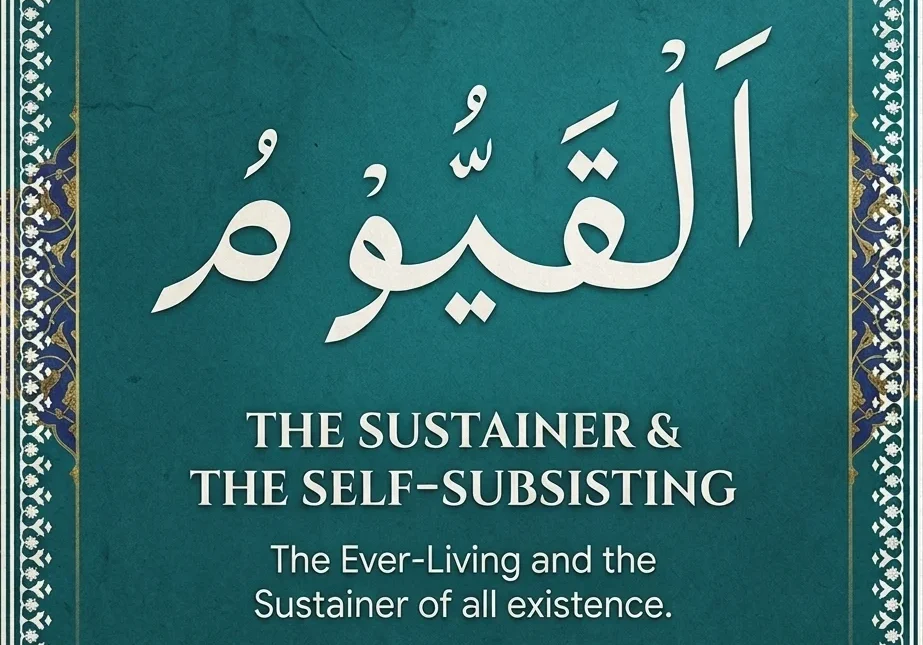
Al-Qayyum (ٱلْقَيُّومُ) means “The Sustainer of All” or “The Self-Sustaining.” Allah sustains, maintains, and preserves all creation, while He Himself is completely independent and needs nothing from His creation.
Al Qayyum – The Sustainer | Meaning, Quran, Hadith & Benefits
Quick Answer: Al-Qayyum means “The Sustainer of All” and describes Allah as the One upon whom every created thing depends. He sustains the heavens and the earth, gives creation what it needs, and remains completely independent of everything.
Introduction
The Beautiful Name Al-Qayyum reminds believers that Allah continuously sustains and maintains all creation. Everything depends upon Him, while Allah depends upon no one.
This Name gives comfort during difficult times. When a person feels weak or uncertain, remembering that Allah sustains everything can strengthen trust in Him and encourage sincere reliance upon Him.
Understanding Al-Qayyum also teaches humility and gratitude. Every breath, ability, blessing, and moment of life exists by Allah’s permission and sustaining power.
Quick Facts About Al-Qayyum
| Name | Al-Qayyum (ٱلْقَيُّومُ) |
|---|---|
| English Meaning | The Sustainer of All; The Self-Sustaining; The One Who Sustains Everything |
| Arabic Root | ق-و-م (Q-W-M) |
| Root Meaning | To stand, establish, maintain, sustain, and uphold. |
| Qur’anic Status | Al-Qayyum is explicitly mentioned in the Qur’an together with Al-Hayy in Surah Al-Baqarah 2:255, Aal ‘Imran 3:2, and Ta-Ha 20:111. |
| Related Name | Al-Hayy – The Ever-Living; Al-Qayyum emphasizes Allah’s sustaining and maintaining of all creation. |
| Main Attribute | Allah sustains and maintains all creation while being completely independent of His creation. |
| Main Lesson | Rely upon Allah, recognize your dependence upon Him, and remain grateful for every blessing He sustains. |
Arabic Script, Transliteration & Pronunciation
| Arabic | ٱلْقَيُّومُ |
|---|---|
| English Transliteration | Al-Qayyum |
| Pronunciation | Al-Qai-yoom |
| Literal Meaning | The Sustainer of All; The Self-Sustaining |
| Arabic Root | ق-و-م (Q-W-M) |
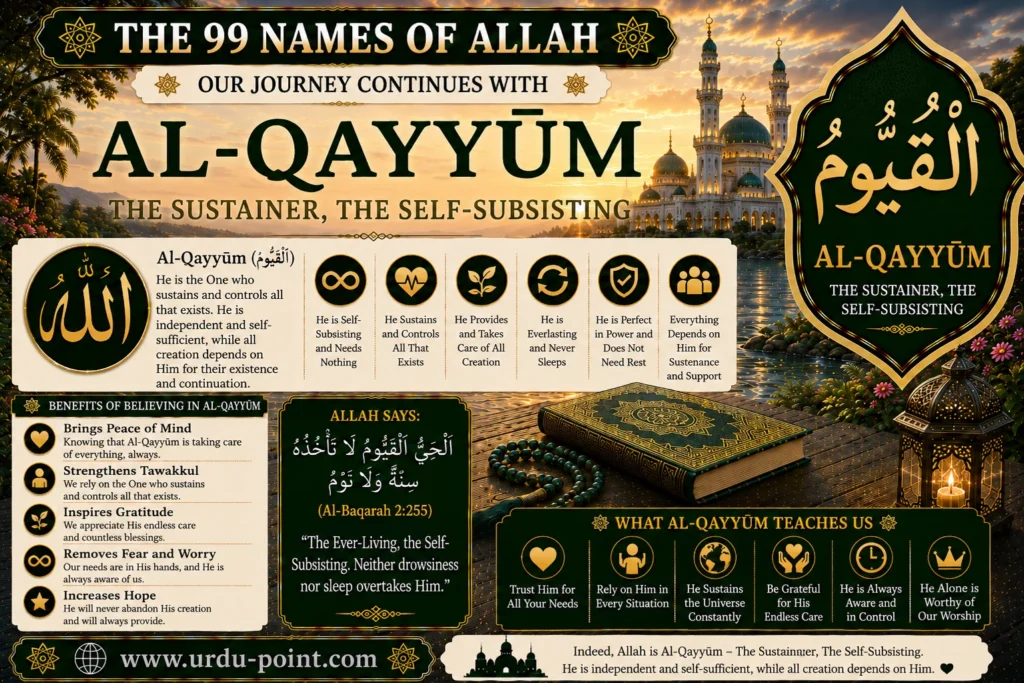
Detailed Meaning in English.
The Beautiful Name Al-Qayyum comes from the Arabic root ق-و-م, which is connected with standing, establishing, maintaining, and sustaining. As a Divine Name, it describes Allah as the One who sustains and maintains all creation.
Every created thing depends upon Allah for its existence and continued existence. The heavens, earth, human beings, animals, plants, and everything within creation are sustained by His command and power. Allah, however, is not dependent upon anything.
Al-Qayyum also points to Allah’s perfect independence. He does not become tired, weak, or in need of rest. Ayat al-Kursi describes Allah as Al-Hayy Al-Qayyum and states that neither drowsiness nor sleep overtakes Him. :contentReference[oaicite:0]{index=0}
Reflecting upon Al-Qayyum teaches believers to place their trust in Allah. Our strength, health, provision, knowledge, and ability to continue each day are all dependent upon His sustaining will.
Al-Qayyum Meaning in English, Urdu & Hindi.
| English | Urdu | Hindi |
|---|---|---|
| The Sustainer of All; The Self-Sustaining. | سب کو قائم رکھنے والا، خود قائم رہنے والا | सबको कायम रखने वाला, स्वयं कायम रहने वाला |
| Allah sustains and maintains everything in creation. | اللہ تعالیٰ مخلوق کی ہر چیز کو قائم اور برقرار رکھتا ہے۔ | अल्लाह मख़लूक़ की हर चीज़ को कायम और बरकरार रखता है। |
| Every created being depends upon Allah, while Allah depends upon no one. | ہر مخلوق اللہ کی محتاج ہے، جبکہ اللہ کسی کا محتاج نہیں۔ | हर मख़लूक़ अल्लाह की मोहताज है, जबकि अल्लाह किसी का मोहताज नहीं। |
| Al-Qayyum reminds believers to rely upon Allah and recognize their complete dependence upon Him. | القیوم مومن کو اللہ پر بھروسہ کرنے اور اپنی مکمل محتاجی کو سمجھنے کی یاد دلاتا ہے۔ | अल-क़य्यूम मोमिन को अल्लाह पर भरोसा करने और अपनी पूर्ण निर्भरता को समझने की याद दिलाता है। |
| Allah continuously preserves His creation without becoming tired or weak. | اللہ تعالیٰ اپنی مخلوق کی مسلسل حفاظت اور نگہداشت کرتا ہے، نہ وہ تھکتا ہے اور نہ کمزور ہوتا ہے۔ | अल्लाह अपनी मख़लूक़ की लगातार हिफाज़त और देखभाल करता है; न वह थकता है और न कमज़ोर होता है। |
Al-Qayyum vs Al-Hayy
The Al-Hayy and Al-Qayyum are frequently mentioned together in the Qur’an. Al-Hayy emphasizes Allah’s perfect and everlasting life, while Al-Qayyum emphasizes that He sustains and maintains all creation. The two Names beautifully express Allah’s perfection: He is Ever-Living and continuously sustains everything. :contentReference[oaicite:1]{index=1}
| Al-Qayyum | Al-Hayy |
|---|---|
| The Sustainer of All; The Self-Sustaining. | The Ever-Living. |
| Emphasizes Allah’s sustaining and maintaining of all creation. | Emphasizes Allah’s perfect and everlasting life. |
| Reminds believers that everything depends upon Allah. | Reminds believers that Allah never dies or experiences weakness. |
| Encourages reliance upon Allah and gratitude for His sustaining care. | Encourages believers to worship the One whose life is perfect and everlasting. |
| Shows that Allah is independent while creation is completely dependent upon Him. | Shows that Allah’s life is unlike the limited life of created beings. |
The combination Al-Hayy Al-Qayyum is especially significant in the Qur’an. It appears in Ayat al-Kursi, in Surah Aal ‘Imran, and again in Surah Ta-Ha, emphasizing Allah’s perfect life and His complete sustaining authority over creation. :contentReference[oaicite:2]{index=2}
Qur’anic References Related to Al-Qayyum
The Beautiful Name Al-Qayyum is mentioned in the Qur’an together with Al-Hayy. These verses highlight Allah’s perfect life, His complete authority, and His continuous sustaining of all creation.
Key Qur’anic Verses Related to Al-Qayyum
| Arabic | English Translation | Reference | Lesson |
|---|---|---|---|
| اللَّهُ لَا إِلَٰهَ إِلَّا هُوَ الْحَيُّ الْقَيُّومُ | Allah—there is no deity except Him, the Ever-Living, the Sustainer of all. | Surah Al-Baqarah (2:255) | Allah alone deserves worship. He is Ever-Living and continuously sustains all creation. |
| اللَّهُ لَا إِلَٰهَ إِلَّا هُوَ الْحَيُّ الْقَيُّومُ | Allah—there is no deity except Him, the Ever-Living, the Sustainer of all. | Surah Aal ‘Imran (3:2) | Allah’s perfect life and sustaining authority belong to Him alone. |
| وَعَنَتِ الْوُجُوهُ لِلْحَيِّ الْقَيُّومِ | And all faces will be humbled before the Ever-Living, the Sustainer of all. | Surah Ta-Ha (20:111) | Every created being is ultimately dependent upon Allah and will stand before Him. |
These verses show the profound connection between Al-Hayy and Al-Qayyum. Allah possesses perfect and everlasting life, and He continuously sustains everything that exists. Creation depends upon Him at every moment.
Authentic Hadith Related to Al-Qayyum
The Sunnah contains supplications in which the Prophet ﷺ called upon Allah using the Names Al-Hayy and Al-Qayyum. These teachings show believers how to turn to Allah during times of difficulty and need.
| Hadith | Source | Lesson |
|---|---|---|
| The Prophet ﷺ would say: “O Ever-Living, O Sustainer, by Your mercy I seek relief.” | Jami’ at-Tirmidhi 3524 | Believers can turn to Allah for help and relief by calling upon Him as Al-Hayy Al-Qayyum. |
| The Prophet ﷺ taught the supplication: “O Allah, I have submitted to You, believed in You, relied upon You…” | Sahih al-Bukhari 247 | A believer should place sincere reliance upon Allah and recognize that ultimate support comes from Him. |
| The Prophet ﷺ taught believers to seek Allah’s help and remain patient during difficulties. | Sahih Muslim 2664 | Reliance upon Allah should be accompanied by sincere effort, patience, and perseverance. |
The supplication “Yā Hayyu Yā Qayyūm, bi-raḥmatika astaghīth” is particularly meaningful when reflecting upon this Name. It teaches the believer to seek Allah’s mercy and help while recognizing that Allah alone continuously sustains His creation.
How to Call Upon Allah Using the Name Al-Qayyum
Muslims may call upon Allah using His Beautiful Names when making du’a. The Name Al-Qayyum is especially meaningful when asking Allah for support, guidance, strength, protection, and relief from difficulties.
The following examples are general supplications based on the meaning of the Name. They should not be treated as fixed Sunnah formulas with a specific number of repetitions unless authentic evidence establishes that practice.
| Situation | Example Du’a |
|---|---|
| Seeking Help | Yā Qayyūm, sustain me, help me, and guide me through every difficulty. |
| During Hardship | Yā Qayyūm, You sustain all creation. Give me strength and make this difficulty easy for me. |
| Seeking Guidance | Yā Qayyūm, guide my heart toward what pleases You and keep me firm upon the truth. |
| Seeking Provision | Yā Qayyūm, provide for me through lawful means and make me grateful for every blessing You give. |
| Seeking Protection | Yā Qayyūm, protect me from harm and preserve my faith, family, and well-being. |
The Prophetic Supplication: Ya Hayyu Ya Qayyum
One of the well-known supplications of the Prophet ﷺ is:
يَا حَيُّ يَا قَيُّومُ بِرَحْمَتِكَ أَسْتَغِيثُ
Transliteration: Yā Hayyu Yā Qayyūm, bi-raḥmatika astaghīth.
Meaning: “O Ever-Living, O Sustainer, by Your mercy I seek relief.”
This supplication beautifully reflects the meaning of Al-Qayyum. The believer recognizes that Allah is the One who sustains all things and turns to His mercy when in need.
Reflecting on Al-Qayyum in Daily Life
Remembering Al-Qayyum can change the way a believer views everyday blessings. Food, health, family, knowledge, opportunities, and even the ability to worship Allah are all dependent upon His sustaining power.
This understanding should produce gratitude. Instead of assuming that blessings will always remain, a believer recognizes that Allah sustains them and should therefore thank Him for them.
The Name also provides comfort during hardship. When a person feels that they cannot continue, remembering that Allah is Al-Qayyum reminds them that their Creator is fully capable of sustaining them through every stage of life.
Al-Qayyum and Reliance Upon Allah
Understanding Al-Qayyum teaches believers to distinguish between using worldly means and depending upon those means. Islam encourages people to work, plan, seek treatment, learn, and take appropriate steps, but the heart should ultimately depend upon Allah.
| Situation | Practical Response |
|---|---|
| When You Need Provision | Work through lawful means while trusting Allah as the ultimate Provider and Sustainer. |
| When You Face Difficulty | Take appropriate steps, make du’a, and rely upon Allah for the outcome. |
| When You Receive Blessings | Thank Allah and remember that every blessing continues by His permission. |
| When You Feel Weak | Seek Allah’s help and remember that your strength ultimately depends upon Him. |
| When You Fear the Future | Plan responsibly but place your ultimate trust in the One who sustains all creation. |
Reflecting upon Al-Qayyum therefore builds a balanced relationship with worldly life: take beneficial means, remain grateful, make sincere du’a, and keep the heart dependent upon Allah alone.
Benefits of Knowing Allah’s Name Al-Qayyum
Reflecting upon Al-Qayyum reminds believers that Allah continuously sustains all creation. This understanding strengthens trust, gratitude, patience, and reliance upon Allah in every situation.
| Benefit | Explanation |
|---|---|
| Strengthens Trust in Allah | Knowing that Allah sustains everything encourages believers to rely upon Him during ease and difficulty. |
| Increases Gratitude | Every blessing is recognized as something that Allah continuously provides and maintains. |
| Provides Comfort | When a person feels weak or uncertain, remembering Al-Qayyum brings reassurance that Allah is always in control. |
| Encourages Humility | A believer recognizes that every created being depends upon Allah and that human strength is limited. |
| Strengthens Patience | Remembering Allah’s sustaining power helps believers remain patient during trials and difficulties. |
| Improves Reliance | Believers learn to take appropriate means while keeping their hearts dependent upon Allah. |
Life Lessons from the Name Al-Qayyum
The Beautiful Name Al-Qayyum teaches Muslims that everything in creation depends upon Allah. A person may have wealth, knowledge, health, or strength, but none of these things exist independently of Allah’s sustaining power.
This Name also teaches believers to combine effort with tawakkul. We should use lawful and beneficial means, but we should not place our ultimate dependence upon people, possessions, or circumstances.
| Life Lesson | Practical Application |
|---|---|
| Depend Upon Allah | Use available means while keeping your heart reliant upon Allah alone. |
| Be Grateful | Thank Allah for the blessings He gives and continuously sustains. |
| Stay Humble | Remember that your abilities, knowledge, and strength are dependent upon Allah. |
| Remain Patient | During hardship, continue making du’a and trust Allah’s wisdom and care. |
| Protect Your Faith | Recognize that guidance and the ability to remain steadfast are also blessings from Allah. |
| Do Not Despair | When circumstances become difficult, remember that Allah is fully capable of sustaining you through them. |
When a believer truly reflects upon Al-Qayyum, dependence upon Allah becomes a source of strength rather than weakness. The believer works sincerely, seeks beneficial means, and trusts the One who sustains everything.
Can You Name a Child “Qayyum”?
Al-Qayyum is a Divine Name of Allah describing Him as the One who sustains and maintains all creation. When considering a personal name, Muslims should distinguish between the Divine Name and names used for people.
A commonly used servant-name is Abdul Qayyum, meaning “Servant of Al-Qayyum.” Parents should check the exact Arabic spelling and intended meaning when choosing a child’s name.
| Name | Meaning | Guidance |
|---|---|---|
| Al-Qayyum | The Sustainer of All; The Self-Sustaining. | A Divine Name describing Allah’s complete sustaining authority. |
| Qayyum | Connected with sustaining, maintaining, and being established. | The exact usage and intended meaning should be verified when used as a personal name. |
| Abdul Qayyum | Servant of Al-Qayyum. | A servant-name expressing devotion and servitude to Allah. |
Scholar’s Summary: Al-Qayyum is a Divine Name describing Allah as the One who sustains all creation and is completely independent of it. The name Abdul Qayyum expresses servitude to Allah.
Frequently Asked Questions About Al-Qayyum
Al-Qayyum means “The Sustainer of All,” “The Self-Sustaining,” or “The One Who Sustains Everything.”
It describes Allah as the One upon whom every created thing depends, while Allah Himself is completely independent of His creation.
Yes. Al-Qayyum is mentioned with Al-Hayy in Surah Al-Baqarah 2:255, Surah Aal ‘Imran 3:2, and Surah Ta-Ha 20:111.
The Name teaches believers to depend upon Allah, appreciate His blessings, remain patient during hardship, and recognize their complete dependence upon Him.
Abdul Qayyum means “Servant of Al-Qayyum.” It is a servant-name expressing devotion to Allah.
Conclusion
The Beautiful Name Al-Qayyum reminds believers that Allah sustains and maintains everything in existence. Every created being depends upon Him, while Allah is completely independent of His creation.
Reflecting upon this Name encourages gratitude during times of blessing and patience during times of difficulty. It teaches us to take beneficial means while placing our ultimate trust in Allah.
May Allah make us among those who sincerely rely upon Him, remain grateful for His blessings, and turn to Him in every situation. Ameen.
Stay Connected With Us
You can join our WhatsApp and Telegram Channels to receive new Islamic articles, Duas, Quran content, and updates.
Related Posts:
- Al Hayy – The Ever-Living | Meaning, Quran, Hadith & Benefits
- Al Muqeet – The Sustainer | Meaning, Quran, Hadith & Benefits
- Al Bari – The Originator, The Evolver | Meaning, Quran, Hadith & Benefits
- Al Mubdi – The Originator | Meaning, Quran, Hadith & Benefits
- Al Muhyi – The Giver of Life | Meaning, Quran, Hadith & Benefits