
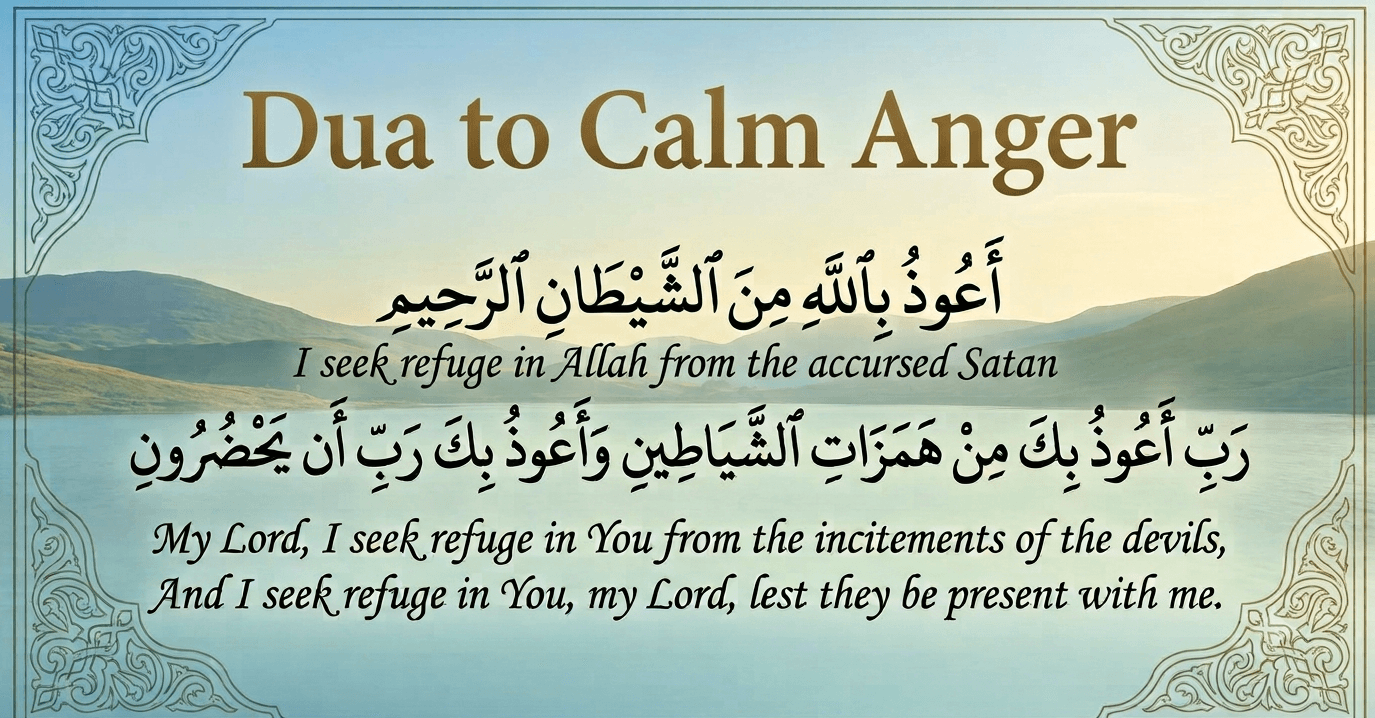
Dua to Calm Anger in Arabic with English translation, transliteration, meaning, benefits, Quran references, and practical guidance for controlling anger according to Islam.
Estimated reading time: 6 minutes
Table of contents
- Dua to Calm Anger
- Dua to Calm Anger (Arabic, Transliteration, Translation)
- When to Recite Dua to Calm Anger?
- How to Recite Dua to Calm Anger?
- Importance of Dua to Calm Anger in Islam
- Quran & Hadith About Dua to Calm Anger
- Rewards of Reciting Dua to Calm Anger
- Common Mistakes Related to Dua to Calm Anger
- Key Takeaways
- Conclusion
- FAQs
Dua to Calm Anger
Anger is a natural human emotion, but Islam teaches believers to control it with patience, remembrance of Allah, and sincere supplication. Prophet Muhammad ﷺ advised Muslims not to become angry and taught several duas that help calm the heart and protect a person from the whispers of Shaytan. The Dua to Calm Anger is among the most beneficial supplications because it combines seeking Allah’s protection from Shaytan with asking Him to keep evil influences away.
| Name | Dua to Calm Anger |
| Meaning | Supplication for Protection from Anger and Shaytan |
| Source | Authentic Hadith & Quran (Surah Al-Mu’minun 23:97–98) |
| Main Theme | Seeking Allah’s Protection, Controlling Anger, and Avoiding Shaytan’s Whispers |
| Recited When | During anger, frustration, arguments, or whenever seeking protection from Shaytan |
| Related Quran Verses | Surah Al-Mu’minun (23:97–98) |
Dua to Calm Anger (Arabic, Transliteration, Translation)
| Arabic | أَعُوذُ بِاللّٰهِ مِنَ الشَّيْطَانِ الرَّجِيمِ |
| English Transliteration | A‘oodhu billaahi minash shaytaanir-rajeem. |
| English Translation | I seek refuge in Allah from the accursed Satan. |
| Arabic | رَّبِّ أَعُوذُ بِكَ مِنْ هَمَزَاتِ الشَّيَاطِينِ وَأَعُوذُ بِكَ رَبِّ أَنْ يَحْضُرُونِ |
| English Transliteration | Rabbi a‘oodhu bika min hamazaatish shayaateen. Wa a‘oodhu bika Rabbi an yahduroon. |
| English Translation | My Lord, I seek refuge in You from the incitements of the devils, and I seek refuge in You, my Lord, lest they be present with me. |
When to Recite Dua to Calm Anger?
The Dua to Calm Anger should be recited whenever a person feels anger beginning to rise or fears losing control over their words and actions. The Prophet Muhammad ﷺ taught that anger often comes from Shaytan, so remembering Allah and seeking His protection is one of the best ways to calm the heart.
You may also recite this dua during family disagreements, workplace conflicts, stressful situations, moments of frustration, or whenever you experience disturbing thoughts. Making this supplication a regular habit helps develop patience, self-control, and reliance upon Allah.
How to Recite Dua to Calm Anger?
Reciting the Dua to Calm Anger with sincerity and mindfulness helps believers control their emotions and remember Allah during difficult moments.
Reciting the Dua to Calm Anger with sincerity and mindfulness helps believers control their emotions and remember Allah during difficult moments.
- Recognize your anger.
As soon as you notice yourself becoming angry, pause before reacting.
- Recite both duas slowly.
Seek Allah’s protection from Shaytan with sincerity and concentration.
- Lower your voice.
Avoid shouting, arguing, or speaking hurtful words while reciting.
- Follow the Sunnah.
Sit down if standing, or lie down if the anger continues.
- Perform wudu if possible.
The Prophet ﷺ recommended ablution because anger is from fire.
- Ask Allah for patience.
Continue making dhikr until your heart becomes calm.
Regular practice of this dua trains believers to respond with patience instead of reacting with anger, leading to stronger faith and better relationships.
Importance of Dua to Calm Anger in Islam
Islam encourages believers to control their emotions, especially anger, because uncontrolled anger can lead to sinful speech and actions. The Dua to Calm Anger reminds Muslims to seek Allah’s protection instead of reacting emotionally. It strengthens patience, increases reliance upon Allah, and helps believers avoid the whispers of Shaytan.
By making this dua during moments of frustration, Muslims acknowledge that true strength lies in self-control rather than overpowering others. Remembering Allah at such times brings peace to the heart and protects relationships from unnecessary conflict.
Quran & Hadith About Dua to Calm Anger
Allah commands believers to seek His protection from Shaytan in the Quran:
“And say: My Lord, I seek refuge in You from the incitements of the devils. And I seek refuge in You, my Lord, lest they be present with me.”
(Surah Al-Mu’minun 23:97–98)
The Prophet Muhammad ﷺ also saw a man become angry and said that if he recited:
“A‘oodhu billaahi minash shaytaanir-rajeem.”
his anger would leave him. This authentic guidance teaches Muslims to seek Allah’s protection whenever anger begins to overcome them.
Rewards of Reciting Dua to Calm Anger
- Helps control anger through remembrance of Allah.
- Protects from the whispers and influence of Shaytan.
- Brings peace and tranquility to the heart.
- Strengthens patience and self-control.
- Follows the Sunnah of Prophet Muhammad ﷺ.
- Prevents sinful speech and harmful actions.
- Improves relationships by reducing unnecessary arguments.
- Increases trust and reliance upon Allah.
- Encourages regular dhikr throughout the day.
- Earns reward for remembering Allah during difficult moments.
Common Mistakes Related to Dua to Calm Anger
- Waiting until anger becomes uncontrollable before remembering Allah.
- Reciting the dua without understanding its meaning.
- Continuing to argue immediately after making the dua.
- Ignoring other Sunnah practices such as changing posture or making wudu.
- Thinking the dua alone is enough without sincerely trying to control one’s behavior.
- Forgetting to teach children this important Sunnah supplication.
Key Takeaways
- The Dua to Calm Anger consists of authentic supplications from the Quran and Sunnah.
- It seeks Allah’s protection from Shaytan and his whispers.
- It should be recited whenever anger begins to arise.
- The dua encourages patience, wisdom, and self-control.
- Following the Sunnah helps reduce anger quickly.
- Regular recitation strengthens faith and reliance upon Allah.
- Understanding the meaning makes the dua more impactful.
- Teaching this dua to children helps build good Islamic character.
Conclusion
The Dua to Calm Anger is one of the most valuable supplications a Muslim can learn for everyday life. By seeking Allah’s protection from Shaytan and asking Him to remove harmful influences, believers develop patience, wisdom, and emotional control. Making this dua a regular habit helps strengthen faith, protect relationships, and follow the beautiful guidance of the Quran and Sunnah.
FAQs
The Dua to Calm Anger is an authentic supplication that seeks Allah’s protection from Shaytan and helps believers control their emotions.
The Dua to Calm Anger should be recited whenever a person feels angry, frustrated, or fears acting upon Shaytan’s whispers.
Yes. Part of the Dua to Calm Anger comes from Surah Al-Mu’minun (23:97–98), while seeking refuge from Shaytan is also taught in authentic Hadith.
Yes. The Dua to Calm Anger is short, easy to memorize, and beneficial for Muslims of all ages.
The Dua to Calm Anger helps control emotions, protects against Shaytan, strengthens patience, and encourages remembrance of Allah during difficult situations.
- Quran — Complete Guide to the Holy Book of Islam
- Dua for Protection from Evil Thoughts in Arabic with English translation, transliteration,
- Dua When Something You Dislike Happens in Arabic with English translation, transliteration
- Dua for Not Getting Sleep in Arabic with English translation, transliteration, meaning,
- Dua for Islamic New Year in Arabic with English translation, transliteration, meaning,