
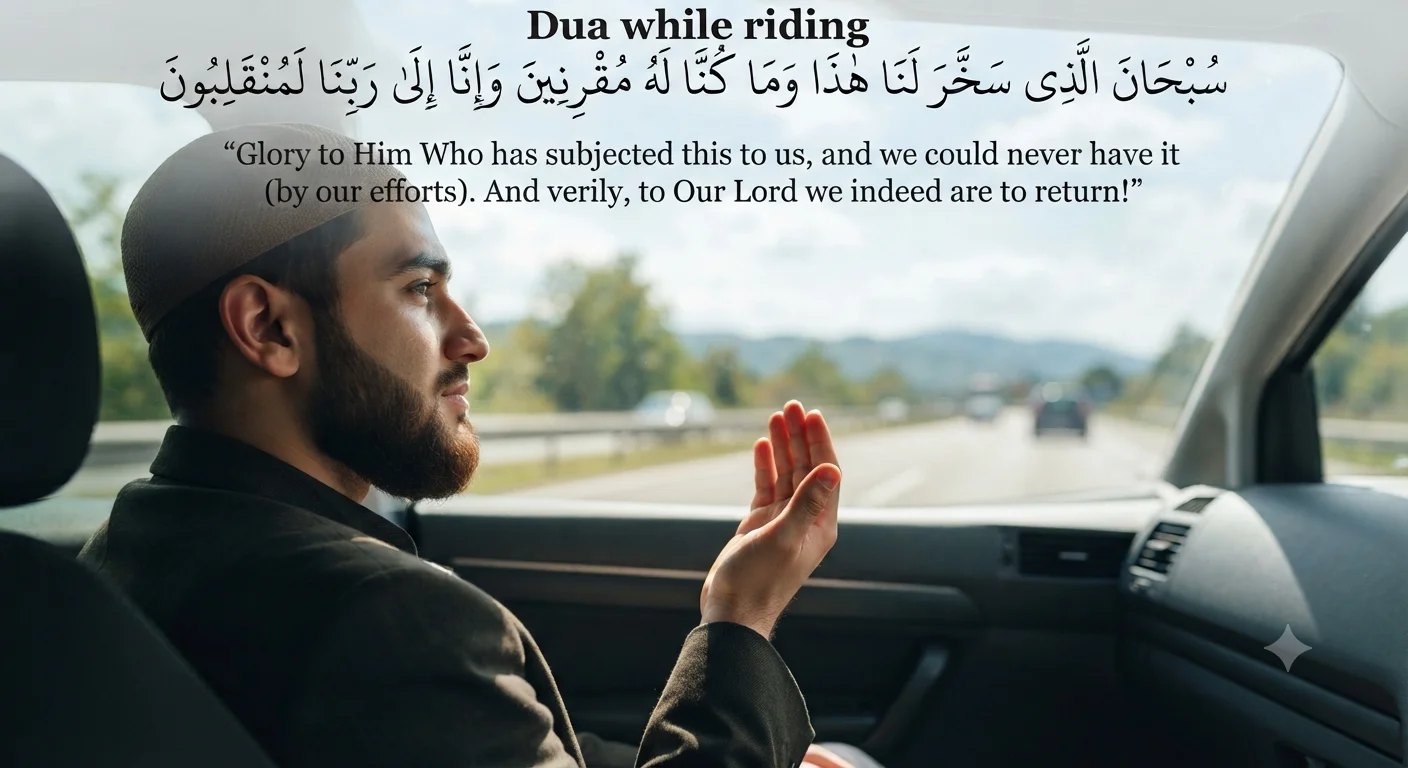
Dua While Riding in Arabic with English Transliteration, Translation & Benefits
Estimated reading time: 8 minutes
Table of contents
Dua While Riding in Arabic with English Transliteration, Translation & Benefits
Dua While Riding is an authentic Sunnah supplication recited after boarding or riding any vehicle. The Prophet Muhammad (ﷺ) would first say “Bismillah” and then recite the Qur’anic dua from Surah Az-Zukhruf (43:13–14). These duas remind Muslims to begin every journey with the name of Allah, thank Him for the blessing of transportation, and remember that every journey in this world ultimately ends with our return to Him.
Information About This Dua
| Topic | Dua While Riding |
|---|---|
| Occasion | After boarding or while riding any vehicle. |
| First Supplication | Bismillah (In the name of Allah) |
| Second Supplication | Qur’anic Riding Dua (Surah Az-Zukhruf 43:13–14) |
| Sources | Qur’an (43:13–14), Sahih Muslim, Sunan Abi Dawud (5096) |
| Purpose | To begin with Allah’s name, thank Him for transportation, and seek His blessings during travel. |
Dua While Riding in Arabic, English Transliteration & English Translation
| First Dua (Arabic) | بِسْمِ اللَّهِ |
|---|---|
| English Transliteration | Bismillah. |
| English Translation | In the name of Allah. |
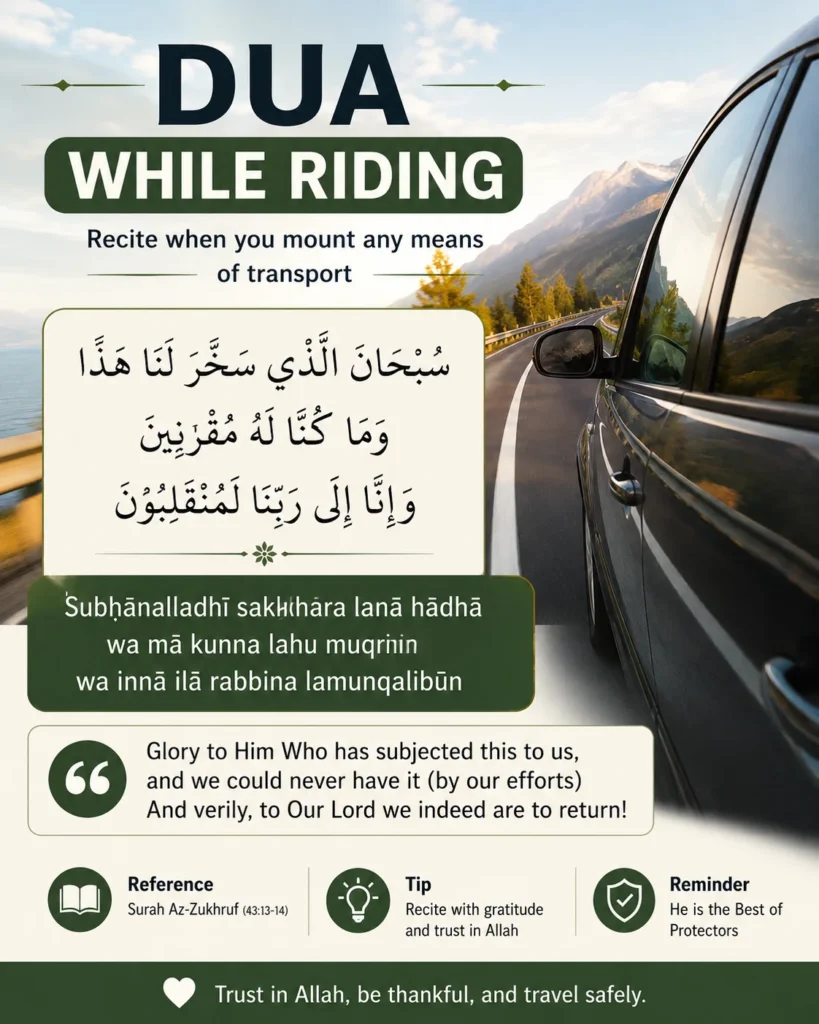
| Second Dua (Arabic) | سُبْحَانَ الَّذِي سَخَّرَ لَنَا هَذَا وَمَا كُنَّا لَهُ مُقْرِنِينَ وَإِنَّا إِلَىٰ رَبِّنَا لَمُنقَلِبُونَ |
| English Transliteration | Subhanal-ladhi sakhkhara lana hadha wa ma kunna lahu muqrinin, wa inna ila Rabbina lamunqalibun. |
| English Translation | Glory is to Him Who has subjected this for us, though we could never have accomplished it ourselves. Surely, to our Lord we will return. |
Hadith Reference
- First Dua (Bismillah): Sunan Abi Dawud (Hadith 5096)
- Second Dua: Qur’an – Surah Az-Zukhruf (43:13–14)
- Sunnah Practice: Sahih Muslim – Abdullah ibn Umar (RA) reported that the Prophet Muhammad (ﷺ) would say “Bismillah”, glorify Allah, and recite these Qur’anic verses when mounting his ride.
Authenticity
Both supplications of the Dua While Riding are authentic. The first dua, “Bismillah”, is established in the Sunnah, while the second supplication is taken directly from Surah Az-Zukhruf (43:13–14) and was regularly recited by Prophet Muhammad (ﷺ) when beginning a journey. These duas are authentic for every Muslim to recite before and while traveling.
Word-by-Word Meaning
| Arabic | Meaning |
|---|---|
| بِسْمِ | In the name of |
| اللَّهِ | Allah |
| سُبْحَانَ | Glory be to |
| الَّذِي | The One Who |
| سَخَّرَ | Has subjected |
| لَنَا | For us |
| هَذَا | This |
| وَمَا | And not |
| كُنَّا | Were we |
| لَهُ مُقْرِنِينَ | Able to control it |
| وَإِنَّا | Indeed we |
| إِلَىٰ رَبِّنَا | To our Lord |
| لَمُنقَلِبُونَ | Will surely return |
Explanation / Meaning
The Dua While Riding consists of two authentic supplications taught in Islam. The first dua, “Bismillah”, means “In the name of Allah.” By saying it, a Muslim begins the journey with Allah’s name, seeking His blessings, protection, and guidance. It reminds us that every action should start with the remembrance of Allah.
After saying Bismillah, Muslims recite the Qur’anic supplication from Surah Az-Zukhruf (43:13–14). In this dua, we glorify Allah for making transportation possible and acknowledge that without His help, we would never have been able to control or benefit from it. The final words remind us that every worldly journey eventually ends with our return to Allah. Together, these duas strengthen faith, gratitude, humility, and complete reliance upon Allah while traveling.
When to Recite This Dua
The Dua While Riding should be recited immediately after boarding or while riding any lawful means of transportation. First say Bismillah, then recite the Qur’anic riding supplication as taught by Prophet Muhammad (ﷺ).
- After sitting inside a car.
- While riding a motorcycle, scooter, or bicycle.
- After boarding a bus or train.
- After taking your seat on an airplane.
- While traveling by boat or ship.
- During family trips, vacations, business travel, Hajj, or Umrah.
- Whenever beginning any lawful journey by vehicle.
Importance of This Dua in Islam
The Dua While Riding teaches Muslims to remember Allah whenever they travel. Beginning with Bismillah and then praising Allah for the blessing of transportation strengthens a believer’s connection with their Creator and brings barakah to the journey.
This dua also reminds us that no matter how advanced our vehicles become, true safety and success come only from Allah. It encourages gratitude, humility, and trust in Allah while reminding believers that every journey in this world ultimately ends with returning to Him.
Hadith About This Dua
Ali ibn Rabiah (RA) narrated that he saw Ali ibn Abi Talib (RA) bring an animal to ride. When he placed his foot in the stirrup, he said:
“Bismillah.”
After sitting upon it, he praised Allah and recited:
“Subhanal-ladhi sakhkhara lana hadha wa ma kunna lahu muqrinin. Wa inna ila Rabbina lamunqalibun.”
Sunan Abi Dawud (5096)
Abdullah ibn Umar (RA) also reported that Prophet Muhammad (ﷺ) recited these Qur’anic verses when mounting his ride to begin a journey, as recorded in Sahih Muslim. This confirms that both supplications are part of the authentic Sunnah.
Benefits of Reciting This Dua
- Begins Every Journey with Allah’s Name: Saying Bismillah brings blessings to every ride.
- Expresses Gratitude: The Qur’anic dua thanks Allah for providing transportation.
- Strengthens Tawakkul: It increases reliance upon Allah for safety and success.
- Revives an Authentic Sunnah: Reciting these duas follows the practice of Prophet Muhammad (ﷺ).
- Encourages Daily Dhikr: It keeps the remembrance of Allah alive during travel.
- Promotes Humility: It reminds believers that every blessing comes only from Allah.
- Reminds Us of the Hereafter: Every journey becomes a reminder that we will eventually return to our Lord.
- Suitable for Every Mode of Transport: These duas can be recited while traveling by car, motorcycle, bicycle, bus, train, airplane, or boat.
Lessons We Learn from This Dua
- Begin Every Journey with Allah’s Name: Saying Bismillah teaches us to start every action by remembering Allah.
- Be Thankful for Transportation: Every vehicle we use is a blessing from Allah and deserves our gratitude.
- Trust Allah for Safety: Although we use modern vehicles, true protection comes only from Allah.
- Follow the Sunnah: Reciting these duas revives the beautiful practice of Prophet Muhammad (ﷺ).
- Stay Humble: The dua reminds us that without Allah, we would never have the ability to travel.
- Remember the Hereafter: Every journey in this world reminds us that we will ultimately return to Allah.
- Increase Daily Dhikr: Remembering Allah during travel brings peace to the heart and strengthens faith.
- Teach Your Family: Parents should encourage children to recite these authentic duas before and while riding.
Common Mistakes to Avoid
- Forgetting to say Bismillah before beginning the ride.
- Skipping the Qur’anic riding dua after boarding the vehicle.
- Reciting the dua without understanding its meaning.
- Depending only on the vehicle instead of trusting Allah.
- Rushing through the Arabic words without trying to pronounce them correctly.
- Thinking the dua replaces following traffic rules and safety precautions.
- Reciting the dua only for long-distance travel and ignoring daily journeys.
How to Recite This Dua
The Dua While Riding should be recited immediately after boarding your vehicle. Begin by saying “Bismillah”, then recite the Qur’anic riding supplication from Surah Az-Zukhruf (43:13–14). Recite both duas calmly while reflecting on Allah’s blessings and placing your trust in Him for a safe and successful journey.
- Step 1: Board the Vehicle
After entering or sitting on your vehicle, pause for a moment before starting your journey.
- Step 2: Say “Bismillah”
Begin by saying Bismillah, asking Allah to bless and protect your journey from the very beginning.
- Step 3: Recite the Riding Dua
Recite “Subhanal-ladhi sakhkhara lana hadha wa ma kunna lahu muqrinin, wa inna ila Rabbina lamunqalibun” while reflecting on Allah’s blessings and His power.
- Step 4: Travel with Tawakkul
Place your complete trust in Allah while also following all safety measures and traffic regulations during your journey.
- Step 5: Make It a Daily Habit
Recite these authentic duas every time you ride a vehicle and teach them to your family so they become part of your daily Sunnah.
Conclusion
The Dua While Riding combines two authentic supplications that every Muslim should make a habit of reciting before and during travel. By saying Bismillah and then reciting the Qur’anic riding dua, believers begin their journey with the remembrance of Allah, thank Him for the blessing of transportation, and place their trust in Him for protection. Whether traveling a short distance or a long journey, these duas help transform every ride into an act of worship.
Frequently Asked Questions (FAQs)
The Dua While Riding consists of two authentic supplications: first saying Bismillah, followed by the Qur’anic riding dua from Surah Az-Zukhruf (43:13–14).
You should recite the Dua While Riding immediately after boarding or while riding any vehicle, including a car, motorcycle, bus, train, airplane, bicycle, or boat.
Yes. The Dua While Riding is authentic. Bismillah is reported in Sunan Abi Dawud (5096), while the riding supplication comes from Surah Az-Zukhruf (43:13–14) and is also mentioned in Sahih Muslim.
Yes. The Dua While Riding should be recited for both short and long journeys whenever you travel by any lawful means of transportation.
The Dua While Riding helps Muslims remember Allah, express gratitude for transportation, strengthen their trust in Him, seek His blessings, and follow the Sunnah of Prophet Muhammad (ﷺ).
- Dua Before Riding in Arabic with Transliteration, Translation & Benefits
- Dua for Travelling in Arabic With Transliteration, Translation & Benefits
- Dua When Bidding Someone Farewell in Arabic, English Translation, Transliteration & Meaning
- Dua for Islamic New Year in Arabic with English translation, transliteration, meaning, importance, authenticity, benefits and FAQs.
- Dua for Not Getting Sleep in Arabic with English translation, transliteration, meaning, benefits, and authentic Sunnah guidance.