
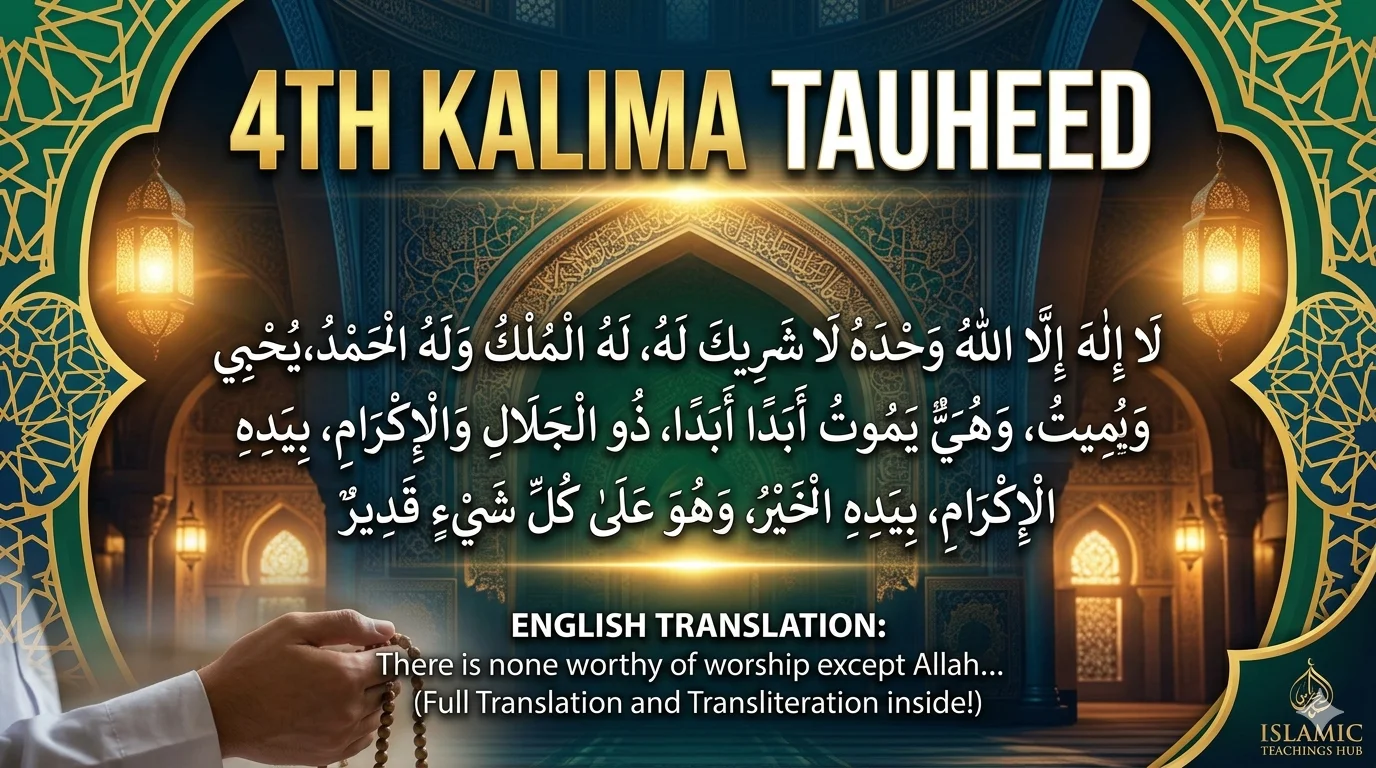
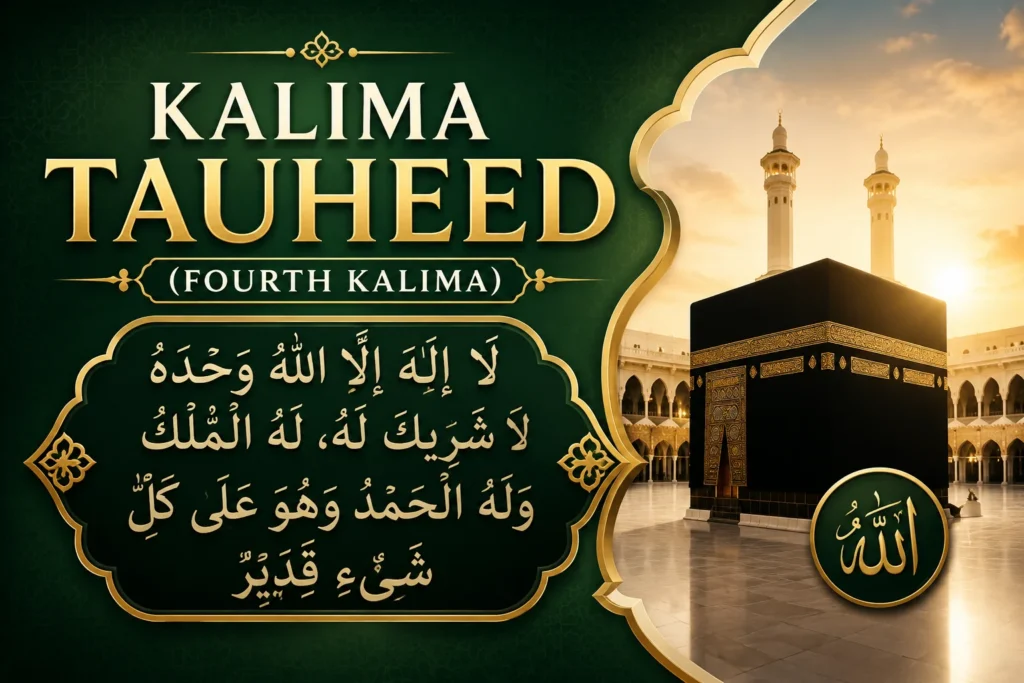
Kalima Tauheed (Fourth Kalima) in Arabic with English translation, transliteration, tafseer, benefits & lessons.
Kalima Tauheed 4 (Fourth Kalima)
| Kalima Number | 4 |
| Name | Kalima Tauheed (Oneness of Allah) |
| Meaning | Declaration of Allah’s Oneness and Absolute Power |
| Origin | Derived from Quran and Authentic Hadith |
| Total Lines | 1 |
| Main Theme | Tawheed, Allah’s Power, Life, Death & Sovereignty |
4th Kalima Tauheed (Arabic, Transliteration, Translation)
| لَا إِلٰهَ إِلَّا اللّٰهُ وَحْدَهُ لَا شَرِيكَ لَهُ لَهُ الْمُلْكُ وَلَهُ الْحَمْدُ يُحْيِي وَيُمِيتُ وَهُوَ حَيٌّ لَا يَمُوتُ أَبَدًا أَبَدًا ذُوالْجَلَالِ وَالْإِكْرَامِ بِيَدِهِ الْخَيْرُ وَهُوَ عَلَىٰ كُلِّ شَيْءٍ قَدِيرٌ |
| Laa ilaaha illal-laahu wahdahoo laa shareeka lah, lahul mulku wa lahul hamdu yuhyee wa yumeetu wa huwa hayyul laa yamootu abadan abadaa, zul jalaali wal ikraam, biyadihil khair, wa huwa ‘alaa kulli shay’in qadeer |
| There is no god but Allah, alone without partner. His is the kingdom and for Him is all praise. He gives life and causes death. He is Ever-Living and never dies. Possessor of Majesty and Honor. In His hand is all goodness, and He has power over everything. |
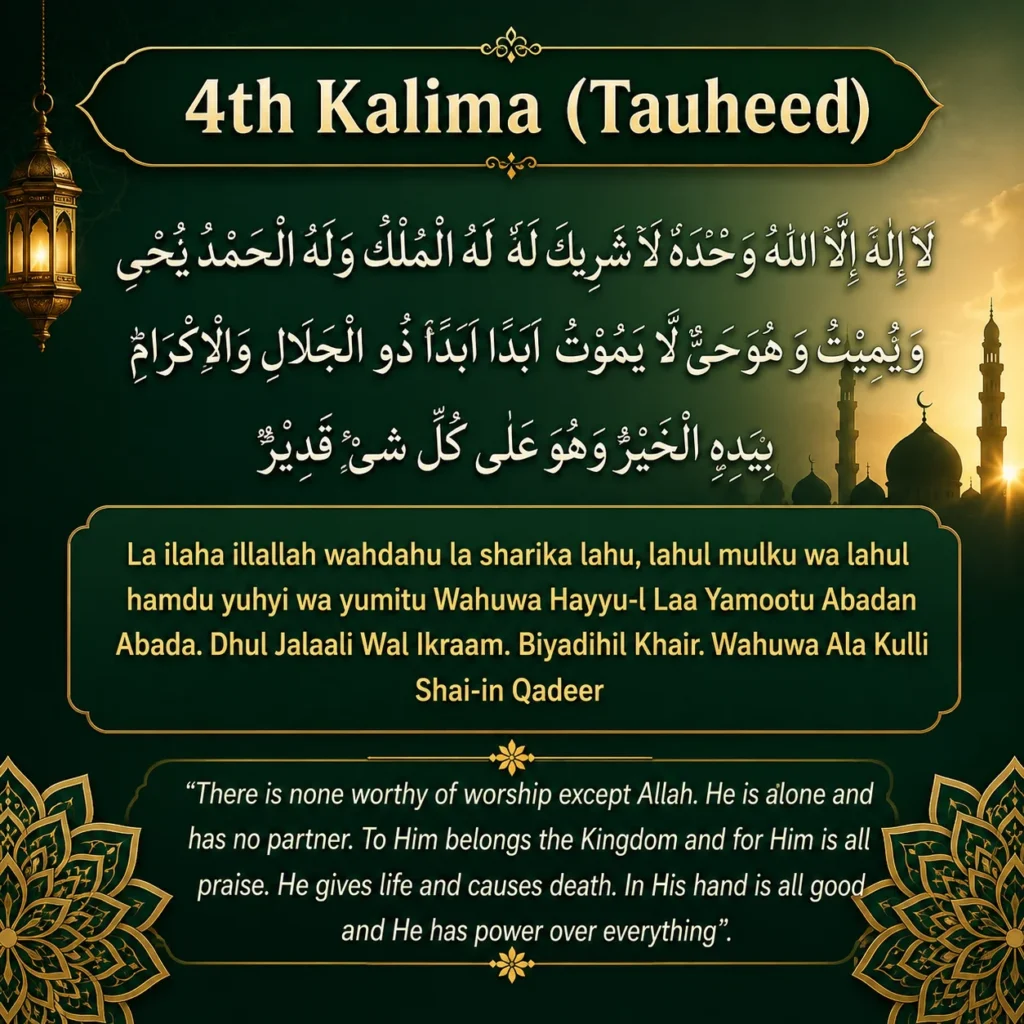
Full Kalima 4 English Transliteration
(4) Laa ilaaha illal-laahu wahdahoo laa shareeka lah, lahul mulku wa lahul hamdu yuhyee wa yumeetu wa huwa hayyul laa yamootu abadan abadaa, zul jalaali wal ikraam, biyadihil khair, wa huwa ‘alaa kulli shay’in qadeer
Full Kalima 4 English Translation
(4) There is no god but Allah, alone without partner. His is the kingdom and for Him is all praise. He gives life and causes death. He is Ever-Living and never dies. Possessor of Majesty and Honor. In His hand is all goodness, and He has power over everything.
Tafseer (Ibn Kathir – Detailed Explanation)
Kalima Tauheed is one of the most comprehensive declarations about Allah’s greatness, authority, and absolute control over creation. According to Tafseer Ibn Kathir, this Kalima deeply explains the meaning of Tawheed and strengthens a believer’s understanding of Allah’s attributes.
The phrase “Laa ilaaha illal-laahu wahdahoo laa shareeka lah” confirms that Allah alone deserves worship and that He has no partner in His lordship, worship, or attributes. Ibn Kathir explains that this statement destroys every form of shirk and establishes pure monotheism.
“Lahul mulku wa lahul hamd” means that the entire kingdom of the heavens and earth belongs to Allah alone, and all praise belongs to Him. Every blessing, success, and favor comes from Him.
The words “Yuhyee wa yumeet” remind believers that Allah alone gives life and causes death. No human has control over life except by Allah’s permission. This creates humility and complete dependence on Him.
“Wa huwa hayyul laa yamoot” describes Allah as the Ever-Living who never dies. Ibn Kathir explains that all creation will perish, but Allah remains forever without beginning or end.
The phrase “Zul jalaali wal ikraam” highlights Allah’s majesty, honor, and greatness. He deserves the highest respect, love, and obedience.
“Biyadihil khair” teaches that all goodness is in Allah’s hand. Wealth, health, guidance, mercy, and success all come from Him alone.
The ending phrase “Wa huwa ‘alaa kulli shay’in qadeer” emphasizes Allah’s complete power over everything. Nothing is impossible for Him, and His control covers all creation.
Benefits & Lessons
1. Strengthens Tawheed
This Kalima deeply reinforces belief in Allah’s Oneness and removes all forms of shirk from the heart.
2. Increases Reliance on Allah
Knowing that life, death, power, and goodness are in Allah’s hands increases trust and dependence on Him.
3. Brings Inner Peace
Believers feel peace knowing Allah controls every matter and nothing happens without His wisdom.
4. Removes Fear of Creation
Understanding Allah’s supreme authority helps believers fear Allah alone instead of people.
5. Encourages Gratitude
Since all blessings come from Allah, this Kalima teaches thankfulness and appreciation.
6. Builds Humility
Humans realize they have no independent power, making them humble before Allah.
7. Strengthens Hope
Allah’s power over everything gives believers hope even in difficult situations.
8. Increases Love for Allah
Reflecting on Allah’s mercy, greatness, and blessings increases love and closeness to Him.
9. Encourages Daily Dhikr
Reciting this Kalima regularly keeps the heart connected with Allah.
10. Leads to Success in Hereafter
Sincere belief in Tawheed is the key to salvation and eternal success.
FAQs
It is the fourth Kalima emphasizing Allah’s Oneness, power, and authority.
It means Allah has no partner in worship, power, or authority.
It means the entire kingdom belongs to Allah alone.
Because Allah is Ever-Living and never dies.
It teaches that all goodness and blessings are from Allah.
Yes, Muslims are encouraged to remember Allah through daily recitation.
The main message is complete Tawheed and Allah’s absolute control.
Yes, reflecting on its meanings strengthens belief and certainty.
Yes, its meanings are directly connected to Quran and Hadith.
Because it is the foundation of all Islamic beliefs and worship.