

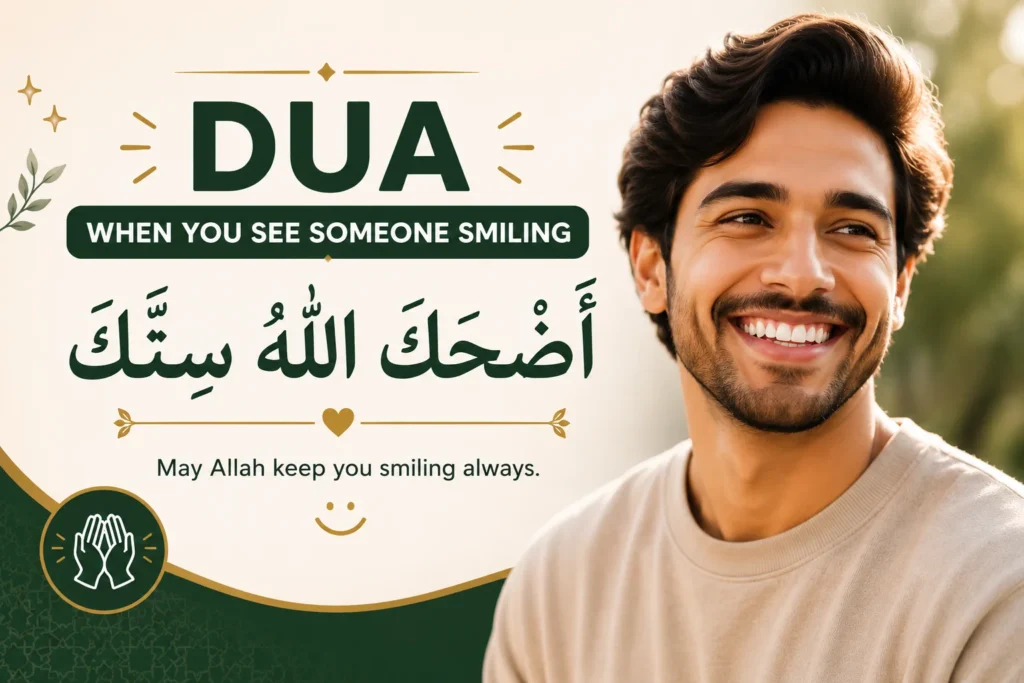
Dua when you see someone Happy and Smiling
| Name | Adhakal-lahu Sinnaka |
| Meaning | May Allah Keep You Smiling |
| Language | Arabic |
| Source | Mentioned in the context of an authentic Hadith (Sahih al-Bukhari) |
| Total Lines | 1 |
| Main Theme | Supplication for Happiness, Joy, and Allah’s Blessings |
| Common Occasion | When praying for someone’s happiness or expressing a kind Islamic supplication |
Adhakal-lahu Sinnaka in Arabic, Transliteration & English Translation
| أَضْحَكَ اللَّهُ سِنَّكَ |
| Adhakal-laahu sinnaka |
| May Allah keep you smiling. |
What Does Adhakal-lahu Sinnaka Mean?
Adhakal-lahu Sinnaka is a beautiful Arabic supplication that literally means “May Allah make your teeth visible through smiling.” In Arabic, showing one’s teeth is an expression for smiling, so the intended meaning is “May Allah keep you happy and smiling.”
This short dua expresses sincere love, kindness, and a prayer that Allah blesses another person with happiness, joy, and pleasant moments in life. It reflects the Islamic values of spreading goodness and making dua for fellow Muslims.
Hadith Context of Adhakal-lahu Sinnaka
The phrase “Adhakal-lahu Sinnaka” appears in the context of an authentic narration recorded in Sahih al-Bukhari (Hadith 6085). During an incident involving one of the Companions, the Prophet Muhammad ﷺ used these words as a supplication.
Importance of Adhakal-lahu Sinnaka in Islam
Islam encourages Muslims to spread kindness, happiness, and sincere prayers for one another. One of the beautiful ways of doing this is through supplications that ask Allah to bless another person with goodness and joy. The phrase Adhakal-lahu Sinnaka reflects this noble character by expressing a heartfelt prayer that Allah keeps someone smiling and grants them happiness.
Although this expression appears in an authentic Hadith, Islamic scholars explain that it should be understood within its context. It is a beautiful supplication that may be said as a prayer for someone’s happiness.
This dua also reminds Muslims to make positive supplications for others instead of speaking words that may hurt or discourage them. Islam teaches believers to spread love, mercy, and kindness through both actions and words.
When Can You Say Adhakal-lahu Sinnaka?
You may say Adhakal-lahu Sinnaka as a sincere dua for someone whenever you wish to pray for their happiness and well-being. Since it is a general supplication, there is no restriction on the occasion.
- When someone is smiling or cheerful.
- When wishing happiness for a family member or friend.
- As a kind Islamic greeting during a pleasant conversation.
- While praying that Allah grants someone lasting joy.
- When encouraging someone who has recently experienced happiness or success.
Lessons from the Hadith Context
The Hadith teaches Muslims several valuable manners. One lesson is that making dua for others is an act of kindness and love. Instead of jealousy or negative speech, believers are encouraged to ask Allah to bless others.
Another important lesson is that the Prophet Muhammad ﷺ always chose beautiful words that spread mercy and comfort. His speech strengthened relationships and encouraged good character among the Companions.
Rewards of Making Dua for Others
- Making sincere dua for fellow Muslims is an act of worship.
- It strengthens love, unity, and brotherhood among believers.
- It reflects the noble character taught by Prophet Muhammad ﷺ.
- It spreads kindness and positive speech within the community.
- Praying for others without expecting anything in return is highly virtuous.
- According to authentic Hadith, when a believer sincerely prays for another Muslim in their absence, the angels say, “Ameen, and the same for you.”
- It encourages compassion and removes feelings of envy.
- Good supplications strengthen relationships among family and friends.
- Speaking beautiful words earns reward and pleases Allah.
- Regularly making dua for others develops a caring and generous heart.
Key Takeaways
- Adhakal-lahu Sinnaka means “May Allah keep you smiling.”
- It is mentioned in the context of an authentic narration in Sahih al-Bukhari.
- It is a beautiful supplication for another person’s happiness and well-being.
- It should not be presented as a fixed Sunnah dua specifically for seeing someone smile.
- Making sincere dua for fellow Muslims is encouraged throughout Islam.
- Kind words and sincere prayers strengthen love and unity among believers.
Conclusion
Adhakal-lahu Sinnaka is a beautiful Arabic supplication that means “May Allah keep you smiling.” It appears in the context of an authentic Hadith and reflects the Islamic manners of making sincere prayers for others. While it is not a fixed Sunnah dua prescribed for every occasion of seeing someone smile, it remains a meaningful way to ask Allah to bless another person with happiness, joy, and well-being. Understanding its authentic context helps Muslims practice and share Islamic teachings accurately while spreading kindness through beautiful words and sincere supplications.
FAQs
What is Adhakal-lahu Sinnaka?
Adhakal-lahu Sinnaka is an Arabic supplication that means “May Allah keep you smiling.”
Is Adhakal-lahu Sinnaka mentioned in Hadith?
Yes. The phrase appears in the context of an authentic narration recorded in Sahih al-Bukhari.
When can Adhakal-lahu Sinnaka be said?
It may be said as a sincere dua for someone’s happiness and well-being, but it is not a prescribed Sunnah for every smiling person.
What does Adhakal-lahu Sinnaka mean in English?
It means “May Allah keep you smiling” or “May Allah always make you smile.”
Why is Adhakal-lahu Sinnaka important?
It teaches kindness, making dua for others, and understanding authentic Hadith within its proper context.
- Dua for Islamic New Year in Arabic with English translation, transliteration, meaning, importance, authenticity, benefits and FAQs.
- Dua When Something Happens You Like in Arabic with English translation, transliteration, meaning, benefits and FAQs.
- Dua for Breaking Fast in Arabic with English translation, transliteration, benefits, lessons, hadith, and FAQs.
- Dua Before Sleeping in Arabic with English translation, transliteration, meaning, benefits, Hadith and FAQs.
- Dua Before Drinking Milk in Arabic with English translation, transliteration, meaning, benefits, lessons, and FAQs.