
As Samad – The Eternal Refuge | Meaning, Quran, Hadith & Benefits
Table of contents
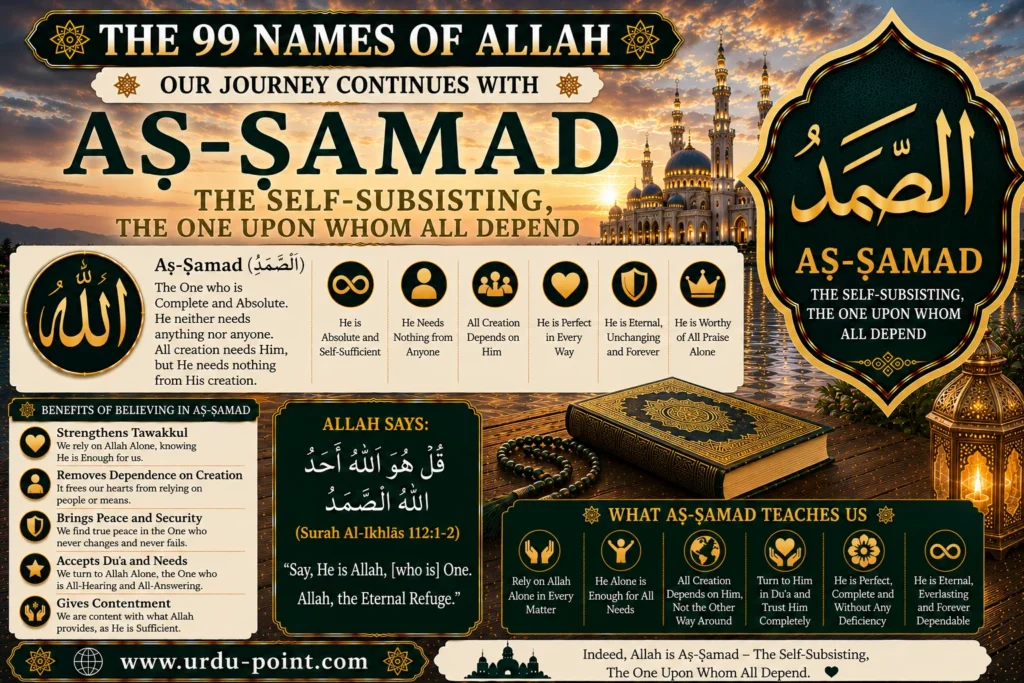
As-Samad (ٱلصَّمَدُ) means “The Eternal Refuge,” “The Self-Sufficient,” and the One upon whom all creation depends. Allah is perfect, independent, and free of all need, while every created being is dependent upon Him.
As Samad – The Eternal Refuge | Meaning, Quran, Hadith & Benefits
Quick Answer: As-Samad refers to Allah as the One who is perfect, self-sufficient, and sought by His creation for their needs. He has no need for anyone, while all creation depends upon Him.
Introduction
The Beautiful Name As-Samad reminds believers that Allah is completely independent and that every created being depends upon Him.
When people face difficulties or have important needs, they turn to Allah. He is the One who provides, protects, guides, and answers the needs of His servants according to His perfect wisdom.
Understanding As-Samad strengthens reliance upon Allah and teaches believers not to place ultimate dependence on creation. It also encourages humility because every blessing ultimately comes from Allah.
Quick Facts About As-Samad
| Name | As-Samad (ٱلصَّمَدُ) |
|---|---|
| English Meaning | The Eternal Refuge; The Self-Sufficient; The One upon whom all depend |
| Arabic Root | ص-م-د (Ṣ-M-D) |
| Root Meaning | To turn toward, seek, intend, or rely upon one who is enduring and sufficient. |
| Qur’anic Status | As-Samad is explicitly mentioned in the Qur’an in Surah Al-Ikhlas. |
| Related Name | Al-Ghaniyy – The Self-Sufficient; Al-Qayyum – The Sustainer of all existence. |
| Main Attribute | Allah is completely independent, perfect, and free of all need, while all creation depends upon Him. |
| Main Lesson | Turn to Allah for your needs, rely upon Him, and remember that ultimate dependence belongs to Him alone. |
Arabic Script, Transliteration & Pronunciation
| Arabic | ٱلصَّمَدُ |
|---|---|
| English Transliteration | As-Samad |
| Pronunciation | As-Sa-mad |
| Literal Meaning | The Eternal Refuge; The Self-Sufficient; The One upon whom all depend |
| Arabic Root | ص-م-د (Ṣ-M-D) |
Detailed Meaning in English.
The Beautiful Name As-Samad comes from the Arabic root ص-م-د, which is associated with turning toward, seeking, and depending upon someone. In relation to Allah, it conveys the profound meaning that He is the One whom creation turns to for its needs and the One who is completely free of need.
Allah is perfect and independent. He does not depend upon food, rest, assistance, or anything else, while every created being depends upon Him. All provision, strength, protection, and support ultimately come from Allah.
As-Samad also teaches believers where their ultimate reliance should be placed. People may help one another, and Islam encourages taking lawful means, but the heart should recognize that Allah alone is the ultimate source of help and provision.
This Name is especially powerful when understood through Surah Al-Ikhlas. Allah describes Himself as As-Samad after declaring His absolute oneness, emphasizing His perfection, independence, and uniqueness.
As-Samad Meaning in English, Urdu & Hindi.
| English | Urdu | Hindi |
|---|---|---|
| The Eternal Refuge; The Self-Sufficient; The One upon whom all depend. | بے نیاز، سب کی حاجتیں پوری کرنے والا، وہ ذات جس کی طرف سب رجوع کرتے ہیں | बे-नियाज़, सबकी ज़रूरतें पूरी करने वाला, वह जिसकी ओर सब रुख करते हैं |
| Allah is completely independent and free from every need. | اللہ تعالیٰ ہر ضرورت سے بے نیاز اور مکمل طور پر خود کفیل ہے۔ | अल्लाह हर ज़रूरत से बेनियाज़ और पूरी तरह आत्मनिर्भर है। |
| All creation depends upon Allah for existence, provision, protection, and support. | تمام مخلوقات اپنے وجود، رزق، حفاظت اور مدد کے لیے اللہ کی محتاج ہیں۔ | सारी मख़लूक़ अपने अस्तित्व, रोज़ी, सुरक्षा और मदद के लिए अल्लाह की मोहताज है। |
| As-Samad teaches believers to turn to Allah with their needs and rely upon Him. | الصمد مومن کو اپنی حاجات کے لیے اللہ کی طرف رجوع کرنے اور اسی پر بھروسہ کرنے کی تعلیم دیتا ہے۔ | अस-समद मोमिन को अपनी ज़रूरतों के लिए अल्लाह की ओर रुख करने और उसी पर भरोसा करने की शिक्षा देता है। |
| Allah needs no one, while everyone needs Allah. | اللہ کسی کا محتاج نہیں، جبکہ ہر شخص اللہ کا محتاج ہے۔ | अल्लाह किसी का मोहताज नहीं, जबकि हर व्यक्ति अल्लाह का मोहताज है। |
As-Samad vs Al-Ghaniyy
The As-Samad and Al-Ghaniyy are closely related because both describe Allah’s complete independence and freedom from need. As-Samad also emphasizes that creation turns to Allah for its needs, while Al-Ghaniyy emphasizes His complete self-sufficiency.
| As-Samad | Al-Ghaniyy |
|---|---|
| The Eternal Refuge; The One upon whom all depend. | The Self-Sufficient; The Free of All Need. |
| Emphasizes that creation turns to Allah for its needs. | Emphasizes that Allah is completely free from dependence upon creation. |
| Reminds believers to seek Allah when they are in need. | Reminds believers that Allah needs nothing from His creation. |
| Encourages reliance upon Allah. | Encourages humility and gratitude for Allah’s blessings. |
| Shows the relationship between creation’s dependence and Allah’s perfection. | Shows Allah’s absolute independence and sufficiency. |
Reflecting upon As-Samad and Al-Ghaniyy together reminds believers that Allah is completely free of need while all creation depends upon Him. This understanding strengthens tawakkul, gratitude, humility, and sincere worship.
Qur’anic References Related to As-Samad
The Beautiful Name As-Samad is explicitly mentioned in the Qur’an in Surah Al-Ikhlas. The surah presents a concise description of Allah’s absolute oneness, perfection, independence, and uniqueness.
As-Samad in Surah Al-Ikhlas
| Verse | English Translation | Reference | Lesson |
|---|---|---|---|
| اللَّهُ الصَّمَدُ | Allah, the Eternal Refuge. | Surah Al-Ikhlas (112:2) | Allah is perfect, independent, and the One upon whom all creation depends. |
The word As-Samad carries a profound meaning. Allah is the One whom His creation turns to for their needs, while He Himself has no need of anyone. This establishes the complete dependence of creation upon Allah.
Understanding As-Samad Through Surah Al-Ikhlas
Surah Al-Ikhlas begins by declaring Allah’s absolute oneness and then describes Him as As-Samad. The following verses explain that Allah has no child, was not born, and has no equal or comparable being.
| Verse | Meaning | Connection to As-Samad |
|---|---|---|
| قُلْ هُوَ اللَّهُ أَحَدٌ | Say, “He is Allah, [who is] One.” | Allah is absolutely One and unique. |
| اللَّهُ الصَّمَدُ | Allah, the Eternal Refuge. | All creation depends upon Him, while He is free of all need. |
| لَمْ يَلِدْ وَلَمْ يُولَدْ | He neither begets nor is born. | Allah is not dependent upon ancestry, family, or the process of creation. |
| وَلَمْ يَكُن لَّهُ كُفُوًا أَحَدٌ | Nor is there to Him any equivalent. | Nothing is comparable to Allah in His perfection and independence. |
These verses provide a powerful understanding of As-Samad. Allah is completely unique and independent, while every created being is dependent upon Him.
Authentic Hadith Related to As-Samad
The Prophet Muhammad ﷺ explained the special status of Surah Al-Ikhlas, which contains the Beautiful Name As-Samad. Authentic narrations also show the importance and virtue of reciting this surah.
| Authentic Hadith | Source | Lesson |
|---|---|---|
| A man used to recite “Say: He is Allah, One” in every prayer. The Prophet ﷺ said that his love for the surah would cause him to enter Paradise. | Sahih al-Bukhari 774 | Surah Al-Ikhlas contains profound teachings about Allah’s oneness and perfection. |
| The Prophet ﷺ said: “By Him in Whose Hand is my soul, it is equal to one-third of the Qur’an.” | Sahih al-Bukhari 5013 | Surah Al-Ikhlas has exceptional virtue because of its concise declaration of Allah’s essential attributes. |
| The Prophet ﷺ told the Companions about a man who loved Surah Al-Ikhlas because it describes the attributes of the Most Merciful, and he approved of this love. | Sahih al-Bukhari 7375 | Believers should love and reflect upon the meanings of Allah’s Names and attributes. |
These narrations highlight the importance of understanding and loving the meanings contained in Surah Al-Ikhlas. Reflecting upon As-Samad can deepen a believer’s understanding of Allah’s perfection and complete independence.
How to Call Upon Allah Using the Name As-Samad
Muslims may call upon Allah using His Beautiful Names when making du’a. Reflecting upon As-Samad is especially appropriate when seeking Allah’s help, protection, provision, guidance, and relief from difficulties.
The following are general examples of supplication based on the meaning of the Name. They are not fixed Sunnah formulas and should not be treated as prescribed du’as with a specific number of repetitions unless authentic evidence establishes that.
| Situation | Example Du’a |
|---|---|
| Seeking Help | Yā Samad, I turn to You for my needs. Help me with what is best for me. |
| During Difficulty | Yā Samad, You are sufficient for me. Relieve my hardship and guide me to what is good. |
| Seeking Provision | Yā Samad, provide for me through lawful means and place blessing in what You give me. |
| Seeking Protection | Yā Samad, protect me from harm and keep my heart firm upon faith. |
| Seeking Guidance | Yā Samad, guide me toward what pleases You and keep me dependent upon You alone. |
Reflecting on As-Samad in Daily Life
Remembering As-Samad changes the way a believer understands dependence. People may assist one another, but the heart should recognize that Allah is the ultimate source of every blessing, provision, protection, and form of help.
This understanding does not mean abandoning worldly means. A Muslim should work, seek treatment when needed, ask knowledgeable people for advice, and use lawful resources while keeping the heart dependent upon Allah.
When a believer feels helpless, remembering As-Samad can bring comfort. Allah does not become tired, weak, or dependent. He knows the needs of His servants and has complete power over every matter.
As-Samad and Tawakkul
Tawakkul means placing sincere reliance upon Allah while taking appropriate and lawful means. The meaning of As-Samad strengthens this attitude because it reminds believers that all created means are ultimately dependent upon Allah.
| Situation | How to Apply Tawakkul |
|---|---|
| Financial Difficulty | Seek lawful work and solutions while asking Allah for provision and placing your trust in Him. |
| Illness | Seek appropriate treatment while remembering that healing ultimately comes from Allah. |
| Important Decision | Seek good advice, consider the available options, and ask Allah to guide you toward what is best. |
| Emotional Difficulty | Turn to Allah through sincere du’a, worship, patience, and beneficial support. |
| Uncertainty About the Future | Take reasonable steps without allowing fear to replace trust in Allah. |
Reflecting upon As-Samad therefore teaches believers to use the means available to them without making those means the ultimate object of dependence. The heart remains attached to Allah, the One upon whom all creation depends.
Benefits of Knowing Allah’s Name As-Samad
Reflecting upon As-Samad reminds believers that Allah is completely independent while all creation depends upon Him. This understanding can strengthen tawakkul, humility, gratitude, patience, and sincere worship.
| Benefit | Explanation |
|---|---|
| Strengthens Tawakkul | It reminds believers to place their ultimate reliance upon Allah while using lawful means. |
| Increases Faith | Understanding Allah’s complete independence strengthens belief in His perfection and greatness. |
| Provides Comfort | A believer knows that Allah is always sufficient when facing needs, difficulties, and uncertainty. |
| Develops Humility | Recognizing that everyone depends upon Allah prevents arrogance and pride. |
| Encourages Gratitude | Believers recognize that their provision, abilities, protection, and blessings ultimately come from Allah. |
| Strengthens Sincere Worship | Knowing that Allah alone is ultimately sufficient encourages believers to direct their worship and dependence to Him. |
Life Lessons from the Name As-Samad
The Beautiful Name As-Samad teaches Muslims that every created being has needs, while Allah is completely free from need. This understanding should influence how believers respond to hardship, blessings, success, and uncertainty.
A Muslim should use the means Allah has provided but should not place ultimate dependence upon those means. People, wealth, careers, and possessions can change, while Allah remains perfect and independent.
| Life Lesson | Practical Application |
|---|---|
| Turn to Allah | Make Allah the first and ultimate source of your reliance when facing important needs. |
| Use Lawful Means | Take practical steps while remembering that the final outcome is in Allah’s hands. |
| Remain Humble | Remember that your abilities and possessions are blessings and that you remain dependent upon Allah. |
| Be Grateful | Thank Allah for provision, health, knowledge, family, opportunities, and every other blessing. |
| Stay Hopeful | Do not become hopeless during hardship because Allah is sufficient for His servants. |
| Strengthen Worship | Direct your ultimate love, fear, hope, reliance, and worship toward Allah alone. |
When a believer truly reflects upon As-Samad, worldly means are placed in their proper position. They are used responsibly, but the heart remains dependent upon Allah alone.
Can You Name a Child “Samad”?
As-Samad is a specific Divine Name of Allah mentioned in Surah Al-Ikhlas. Because the meaning of this Divine Name refers to Allah’s absolute perfection and independence, parents should distinguish the Divine Name As-Samad from ordinary personal naming.
When choosing a Muslim child’s name, it is better to verify the Arabic meaning, scholarly usage, and exact form of the name. Names that express servitude to Allah, such as Abdus-Samad, clearly indicate servitude to Allah.
| Name | Meaning | Guidance |
|---|---|---|
| Samad | A word associated with the meanings of being sought, relied upon, enduring, and free of need, depending on context. | The exact meaning and intended usage should be considered when using it as a personal name. |
| As-Samad | The Eternal Refuge; The One upon whom all depend; The Self-Sufficient. | A Divine Name describing Allah’s absolute perfection and independence. |
| Abdus-Samad | Servant of As-Samad. | A servant-name expressing devotion and servitude to Allah. |
Scholar’s Summary: As-Samad is a Divine Name describing Allah as the One upon whom all creation depends and the One who is completely free of need. The name Abdus-Samad expresses servitude to Allah. Parents choosing a personal name should verify its Arabic spelling, meaning, and Islamic usage.
Frequently Asked Questions About As-Samad
As-Samad means “The Eternal Refuge,” “The Self-Sufficient,” and the One upon whom all creation depends.
It describes Allah as completely independent and perfect, while every created being depends upon Him for existence, provision, protection, and support.
Yes. As-Samad is explicitly mentioned in Surah Al-Ikhlas 112:2: اللَّهُ الصَّمَدُ.
The Name teaches believers to turn to Allah for their needs, rely upon Him, remain humble, and use worldly means without making them the ultimate object of dependence.
As-Samad is a Divine Name of Allah. For personal naming, parents should verify the intended meaning and usage. Abdus-Samad means “Servant of As-Samad.”
Conclusion
The Beautiful Name As-Samad reminds believers that Allah is completely perfect, independent, and free from every need, while all creation depends upon Him.
Reflecting upon this Name strengthens tawakkul and teaches us to turn to Allah in every situation. We should take beneficial and lawful means, but our hearts should remain dependent upon Allah alone.
May Allah make us among those who sincerely rely upon Him, remain grateful for His blessings, turn to Him in times of difficulty, and worship Him with sincere hearts. Ameen.
Stay Connected With Us
You can join our WhatsApp and Telegram Channels to receive new Islamic articles, Duas, Quran content, and updates.
Related Posts:
- Al Hayy – The Ever-Living | Meaning, Quran, Hadith & Benefits
- Al Ahad – The One and Only | Meaning, Quran, Hadith & Benefits
- Al-‘Aleem – The All-Knowing | Meaning, Quran, Hadith & Benefits
- Al Wajid – The Finder and Perceiver | Meaning, Quran, Hadith & Benefits
- Al Qayyum – The Sustainer | Meaning, Quran, Hadith & Benefits