
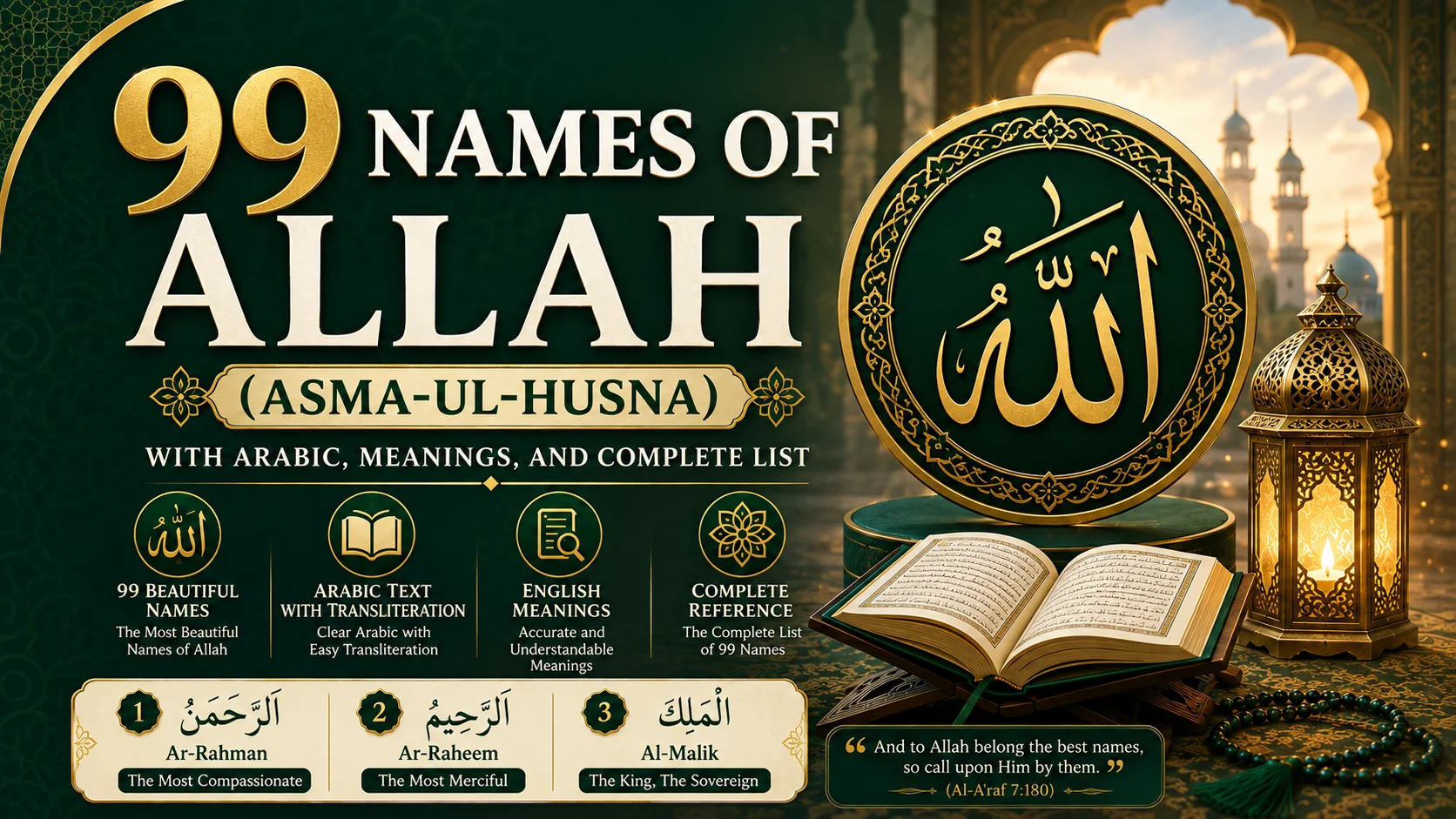
99 Names of Allah (Asma-ul-Husna) Meanings, Benefits & Complete List
Table of contents
99 Names of Allah (Asma-ul-Husna) Meanings, Benefits & Complete List
Quick Answer (Featured Snippet)
The 99 Names of Allah (Asma-ul-Husna) are the Beautiful Names and perfect Attributes of Allah mentioned throughout the Qur’an and authentic Sunnah. Each Name reflects one of Allah’s unique qualities, such as His mercy, wisdom, power, justice, forgiveness, and generosity. Learning these Names helps Muslims know their Creator better, strengthens faith, improves worship, and teaches believers how to call upon Allah in their daily supplications.
Introduction
The 99 Names of Allah, also known as Asma-ul-Husna (الأسماء الحسنى), hold a special place in Islam. Every Name reveals a perfect Attribute of Allah, helping believers understand His greatness, mercy, wisdom, justice, and countless other qualities. By learning these Names, Muslims develop a stronger connection with their Creator and gain a deeper appreciation of His perfection.
Throughout the Qur’an, Allah encourages believers to remember Him by His Beautiful Names and to call upon Him through them. Whether a person seeks forgiveness, guidance, protection, patience, or blessings, understanding Allah’s Names makes every act of worship more meaningful. Instead of simply knowing the Names by heart, Muslims are encouraged to reflect upon their meanings and apply their lessons in everyday life.
This comprehensive guide introduces the 99 Names of Allah, explains their importance in Islam, highlights authentic Qur’anic verses and Hadith, and provides a complete list of the Beautiful Names with their meanings. You will also discover the benefits of learning Asma-ul-Husna, practical ways to remember them, and links to detailed explanations of each Name so that you can continue your journey of learning one Name at a time.
What Are Asma-ul-Husna?
Asma-ul-Husna is an Arabic phrase that means “The Most Beautiful Names.” These are the Names by which Allah has described Himself in the Qur’an and through the authentic teachings of Prophet Muhammad ﷺ. Every Name represents a perfect Attribute of Allah, and together they help believers understand His majesty, mercy, knowledge, power, and wisdom. Since Allah is perfect, all of His Names are also perfect and free from any deficiency.
It is important to remember that the 99 Names are not simply titles. Each Name teaches a lesson about Allah and strengthens a believer’s relationship with Him. For example, when a Muslim learns that Allah is Ar-Rahman (The Entirely Merciful), it increases hope in His mercy. Learning that Allah is Al-Hakeem (The All-Wise) reminds believers to trust His decisions, even when they do not understand every situation in life.
Islamic scholars explain that Allah has many Names, but the Prophet ﷺ specifically mentioned ninety-nine Names whose knowledge and understanding carry great virtue. Muslims should therefore strive not only to memorize these Names but also to understand their meanings, reflect upon them, and live according to the guidance they provide.
Quick Facts About the 99 Names of Allah
The table below provides a quick overview of the 99 Names of Allah and their significance in Islam.
| Property | Details |
|---|---|
| Arabic Name | الأسماء الحسنى (Asma-ul-Husna) |
| English Meaning | The Most Beautiful Names of Allah |
| Total Famous Names | 99 Names (mentioned in authentic Hadith) |
| Source | The Noble Qur’an and Authentic Sunnah |
| Main Purpose | To know Allah better through His perfect Names and Attributes. |
| Importance | Strengthens faith, improves worship, and increases love and fear of Allah. |
| Used In | Du’a, Dhikr, reflection, and daily worship. |
| Examples | Ar-Rahman, Ar-Raheem, Al-Malik, Al-Quddus, As-Salam, Al-Aziz. |
| Reward | The Prophet ﷺ informed us of the great virtue of preserving, understanding, and living by these Names. |
Complete List of the 99 Names of Allah
The table below contains the 99 Names of Allah (Asma-ul-Husna). Each Name represents one of Allah’s perfect Attributes. Click the “Read More” link to explore the detailed meaning, Qur’anic references, authentic Hadith, benefits, and practical lessons for each Name.
| No. | Arabic | Transliteration | Meaning | Read More |
|---|---|---|---|---|
| 1 | ٱلرَّحْمَٰنُ | Ar-Rahman | The Entirely Merciful | Read More |
| 2 | ٱلرَّحِيمُ | Ar-Raheem | The Especially Merciful | Read More |
| 3 | ٱلْمَلِكُ | Al-Malik | The King | Read More |
| 4 | ٱلْقُدُّوسُ | Al-Quddus | The Most Holy | Read More |
| 5 | ٱلسَّلَامُ | As-Salam | The Source of Peace | Read More |
| 6 | ٱلْمُؤْمِنُ | Al-Mu’min | The Granter of Security | Read More |
| 7 | ٱلْمُهَيْمِنُ | Al-Muhaymin | The Guardian | Read More |
| 8 | ٱلْعَزِيزُ | Al-Aziz | The Almighty | Read More |
| 9 | ٱلْجَبَّارُ | Al-Jabbar | The Compeller | Read More |
| 10 | ٱلْمُتَكَبِّرُ | Al-Mutakabbir | The Supreme | Read More |
| 11 | ٱلْخَالِقُ | Al-Khaliq | The Creator | Read More |
| 12 | ٱلْبَارِئُ | Al-Bari’ | The Originator | Read More |
| 13 | ٱلْمُصَوِّرُ | Al-Musawwir | The Fashioner | Read More |
| 14 | ٱلْغَفَّارُ | Al-Ghaffar | The Constant Forgiver | Read More |
| 15 | ٱلْقَهَّارُ | Al-Qahhar | The All-Prevailing | Read More |
| 16 | ٱلْوَهَّابُ | Al-Wahhab | The Supreme Bestower | Read More |
| 17 | ٱلرَّزَّاقُ | Ar-Razzaq | The All-Provider | Read More |
| 18 | ٱلْفَتَّاحُ | Al-Fattah | The Opener | Read More |
| 19 | ٱلْعَلِيمُ | Al-‘Aleem | The All-Knowing | Read More |
| 20 | ٱلْقَابِضُ | Al-Qabid | The Withholder | Read More |
| 21 | ٱلْبَاسِطُ | Al-Basit | The Extender | Read More |
| 22 | ٱلْخَافِضُ | Al-Khafid | The Reducer | Read More |
| 23 | ٱلرَّافِعُ | Ar-Rafi’ | The Exalter | Read More |
| 24 | ٱلْمُعِزُّ | Al-Mu’izz | The Honourer | Read More |
| 25 | ٱلْمُذِلُّ | Al-Mudhill | The Humiliator | Read More |
| 26 | ٱلسَّمِيعُ | As-Samee’ | The All-Hearing | Read More |
| 27 | ٱلْبَصِيرُ | Al-Baseer | The All-Seeing | Read More |
| 28 | ٱلْحَكَمُ | Al-Hakam | The Judge | Read More |
| 29 | ٱلْعَدْلُ | Al-‘Adl | The Utterly Just | Read More |
| 30 | ٱللَّطِيفُ | Al-Lateef | The Most Subtle | Read More |
| 31 | ٱلْخَبِيرُ | Al-Khabeer | The All-Aware | Read More |
| 32 | ٱلْحَلِيمُ | Al-Haleem | The Most Forbearing | Read More |
| 33 | ٱلْعَظِيمُ | Al-‘Azeem | The Magnificent | Read More |
| 34 | ٱلْغَفُورُ | Al-Ghafoor | The All-Forgiving | Read More |
| 35 | ٱلشَّكُورُ | Ash-Shakoor | The Most Appreciative | Read More |
| 36 | ٱلْعَلِيُّ | Al-‘Aliyy | The Most High | Read More |
| 37 | ٱلْكَبِيرُ | Al-Kabeer | The Most Great | Read More |
| 38 | ٱلْحَفِيظُ | Al-Hafeez | The Preserver | Read More |
| 39 | ٱلْمُقِيتُ | Al-Muqeet | The Sustainer | Read More |
| 40 | ٱلْحَسِيبُ | Al-Haseeb | The Reckoner | Read More |
| 41 | ٱلْجَلِيلُ | Al-Jaleel | The Majestic | Read More |
| 42 | ٱلْكَرِيمُ | Al-Kareem | The Most Generous | Read More |
| 43 | ٱلرَّقِيبُ | Ar-Raqeeb | The Watchful | Read More |
| 44 | ٱلْمُجِيبُ | Al-Mujeeb | The Responsive One | Read More |
| 45 | ٱلْوَاسِعُ | Al-Wasi’ | The All-Encompassing | Read More |
| 46 | ٱلْحَكِيمُ | Al-Hakeem | The All-Wise | Read More |
| 47 | ٱلْوَدُودُ | Al-Wadud | The Most Loving | Read More |
| 48 | ٱلْمَجِيدُ | Al-Majeed | The Most Glorious | Read More |
| 49 | ٱلْبَاعِثُ | Al-Ba’ith | The Resurrector | Read More |
| 50 | ٱلشَّهِيدُ | Ash-Shaheed | The All-Witnessing | Read More |
| 51 | ٱلْحَقُّ | Al-Haqq | The Absolute Truth | Read More |
| 52 | ٱلْوَكِيلُ | Al-Wakeel | The Trustee | Read More |
| 53 | ٱلْقَوِيُّ | Al-Qawiyy | The All-Strong | Read More |
| 54 | ٱلْمَتِينُ | Al-Mateen | The Firm One | Read More |
| 55 | ٱلْوَلِيُّ | Al-Waliyy | The Protecting Friend | Read More |
| 56 | ٱلْحَمِيدُ | Al-Hameed | The Praiseworthy | Read More |
| 57 | ٱلْمُحْصِي | Al-Muhsi | The Reckoner | Read More |
| 58 | ٱلْمُبْدِئُ | Al-Mubdi’ | The Originator | Read More |
| 59 | ٱلْمُعِيدُ | Al-Mu’eed | The Restorer | Read More |
| 60 | ٱلْمُحْيِي | Al-Muhyi | The Giver of Life | Read More |
| 61 | ٱلْمُمِيتُ | Al-Mumeet | The Creator of Death | Read More |
| 62 | ٱلْحَيُّ | Al-Hayy | The Ever-Living | Read More |
| 63 | ٱلْقَيُّومُ | Al-Qayyum | The Self-Subsisting | Read More |
| 64 | ٱلْوَاجِدُ | Al-Wajid | The Finder | Read More |
| 65 | ٱلْمَاجِدُ | Al-Majid | The Most Glorious | Read More |
| 66 | ٱلْوَاحِدُ | Al-Wahid | The One | Read More |
| 67 | ٱلْأَحَدُ | Al-Ahad | The Unique One | Read More |
| 68 | ٱلصَّمَدُ | As-Samad | The Eternal Refuge | Read More |
| 69 | ٱلْقَادِرُ | Al-Qadir | The All-Powerful | Read More |
| 70 | ٱلْمُقْتَدِرُ | Al-Muqtadir | The Creator of All Power | Read More |
| 71 | ٱلْمُقَدِّمُ | Al-Muqaddim | The Expediter | Read More |
| 72 | ٱلْمُؤَخِّرُ | Al-Mu’akhkhir | The Delayer | Read More |
| 73 | ٱلْأَوَّلُ | Al-Awwal | The First | Read More |
| 74 | ٱلْآخِرُ | Al-Akhir | The Last | Read More |
| 75 | ٱلظَّاهِرُ | Az-Zahir | The Manifest | Read More |
| 76 | ٱلْبَاطِنُ | Al-Batin | The Hidden | Read More |
| 77 | ٱلْوَالِي | Al-Wali | The Sole Governor | Read More |
| 78 | ٱلْمُتَعَالِي | Al-Muta’ali | The Most Exalted | Read More |
| 79 | ٱلْبَرُّ | Al-Barr | The Source of All Goodness | Read More |
| 80 | ٱلتَّوَّابُ | At-Tawwab | The Acceptor of Repentance | Read More |
| 81 | ٱلْمُنْتَقِمُ | Al-Muntaqim | The Avenger | Read More |
| 82 | ٱلْعَفُوُّ | Al-‘Afuww | The Pardoner | Read More |
| 83 | ٱلرَّءُوفُ | Ar-Ra’uf | The Most Kind | Read More |
| 84 | مَالِكُ الْمُلْكِ | Malik-ul-Mulk | Master of the Kingdom | Read More |
| 85 | ذُو الْجَلَالِ وَالْإِكْرَامِ | Dhul-Jalali wal-Ikram | Lord of Majesty and Honour | Read More |
| 86 | ٱلْمُقْسِطُ | Al-Muqsit | The Equitable | Read More |
| 87 | ٱلْجَامِعُ | Al-Jami’ | The Gatherer | Read More |
| 88 | ٱلْغَنِيُّ | Al-Ghaniyy | The Self-Sufficient | Read More |
| 89 | ٱلْمُغْنِي | Al-Mughni | The Enricher | Read More |
| 90 | ٱلْمَانِعُ | Al-Mani’ | The Withholder | Read More |
| 91 | ٱلضَّارُّ | Ad-Darr | The Creator of Harm | Read More |
| 92 | ٱلنَّافِعُ | An-Nafi’ | The Bestower of Benefit | Read More |
| 93 | ٱلنُّورُ | An-Nur | The Light | Read More |
| 94 | ٱلْهَادِي | Al-Hadi | The Guide | Read More |
| 95 | ٱلْبَدِيعُ | Al-Badi’ | The Incomparable Originator | Read More |
| 96 | ٱلْبَاقِي | Al-Baqi | The Everlasting | Read More |
| 97 | ٱلْوَارِثُ | Al-Warith | The Inheritor | Read More |
| 98 | ٱلرَّشِيدُ | Ar-Rasheed | The Guide to the Right Path | Read More |
| 99 | ٱلصَّبُورُ | As-Sabur | The Most Patient | Read More |
By studying each of the 99 Names of Allah, believers gain a deeper understanding of Allah’s perfect Attributes and strengthen their relationship with Him. We recommend reading the dedicated article for each Name to explore its meaning, Qur’anic references, authentic Hadith, practical lessons, and reflections for daily life.
What Does the Qur’an Say About the 99 Names of Allah?
The Qur’an repeatedly reminds believers that Allah possesses the Most Beautiful Names (Asma-ul-Husna). These Names are not merely titles—they describe Allah’s perfect Attributes and help believers know their Creator. Through these verses, Allah encourages Muslims to remember Him, worship Him sincerely, and call upon Him using His Beautiful Names. Reflecting on these verses increases faith, strengthens trust in Allah, and makes our du’as more meaningful.
Although the Qur’an does not present all 99 Names in a single chapter or verse, Allah’s Beautiful Names appear throughout the Qur’an. Each Name highlights one or more of His perfect qualities, such as mercy, wisdom, forgiveness, knowledge, justice, power, and majesty.
1. Call Upon Allah by His Beautiful Names
| Arabic | وَلِلَّهِ الْأَسْمَاءُ الْحُسْنَىٰ فَادْعُوهُ بِهَا |
|---|---|
| English Translation | “And to Allah belong the Best Names, so invoke Him by them.” |
| Reference | Surah Al-A’raf (7:180) |
| Key Lesson | Allah commands believers to call upon Him through His Beautiful Names. When asking for forgiveness, mercy, guidance, protection, or provision, choosing the appropriate Name of Allah makes our supplication more meaningful and reminds us of His perfect Attributes. |
2. All Beautiful Names Belong to Allah
| Arabic | قُلِ ادْعُوا اللَّهَ أَوِ ادْعُوا الرَّحْمَٰنَ ۖ أَيًّا مَّا تَدْعُوا فَلَهُ الْأَسْمَاءُ الْحُسْنَىٰ |
|---|---|
| English Translation | “Say, ‘Call upon Allah or call upon Ar-Rahman. Whichever Name you call—to Him belong the Most Beautiful Names.'” |
| Reference | Surah Al-Isra (17:110) |
| Key Lesson | Whether we call upon Allah using the Name “Allah” or any of His Beautiful Names, we are worshipping the same Lord. Every Name reflects His perfection and deserves our respect and reflection. |
3. Allah’s Beautiful Names Reflect His Perfection
| English Translation | “He is Allah—there is no deity except Him, Knower of the unseen and the witnessed. He is the Entirely Merciful, the Especially Merciful…” |
|---|---|
| Reference | Surah Al-Hashr (59:22–24) |
| Key Lesson | These verses mention several of Allah’s Beautiful Names together, teaching believers about His mercy, knowledge, power, majesty, and holiness. They encourage us to know Allah through His perfect Attributes and increase our love, hope, and trust in Him. |
Authentic Hadith About the 99 Names of Allah
The Prophet Muhammad ﷺ emphasized the great virtue of learning and understanding Allah’s Beautiful Names. The following authentic Hadith is the foundation for studying the 99 Names of Allah and highlights the reward for those who preserve, understand, and live by them.
Hadith of the 99 Names
| Hadith | “Indeed, Allah has ninety-nine Names, one hundred minus one. Whoever preserves (understands, memorizes, and lives by) them will enter Paradise.” |
|---|---|
| Reference | Sahih al-Bukhari (2736, 7392) and Sahih Muslim (2677) |
| Meaning | This Hadith encourages Muslims not only to memorize Allah’s Beautiful Names but also to understand their meanings, reflect upon them, and implement their lessons in everyday life. |
Islamic scholars explain that the phrase “preserves them” includes memorizing the Names, learning their meanings from authentic sources, believing in Allah’s perfect Attributes without distortion, calling upon Allah using these Names, and allowing their lessons to shape one’s character and worship.
Why Learning the 99 Names of Allah Is Important
Learning the 99 Names of Allah is one of the best ways to strengthen your relationship with your Creator. Every Name reveals a unique aspect of Allah’s perfection, helping believers understand His mercy, wisdom, justice, forgiveness, and power. As your knowledge of these Names grows, your worship becomes more sincere, your du’as become more meaningful, and your trust in Allah becomes stronger.
| Benefit | How It Helps |
|---|---|
| Strengthens Faith (Iman) | Knowing Allah through His Beautiful Names increases love, hope, and reliance upon Him. |
| Improves Worship | Prayer, dhikr, and du’a become more meaningful when you understand who Allah is. |
| Builds Good Character | Reflecting on Allah’s mercy, justice, and generosity inspires believers to practice these qualities in their own lives. |
| Increases Trust in Allah | Remembering Allah’s wisdom and knowledge helps believers remain patient during life’s challenges. |
| Makes Du’a More Effective | Calling upon Allah with the appropriate Beautiful Name follows the guidance of the Qur’an. |
Benefits of Learning the 99 Names of Allah
Learning the 99 Names of Allah (Asma-ul-Husna) is more than memorizing a list of names. Each Name reveals one of Allah’s perfect Attributes, helping believers develop a deeper understanding of their Creator. As Muslims learn these Beautiful Names, their faith grows stronger, their worship becomes more meaningful, and they begin to rely upon Allah with greater confidence. Reflecting on Allah’s Names also encourages believers to improve their character and live according to Islamic teachings.
| Benefit | Explanation |
|---|---|
| Strengthens Faith (Iman) | Understanding Allah’s Beautiful Names increases love, trust, and certainty in Him. |
| Improves Worship | Prayer, dhikr, and du’a become more sincere when we understand Allah’s perfect Attributes. |
| Brings Inner Peace | Knowing that Allah is the Most Merciful, All-Wise, and All-Powerful gives comfort during difficult times. |
| Builds Good Character | Reflecting upon Allah’s mercy, justice, patience, and generosity inspires Muslims to practice these qualities in daily life. |
| Encourages Hope | Allah’s Beautiful Names remind believers that His mercy and forgiveness are always greater than their sins. |
| Makes Du’a More Meaningful | Calling upon Allah by the appropriate Name follows the guidance of the Qur’an and strengthens one’s connection with Him. |
How to Learn the 99 Names of Allah
Learning Asma-ul-Husna does not have to be overwhelming. Rather than trying to memorize all 99 Names at once, it is better to study them gradually. By learning one Name at a time, reflecting on its meaning, and applying its lessons in everyday life, you can develop a lasting understanding of Allah’s perfect Attributes.
| Step | What to Do |
|---|---|
| 1 | Learn one Beautiful Name each week instead of trying to memorize all 99 at once. |
| 2 | Read the Name in Arabic and learn its correct pronunciation. |
| 3 | Understand its meaning using authentic Qur’anic verses and Hadith. |
| 4 | Reflect on how the Name appears in your daily life and worship. |
| 5 | Use the Name in your personal du’as whenever it is relevant. |
| 6 | Review previously learned Names regularly so they remain fresh in your memory. |
How to Call Upon Allah Using His Beautiful Names
Allah has instructed believers to call upon Him using His Beautiful Names. Each Name reflects one of His perfect Attributes, making our supplications more meaningful and sincere. For example, when seeking mercy, we may call upon Allah as Ar-Rahman or Ar-Raheem. When asking for forgiveness, we may call upon Him as Al-Ghafur or At-Tawwab. This practice follows the guidance of the Qur’an and strengthens our awareness of Allah’s greatness.
“And to Allah belong the Most Beautiful Names, so invoke Him by them.”
Surah Al-A’raf (7:180)
| If You Are Asking For… | Call Upon Allah As… |
|---|---|
| Mercy | Ar-Rahman, Ar-Raheem |
| Forgiveness | Al-Ghafur, At-Tawwab |
| Provision | Ar-Razzaq |
| Guidance | Al-Hadi |
| Protection | Al-Hafeez |
| Wisdom | Al-Hakeem |
Important Note: There is no authentic evidence that reciting a particular Name of Allah a fixed number of times guarantees specific worldly outcomes. Muslims should rely on authentic Qur’anic teachings and the Sunnah, make sincere du’a, and place their trust in Allah’s wisdom and mercy.
Featured Names of Allah
Each of the 99 Beautiful Names deserves careful study. Below are some of the most well-known Names of Allah. Click on each Name to explore its detailed meaning, Qur’anic references, authentic Hadith, practical lessons, and more.
| Name | Meaning | Read More |
|---|---|---|
| Ar-Rahman (ٱلرَّحْمَٰنُ) | The Entirely Merciful | Add your article link here |
| Ar-Raheem (ٱلرَّحِيمُ) | The Especially Merciful | Add your article link here |
| Al-Malik (ٱلْمَلِكُ) | The King | Add your article link here |
| Al-Quddus (ٱلْقُدُّوسُ) | The Most Holy | Add your article link here |
| As-Salam (ٱلسَّلَامُ) | The Source of Peace | Add your article link here |
| Al-Aziz (ٱلْعَزِيزُ) | The Almighty | Add your article link here |
How to Memorize the 99 Names of Allah
Memorizing the 99 Names of Allah (Asma-ul-Husna) is a rewarding act of worship that helps Muslims strengthen their relationship with Allah. However, true success is not achieved by memorization alone. The greatest benefit comes from learning the correct pronunciation, understanding the meanings, reflecting upon Allah’s perfect Attributes, and applying these lessons in everyday life. By studying one Name at a time with sincerity and consistency, every Muslim can gradually build a lifelong connection with the Beautiful Names of Allah.
Simple Weekly Memorization Plan
| Week | Goal |
|---|---|
| Week 1 | Memorize the first 5 Names with their meanings and pronunciation. |
| Week 2 | Learn the next 5 Names and revise the previous week’s Names. |
| Week 3 | Study Qur’anic verses where these Names appear. |
| Week 4 | Begin using the learned Names in your daily du’as. |
| Following Weeks | Continue learning 3–5 new Names each week while reviewing earlier ones. |
Daily Study Routine
| Time | Activity |
|---|---|
| 5 Minutes | Read the Arabic Name aloud and practice the pronunciation. |
| 5 Minutes | Read the English meaning and understand the Attribute. |
| 5 Minutes | Read a Qur’anic verse or authentic Hadith mentioning the Name. |
| 5 Minutes | Reflect on how this Name applies to your daily life and include it in your du’a. |
Tips for Children
- Teach one Name at a time instead of many together.
- Use flashcards with Arabic, transliteration, and meaning.
- Repeat the Names after Salah or before bedtime.
- Explain each Name using simple, age-appropriate examples.
- Encourage regular revision instead of rushing to finish all 99 Names.
Tips for Adults
- Set a realistic weekly memorization goal.
- Read authentic explanations from reliable scholars.
- Connect each Name to its Qur’anic context.
- Use the Beautiful Names regularly in personal du’as.
- Review previously learned Names every week to strengthen long-term memory.
Common Mistakes While Learning Asma-ul-Husna
Many Muslims sincerely wish to learn the 99 Names of Allah, but certain mistakes can reduce the benefit of this beautiful journey. Avoiding these common errors will help you learn the Names correctly and according to authentic Islamic teachings.
| Common Mistake | Correct Approach |
|---|---|
| Memorizing without understanding the meanings. | Learn the meaning and reflect on every Name. |
| Using unauthentic lists or fabricated virtues. | Study from the Qur’an, authentic Hadith, and reliable scholars. |
| Ignoring the correct Arabic pronunciation. | Listen to qualified reciters and practice regularly. |
| Learning the Names but never using them in du’a. | Call upon Allah using the appropriate Beautiful Name. |
| Trying to memorize all 99 Names too quickly. | Learn gradually and revise consistently. |
| Thinking memorization alone is sufficient. | Combine memorization with understanding, reflection, and practice. |
Download & Learning Resources
To make your learning journey easier, consider keeping a printable copy of the 99 Names of Allah. A downloadable reference allows you to revise the Names regularly, practice pronunciation, and review the meanings whenever you have free time.
- Printable PDF of the 99 Names of Allah.
- Arabic with English transliteration.
- English meanings for every Name.
- Quick reference chart for daily revision.
- Family-friendly learning sheet for children and adults.
Listen to the 99 Names of Allah
Listening to the Beautiful Names of Allah is an excellent way to improve pronunciation and reinforce memorization. Choose authentic recitations from reliable Islamic sources and listen regularly during your daily routine.
Share This Guide
If you found this guide on the 99 Names of Allah (Asma-ul-Husna) helpful, consider sharing it with your family, friends, students, and community members. Spreading authentic Islamic knowledge is a rewarding act that can benefit others long after you share it. By helping someone learn even one of Allah’s Beautiful Names, you may inspire them to strengthen their faith, improve their worship, and develop a deeper relationship with their Creator.
May Allah make this guide beneficial, increase us in beneficial knowledge, and allow us to know Him through His Beautiful Names. Ameen.
Frequently Asked Questions (FAQs)
Below are answers to some of the most frequently asked questions about the 99 Names of Allah (Asma-ul-Husna). These answers are based on authentic Islamic teachings and help clarify common questions that many Muslims have.
The 99 Names of Allah, known as Asma-ul-Husna, are the Beautiful Names and perfect Attributes of Allah mentioned throughout the Qur’an and authentic Sunnah. Every Name reflects Allah’s perfection, such as His mercy, wisdom, justice, knowledge, power, and forgiveness.
No. The Qur’an mentions many of Allah’s Beautiful Names across different chapters and verses. The well-known collection of 99 Names comes from authentic Hadith, while the Names themselves appear throughout the Qur’an.
The Prophet Muhammad ﷺ said that Allah has ninety-nine Names and that whoever preserves, understands, and lives according to them will enter Paradise. Scholars explain that this includes memorizing the Names, learning their meanings, believing in them correctly, and applying their lessons in daily life.
Yes. Allah commands believers in the Qur’an to call upon Him by His Beautiful Names. For example, when asking for mercy, you may call upon Allah as Ar-Rahman or Ar-Raheem, and when seeking forgiveness, you may call upon Him as Al-Ghafur.
Many scholars encourage beginning with commonly mentioned Names such as Ar-Rahman, Ar-Raheem, Al-Malik, Al-Ghafur, and Al-Hakeem. However, every Beautiful Name of Allah is important and worthy of study.
Key Takeaways
Understanding the 99 Names of Allah is one of the most rewarding journeys a Muslim can undertake. Every Name teaches us something unique about Allah and helps us strengthen our faith, improve our worship, and build a closer relationship with our Creator.
| Topic | Summary |
|---|---|
| Meaning | The 99 Names describe Allah’s perfect Attributes and absolute perfection. |
| Main Source | The Noble Qur’an and authentic Sunnah. |
| Purpose | To know Allah better, strengthen faith, and improve worship. |
| Greatest Benefit | Learning, understanding, and living according to these Names brings a believer closer to Allah. |
| Daily Practice | Use Allah’s Beautiful Names in du’a, remember them in dhikr, and reflect upon their meanings every day. |
| Long-Term Goal | Study every Name individually and apply its lessons in your daily life. |
Related Articles
If you would like to study Allah’s Beautiful Names in greater detail, explore the following articles. Each guide explains the Arabic meaning, pronunciation, Qur’anic references, authentic Hadith, practical lessons, and benefits of the individual Name.
| Article | Description |
|---|---|
| Ar-Rahman – The Entirely Merciful | Learn the meaning, Qur’anic references, Hadith, and lessons from Allah’s Name Ar-Rahman. |
| Ar-Raheem – The Especially Merciful | Understand how Ar-Raheem differs from Ar-Rahman and how to call upon Allah using this Name. |
| Al-Malik – The King | Discover the meaning of Allah’s absolute sovereignty and kingship. |
| Al-Quddus – The Most Holy | Explore Allah’s perfect purity and holiness. |
| As-Salam – The Source of Peace | Learn why Allah is the source of true peace and security. |
| Complete Guide to Islamic Du’as | Authentic daily supplications from the Qur’an and Sunnah. |
References & Sources
- The Noble Qur’an (Surah Al-A’raf 7:180, Surah Al-Isra 17:110, Surah Taha 20:8, Surah Al-Hashr 59:22–24).
- Sahih al-Bukhari.
- Sahih Muslim.
- Tafsir Ibn Kathir.
- Tafsir Al-Qurtubi.
- Classical Sunni scholarly works on Asma-ul-Husna.
Conclusion
The 99 Names of Allah (Asma-ul-Husna) are among the greatest treasures a Muslim can study. Every Beautiful Name reveals another aspect of Allah’s perfect mercy, wisdom, knowledge, justice, power, generosity, and majesty. The more we learn these Names, the better we understand our Creator, and the stronger our faith and worship become.
Rather than simply memorizing the Names, strive to understand their meanings, reflect on them regularly, and apply their lessons in your daily life. Call upon Allah using His Beautiful Names, place your trust in Him during times of ease and hardship, and allow His perfect Attributes to inspire patience, gratitude, compassion, and sincerity.
We also encourage you to explore each of the individual articles linked throughout this guide. Studying every Name in detail including its Arabic meaning, Qur’anic references, authentic Hadith, practical lessons, and reflections will help you build a deeper and more meaningful relationship with Allah. May Allah enable us to know Him through His Beautiful Names, increase us in beneficial knowledge, accept our worship, and grant us His mercy in this life and the Hereafter. Ameen.
- Quran — Complete Guide to the Holy Book of Islam
- Surah Al Alaq to Read in Arabic, English Translation, Transliteration, Tafseer, Benefits & Lessons
- Dua for Entering Home in Arabic with English Transliteration, Translation & Benefits
- Dua for Sea Travel in Arabic with English Transliteration, Translation & Benefits